Air Force planners are beginning to weigh whether the service’s next generation of aerial refueling aircraft must carry crews at all, even as they acknowledge that autonomy for aircraft of the size and range required remains out of reach today.
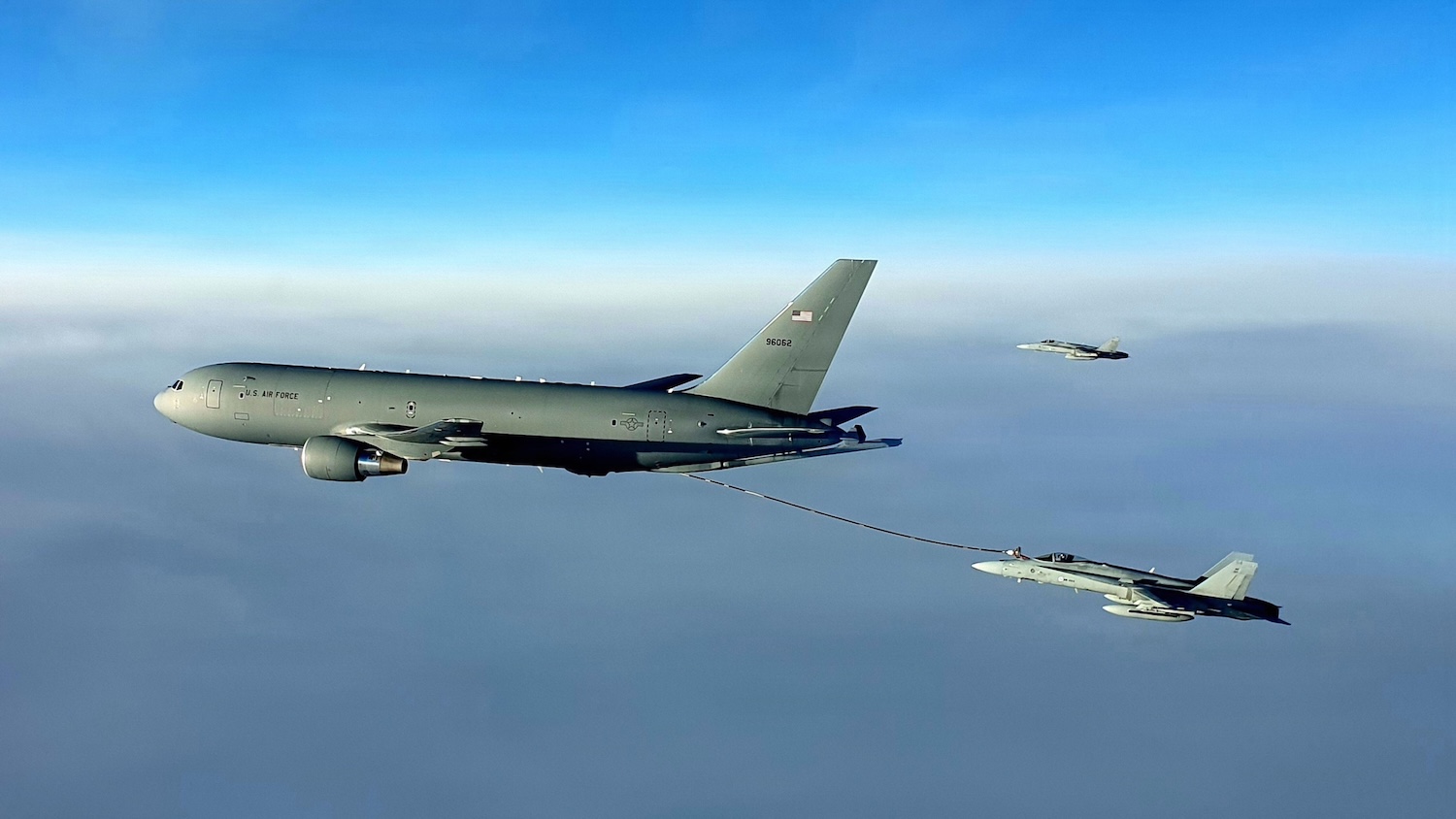
Lt. Gen. Daniel Tulley, who leads Air Mobility Command, said the service is considering manned, optionally manned and autonomous concepts as it looks beyond its current Boeing KC-46 Pegasus procurement and a possible extension of that program. The question is part of a broader effort to define an “advanced tanker system” that would be connected and able to defend itself.
“Thinking beyond the current KC-46 buy and the program extension. Whatever that next tanker looks like—our advanced tanker system—it's got to be connected. It's got to be able to defend itself. But it begs the question: Does it need to be manned? Could it be optionally manned, or could it be autonomous, or is there a family of solutions maybe that would answer that question?”
Lt. Gen. Daniel Tulley, Air Mobility Command commander
The budget shift reflects that early-stage focus. The Air Force is continuing to buy KC-46s and spent $12 million this year to explore a new tanker purchase. Its 2027 budget request, however, eliminated funding to continue those explorations and instead sought $13 million for advanced tanker systems.
Navy tanker program offers a reference point
Tulley pointed to the Navy’s Boeing MQ-25 Stingray program as evidence that uncrewed aerial refueling could eventually become relevant to the Air Force. The Navy announced that the MQ-25, which first flew earlier this year, had been approved to enter low-rate production and ordered three additional aircraft, bringing its planned total to 14.
“I do not believe that it has to be manned, a future air-refueling solution. But then, how do we, the U.S. Air Force, bring that to bear in scope, scale, and range?”
Lt. Gen. Daniel Tulley, Air Mobility Command commander
That issue of scale is central to the Air Force’s deliberations. A tanker drone for the service would need substantial fuel capacity and endurance, making it far larger than the Navy aircraft now moving toward production. The KC-46 can fly nearly 7,400 miles and carry more than a thousand tons of fuel, according to the source material, while the MQ-25 can fly about 500 miles and carry up to 7.5 tons of fuel.
“An optionally manned or an unmanned tanker at the ranges we need it to operate at is a very large aircraft. And we're not yet to where we're employing fully autonomous large aircraft,”
Lt. Gen. Daniel Tulley, Air Mobility Command commander
Autonomy development faces operational and certification hurdles
Tulley said modern large aircraft already possess significant automated flight capability: they can take off with little help, follow programmed routes, land on autopilot and stop on the runway. But the Air Force does not operate them under a system that controls the aircraft through those steps, taxis them and integrates them into a broader operational system.
Matthew George, chief executive of autonomous-aircraft control systems maker Merlin Labs, said autonomy can be introduced incrementally rather than waiting for a fully unmanned tanker. Merlin plans to implement autonomy on the C-130J, an aircraft he described as being in the same general size class as the KC-135 Stratotanker. Human crews could remain aboard while autonomous functions supplement them, he said, allowing operators to build experience before attempting a fully uncrewed tanker.
“The goal is that the unmanned tanker is ready, and the autonomy ends up being ready at the same time.”
Matthew George, CEO of Merlin Labs
George said the difficult problems are the edge cases that require decisions, such as rerouting around weather while en route to a destination. Certification and safety are also prerequisites, he said. Merlin is working with the Air Force on certification this year and says its autonomous-pilot system is intended to take full control of an operational Air Force C-130J. George said the technology had completed a critical design review, though no date was provided for that flight.