General Atomics has released the first imagery of its FQ-42 Vengeance Collaborative Combat Aircraft flying alongside crewed U.S. Air Force fighters, offering a visible example of the service’s ongoing effort to integrate autonomous aircraft with existing combat jets. The image shows an FQ-42 in formation with an F-35A Joint Strike Fighter and an F-15E Strike Eagle.
The disclosure came as General Atomics Aeronautical Systems, Inc. (GA-ASI) announced that another Vengeance aircraft had been delivered to Creech Air Force Base in Nevada. Creech is the Air Force’s main hub for drone operations, and the company said the newly arrived aircraft would support continuing test and evaluation activities with the service.
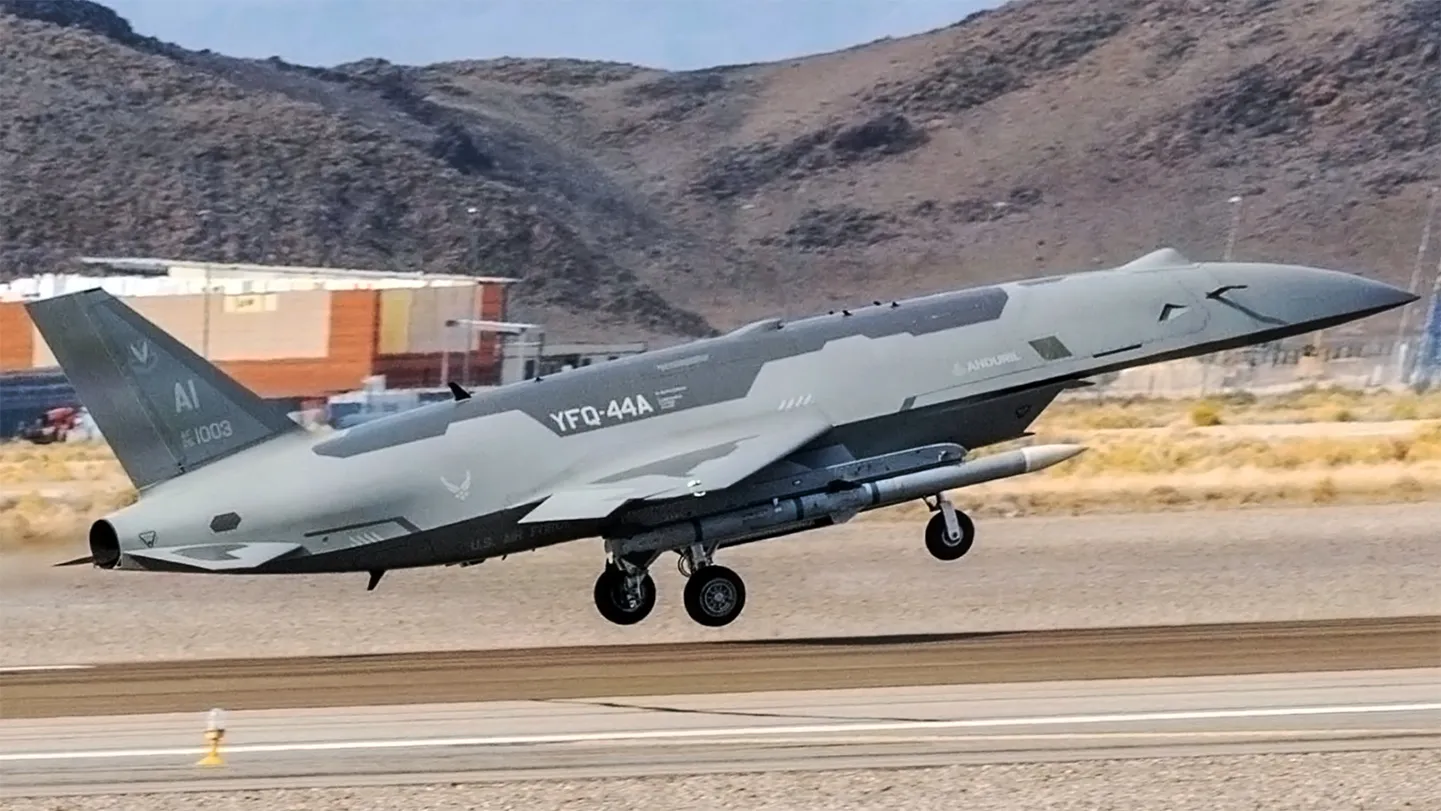
The Air Force is testing both the FQ-42 and Anduril’s FQ-44 Fury as it develops the operating concepts, control arrangements and support processes required for Collaborative Combat Aircraft. The service is seeking to begin fielding its first operational CCAs toward the end of the decade and is currently aiming for a fleet of at least 500 aircraft of all types by 2032.
Creech testing and larger force integration
In a company statement, GA-ASI said the FQ-42 delivered to Creech would continue regular Air Force experimentation with the new aircraft. The work follows earlier testing involving the Vengeance and other GA-ASI aircraft, including the XQ-67A Off-Board Sensing Station and MQ-20 Avenger.
According to GA-ASI, those aircraft have flown in different scenarios involving semi-autonomous and autonomous operations. The company also said its aircraft have operated under collaborative control from pilots flying F-22 Raptor and F-35 Lightning II fighters, although the released formation image by itself does not establish a specific level of autonomous cooperation during that flight.
GA-ASI has previously identified the XQ-67A as an earlier experimental aircraft that served as a prototype for FQ-42 development. The Air Force’s F-22 fleet is also expected to provide the first operational airborne controllers for U.S. Air Force CCAs, according to the reported program direction.
Testing is scheduled to move into a larger-force setting in December, when the FQ-42 and FQ-44 are expected to participate in a large-force employment exercise. The event is intended to provide an opportunity for more extensive and operationally relevant integration with crewed fighters than smaller-scale developmental activities.
The Air Force is also working through the practical requirements of operating CCAs on a routine basis. A major test effort at Creech in July examined issues related to how the aircraft could be deployed, launched, recovered, supported and managed day to day. Those activities are being led by the Experimental Operations Unit, a dedicated test squadron established at Nellis Air Force Base in Nevada.
Semi-autonomous air-to-air demonstrations
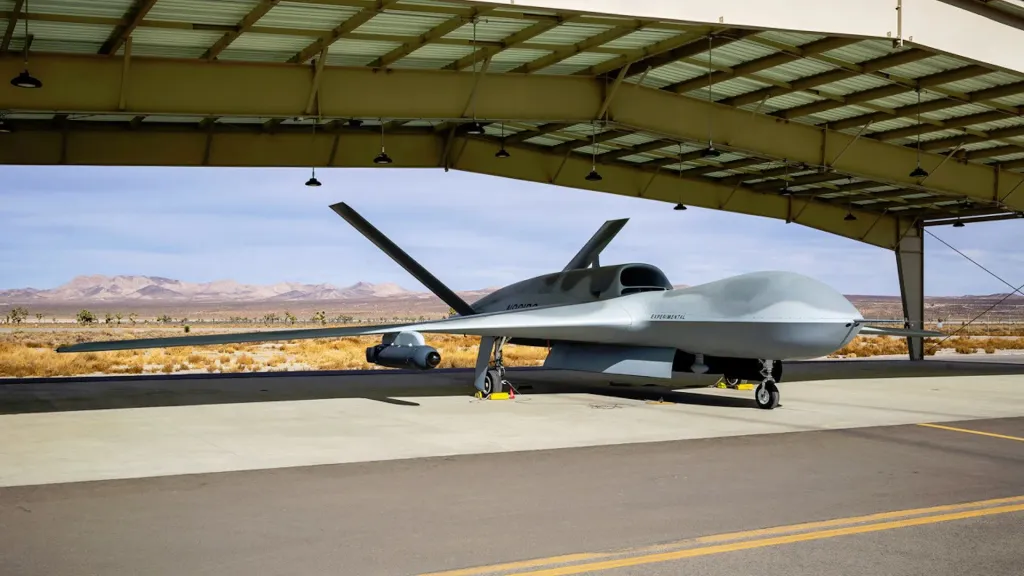
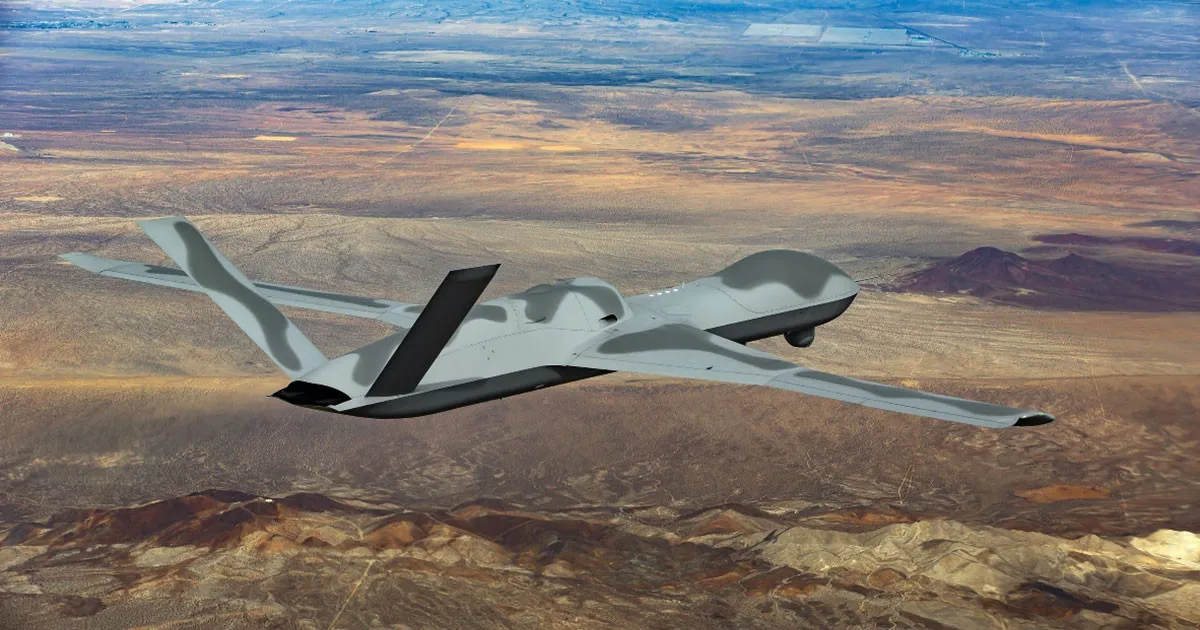
Alongside the formation and operational-process testing, GA-ASI has reported demonstrations focused on tactical cooperation between an unmanned aircraft and crewed fighters. In a recent exercise, the company used crewed F-5AT Advanced Tiger aircraft operated by private adversary-air contractor Tactical Air Support, Inc., together with an unspecified CCA test aircraft. The company used an image of an Avenger drone to illustrate its announcement.
GA-ASI said the exercise demonstrated semi-autonomous air-to-air combat functions. The F-5s and the CCA surrogate carried infrared search-and-track sensors, or IRSTs. The company said the aircraft used sensor data to track, engage and eliminate a simulated airborne target, while a beyond-line-of-sight data link supported coordination between the unmanned and crewed aircraft.
In the company’s account, the airborne F-5 transmitted target information from a system compatible with the Airborne Multi-Sensor Guidance and Reference Architecture, known as AMS-GRA. Those commands were passed to the CCA’s Tactical Autonomy Ecosystem, or TacACE, software. GA-ASI said the demonstration showed that platforms from multiple companies could interoperate through government reference architectures rather than relying on a single vendor’s system.
GA-ASI has previously demonstrated MQ-20 aircraft using podded IRST systems to detect and track airborne targets semi-automatically. The company’s latest description places that earlier sensor work within a broader effort to demonstrate how CCAs could share information with crewed aircraft and act on human-directed commands.
IRST systems detect and track infrared emissions rather than depending on radar reflections. In the context described by the source, that makes them relevant to detecting aircraft designed to reduce radar cross-section. Because IRSTs are passive sensors, they do not transmit a signal that would directly reveal to a target that it is being tracked, and they are not affected in the same way as radio-frequency sensors by electronic-warfare jamming. Their data can also be combined with information from other sensors, including active electronically scanned array radars, to improve track quality and situational awareness.
From testing to an operational CCA fleet
The Air Force expects air-to-air combat to be the initial primary mission for its CCAs. Air-to-ground missions are also beginning to emerge as a potential role for the FQ-42, FQ-44 and other CCA-type aircraft that the service could acquire. Anduril has already fit-checked a range of air-to-ground weapons on the Fury, according to the source.
Anduril has separately reported the first missile launch from a YFQ-44A. The company said the aircraft carried out an end-to-end, beyond-line-of-sight strike against a simulated target in a test conducted from Edwards Air Force Base. The report described the event as a step toward an operational CCA capability, but it did not establish operational deployment of the aircraft.
GA-ASI Vice President for Strategy Business Development Mike Shortsleeve told The War Zone that the company expected to conduct its own air-to-air missile shot in the near future. The statement followed the reported semi-autonomous demonstration with the F-5AT aircraft and the broader testing of CCA-related systems.
Shortsleeve said the Air Force’s target of at least 500 CCAs reflects the importance of both fleet scale and autonomy. He described the intended aircraft as systems that could provide additional weapons or sensing capacity while operating in manned-unmanned or unmanned-unmanned teams. He also emphasized that the company’s use of the term autonomy does not mean the aircraft would operate without direction from people.
“It’s going to be directed,” Shortsleeve said, according to the interview account. He described the intended approach as human-machine teaming in which people determine how the capability is used while the aircraft work collaboratively in the air or under direction from operators on the ground.
The FQ-42’s formation flight with the F-35A and F-15E does not by itself demonstrate the more advanced collaborative behavior being pursued in testing. It does, however, show the aircraft operating in proximity to two of the fighter types that form part of the Air Force’s planned crewed-uncrewed force mix. The December large-force exercise and continuing work at Creech and Nellis are intended to move the program from individual demonstrations toward repeatable integration with fighter operations.