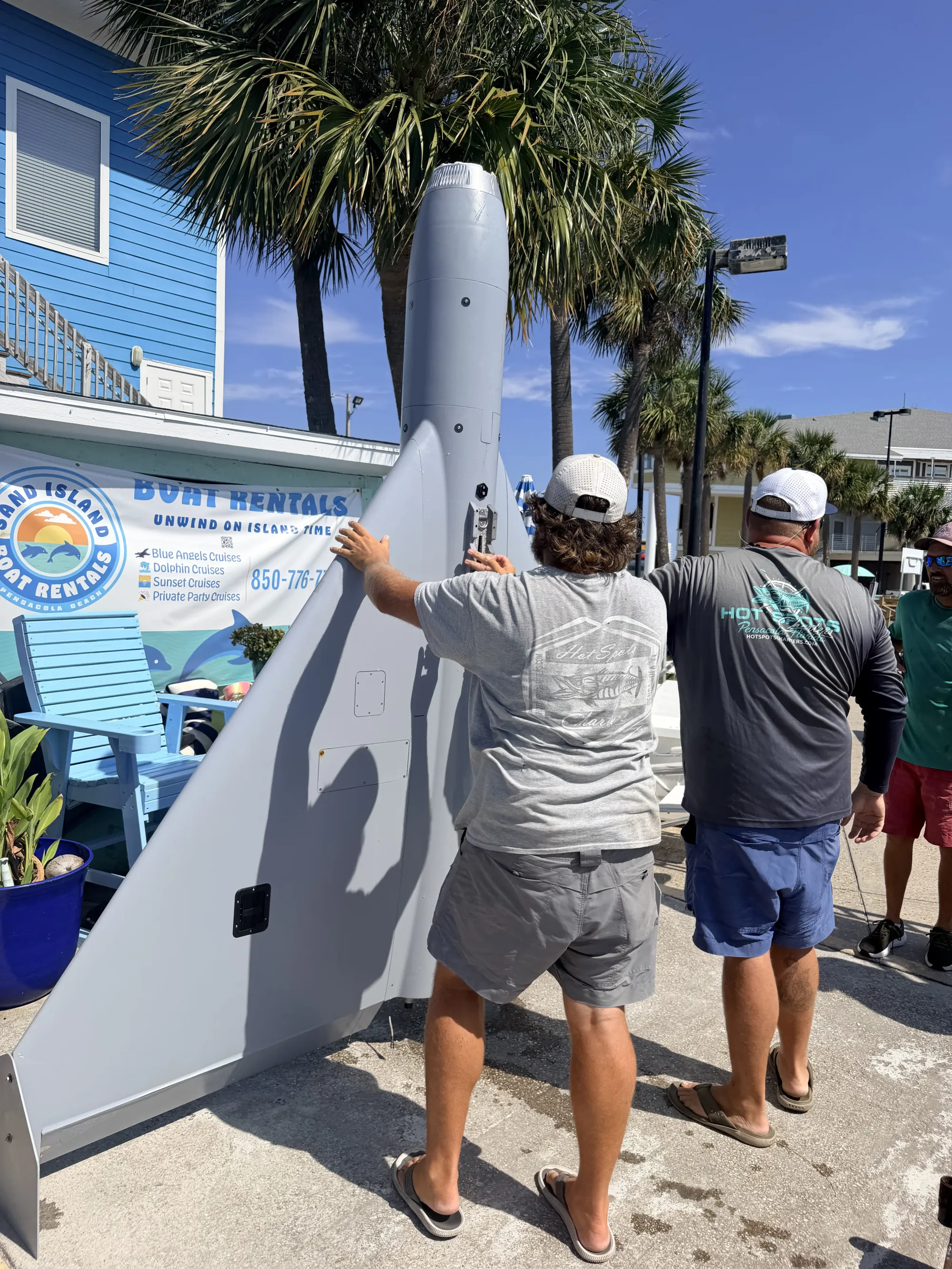
A Florida fishing charter has recovered a damaged delta-wing unmanned aircraft from waters near Eglin Air Force Base, while the base has confirmed that an unspecified test article went down during recent testing. Officials have not identified the lost aircraft or confirmed that it was the same drone retrieved by the charter crew.
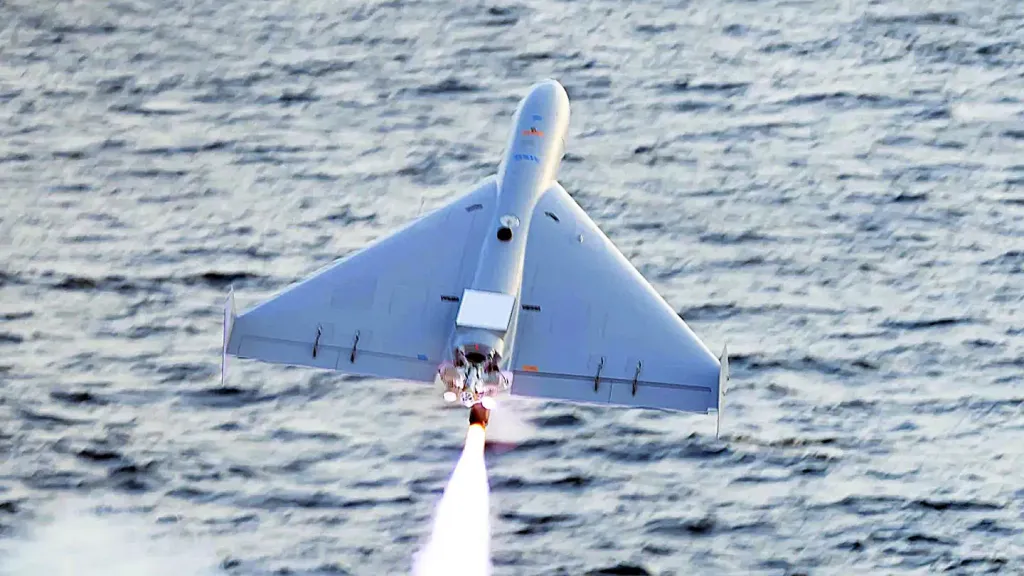
Photographs of the recovered aircraft indicate that it closely resembles the FLM-136, a U.S.-made target drone derived from the Iranian Shahed-136 one-way attack weapon. The FLM-136 was developed by SpecktreWorks to replicate Shahed-136-type threats for testing and training, and is associated with the broader Low-Cost Uncrewed Combat Attack System, or LUCAS, program. However, neither Eglin nor another U.S. authority publicly identified the recovered item as an FLM-136 or a LUCAS-related air vehicle.
The recovery occurred on Saturday during a Hot Spots Charters excursion operating near the base in Florida’s western Panhandle. According to Charlie Green, an aviation photographer who shared images of the find, local charter captain Daniel Arsenault spotted the object at a distance and approached it to investigate. Arsenault then recovered a mahi-mahi from beneath the floating aircraft before passengers helped bring the drone aboard.
He saw the object at a distance and went over to check it out. When he did, he pulled a good size mahi-mahi out from underneath it, complementing his already stocked cooler full of fish from that morning charter. His passengers helped him haul it aboard.
Charlie Green, describing charter captain Daniel Arsenault’s recovery
Green said Arsenault and Hot Spots Charters notified local agencies after the recovery and that an agency subsequently collected the aircraft. Green said he did not know which agency took possession of it. Images provided by Green showed the drone without its engine, propeller, and nose cone or seeker. The source reported that the loss of such components can occur when an aircraft impacts the water.
Eglin confirms test loss, not aircraft identity
An Eglin Air Force Base spokesperson confirmed that a test had been underway and that its test article went down, but declined to say what type of drone was involved, when the incident occurred, or where the vehicle came down. The spokesperson also did not confirm any connection between the installation’s lost article and the drone brought in by the charter crew. The Pentagon did not immediately provide further details.
I can confirm that we were doing a test and the test article went down.
Eglin Air Force Base spokesperson
Eglin’s host organization, the 96th Test Wing, describes itself as the Air Force test and evaluation center for air-delivered weapons, navigation and guidance systems, command-and-control systems, and systems used by Air Force Special Operations Command. The wing oversees the Eglin Gulf Test Range, which, according to the wing, includes approximately 120,000 square miles of overwater airspace across the eastern third of the Gulf of Mexico, extending from the Florida Panhandle toward the Florida Keys.
The land portion of the range covers 724 square miles and includes 70 test and training areas, according to the wing. Its facilities include an approved depleted-uranium test range and what the wing describes as the only qualified air-to-ground supersonic range east of the Mississippi River. The scale of the Gulf range provides airspace for developmental activities involving uncrewed systems, although Eglin has released no details indicating what specific test was underway in this case.
FLM-136 target role and LUCAS connection
The FLM-136’s original role is particularly relevant to the aircraft’s apparent configuration. It was designed as a target vehicle that mimics one-way attack munitions, specifically the Shahed-136 from which it was reverse engineered, for training and testing. The design was later weaponized into the LUCAS one-way attack system. The visual similarity alone, however, does not establish the recovered drone’s identity, intended configuration, or its relationship to Eglin’s acknowledged test loss.
LUCAS was used in combat for the first time on the opening day of Operation Epic Fury, the source reported, on February 28. When U.S. Central Command established Task Force Scorpion Strike, described as the military’s first one-way attack drone unit, in December, Navy Capt. Tim Hawkins said the system cost approximately $35,000 per platform. Hawkins described LUCAS as a low-cost, scalable system intended to provide capabilities at a lower cost than traditional long-range U.S. systems able to deliver similar effects. Task Force Scorpion Strike falls under U.S. Special Operations Command Central, which oversees U.S. special operations activities across the Middle East.
The drone system has an extensive range and the ability to operate beyond line of sight, providing significant capability across CENTCOM’s vast operating area.
Navy Capt. Tim Hawkins, U.S. Central Command spokesperson
CENTCOM has said LUCAS drones are designed to operate autonomously and can be launched by several methods, including catapults, rocket-assisted takeoff, and mobile ground and vehicle systems. The command also described the system as having extensive range. Development work has continued on cooperative swarming capabilities involving multiple LUCAS aircraft, according to the source, a function identified as central to the program’s intended development. The source said such development requires sanitized airspace, a requirement potentially suited to Eglin’s large Gulf range.
Recoveries from Florida waters are not unprecedented
Military drone recoveries in Florida waters have occurred before. In 2021, beachgoers in Palm Beach County found a U.S. Air Force BQM-167A high-performance target drone that had washed ashore. The Air Force also operates a small fleet of 120-foot recovery boats, its only vessels in service, to retrieve drones that have been shot down during live-fire events or otherwise require collection from the water. Contracted crews from Florida Offshore operate the boats and recover about 100 drones annually, according to the source.
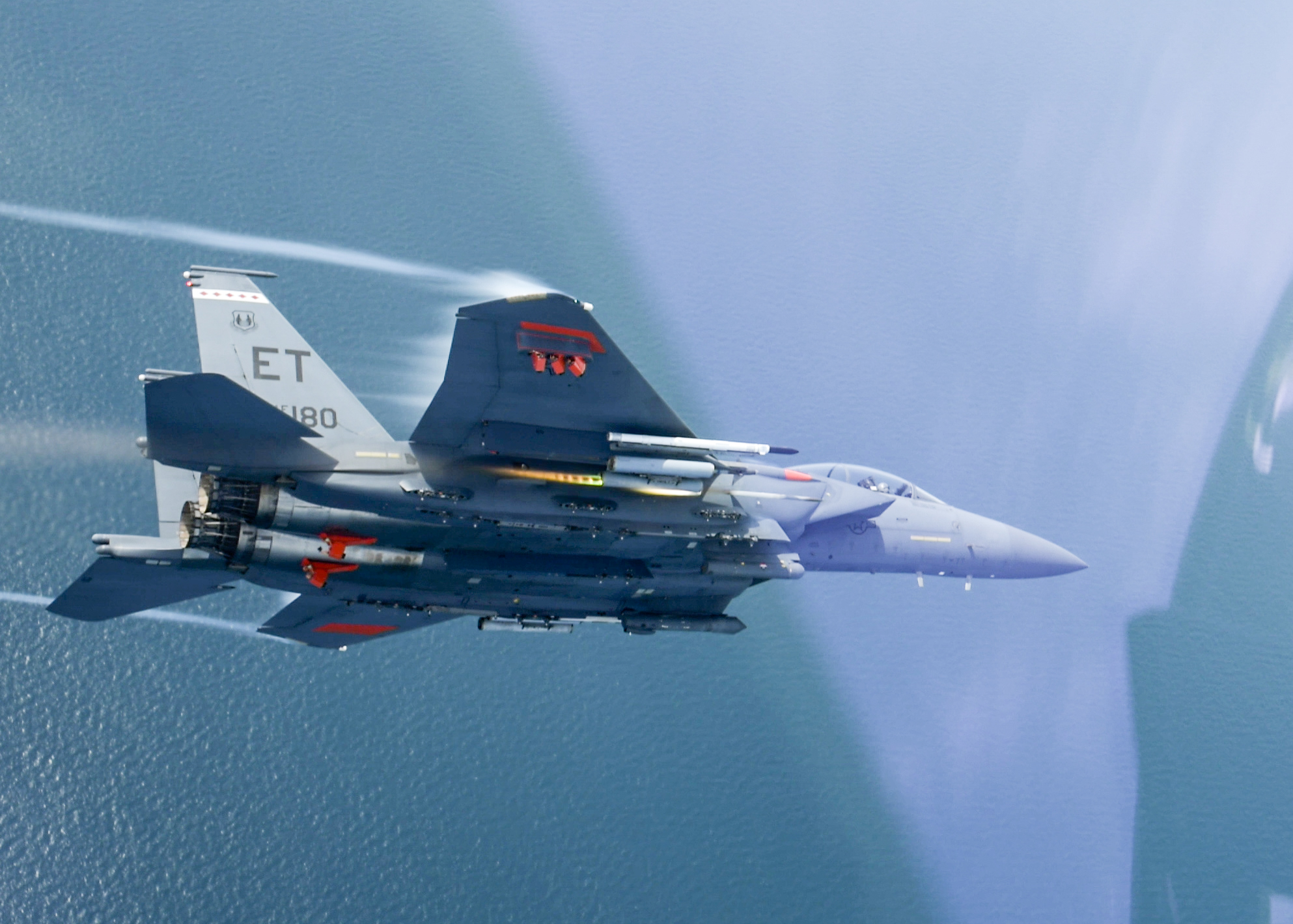
The episode near Eglin comes amid continued U.S. military interest in counter-uncrewed aircraft capabilities, particularly systems intended to address one-way attack drones of the type the FLM-136 was designed to emulate. The source cited Eglin-linked work to arm Air Force fighters with FALCO APKWS laser-guided rockets for intercepting such threats, as well as work on a more capable “fire and forget” air-to-air APKWS. It said the original fighter-rocket effort began in 2019 and was later brought into service as tensions with Iran escalated. The source also characterized counter-uncrewed aircraft efforts as a major focus across the U.S. military as the threat from one-way attack systems has grown.
The source also noted that LUCAS vehicles have been lost and recovered intact during the conflict involving Iran. Yet the Florida recovery remains unresolved: the aircraft’s missing components, Shahed-derived shape, and proximity to Eglin provide grounds for comparison with the FLM-136, but do not amount to official identification. Until Eglin, the Pentagon, or the collecting agency releases further information, the recovered drone’s origin and its connection to the base’s lost test article remain unconfirmed.