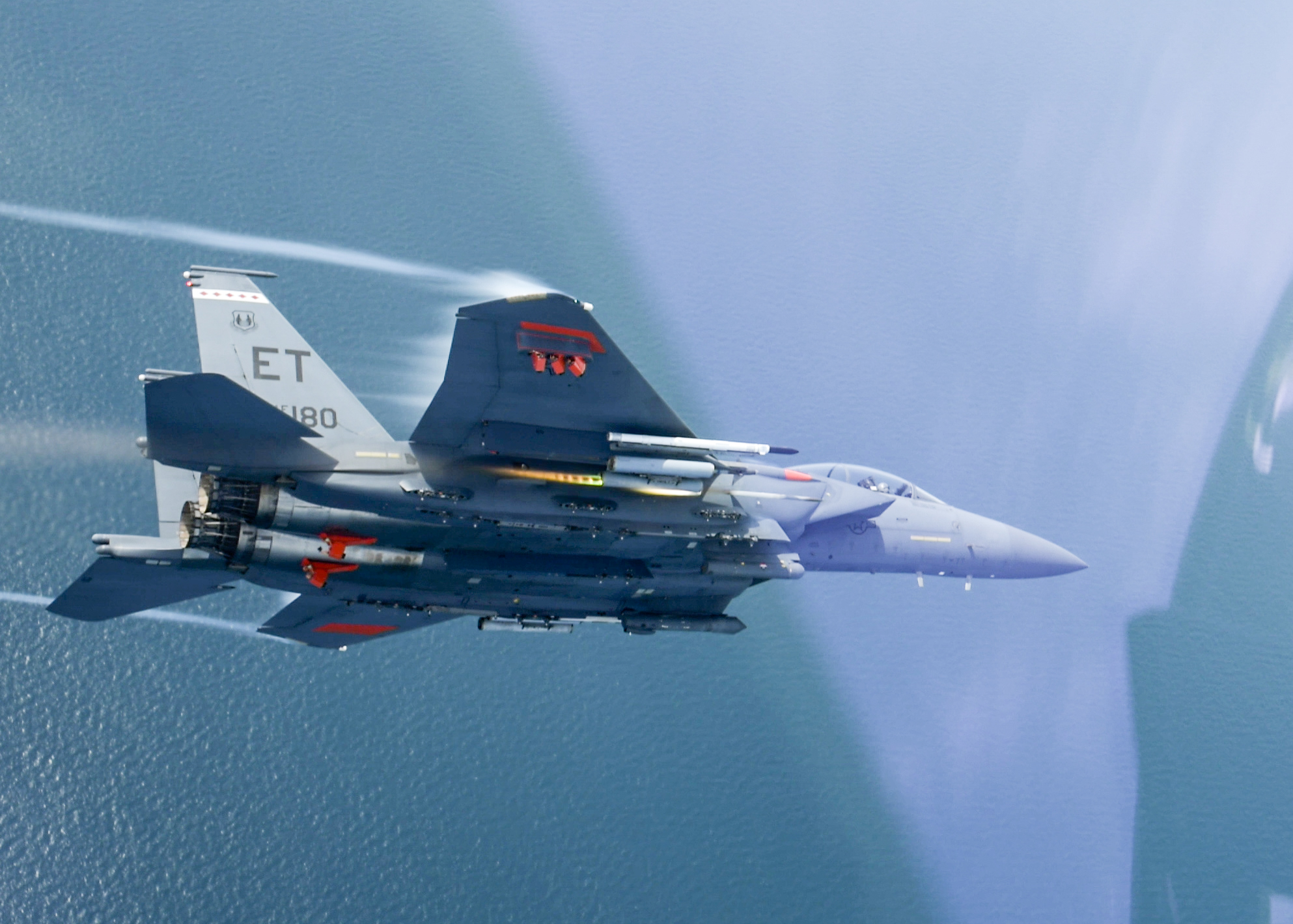
The U.S. Air Force has equipped F-15E Strike Eagles operating in the Middle East with Advanced Precision Kill Weapon System (APKWS) laser-guided rockets for air-to-air engagements against Iranian-made one-way attack drones. The capability was fielded approximately nine days after testing began in May 2025, according to Brig. Gen. Mark A. Massaro, head of the Air Force Test Center.
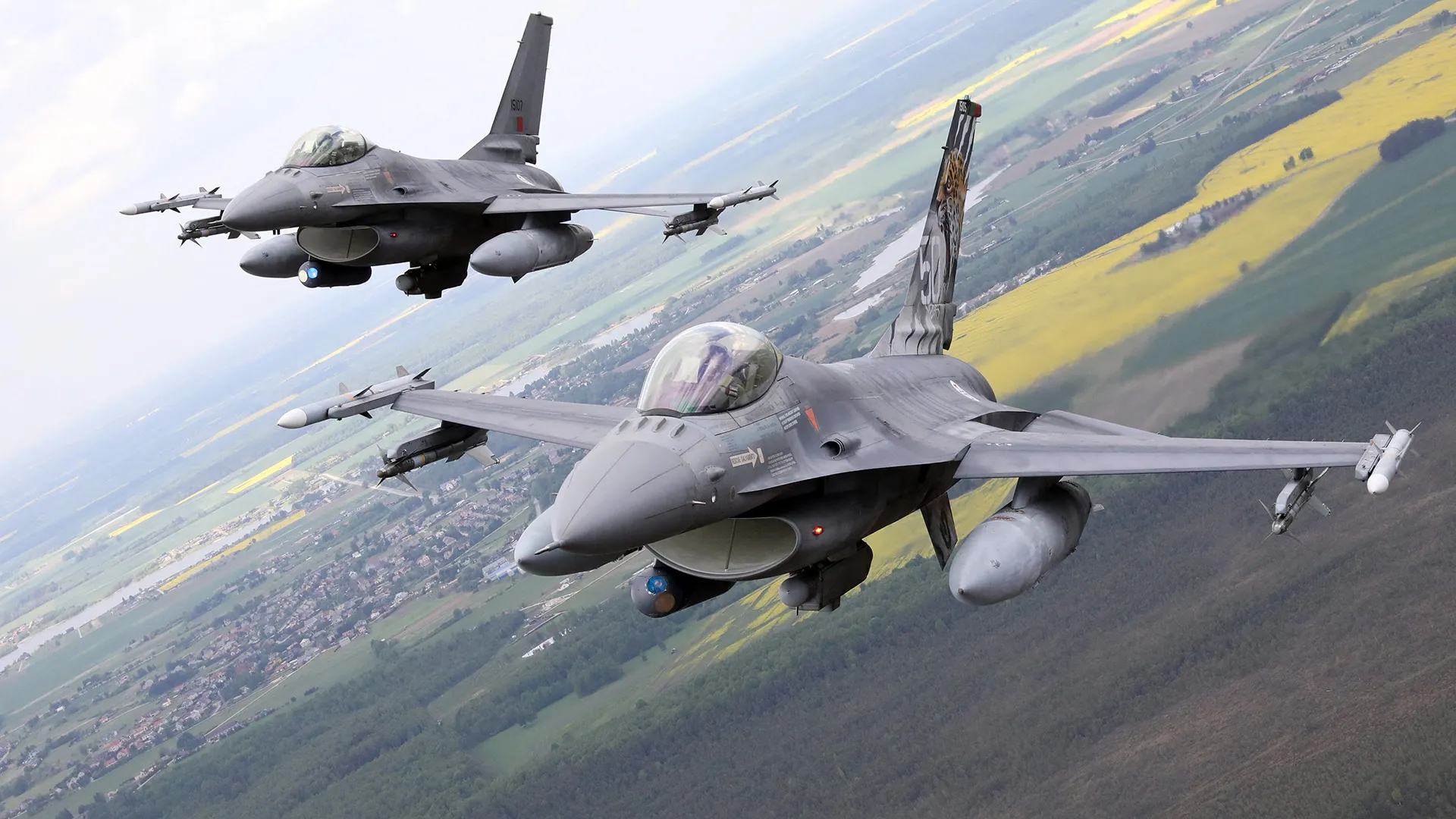
The rapid F-15E effort followed the Air Force’s earlier operational adoption of air-to-air APKWS on F-16 Fighting Falcons. Originally an air-to-ground weapon, APKWS combines a laser-guidance kit with a Hydra-70 rocket, converting the unguided rocket into a precision-guided munition. The service had explored the concept of using the system against airborne targets on F-16s in 2019, but for several years the work remained a proof of concept rather than an operational capability.
Growing use of Iranian drones gave the programme greater urgency. The Air Force rushed the system to F-16s in 2024 and subsequently made F-15E integration a priority in 2025. Massaro said developmental and operational testing were conducted in parallel, enabling the service to demonstrate the capability and send it to the operational theatre within the first week of the activity.
“At the end of the first week, we had demonstrated, both in a developmental and an operational sense, that it was a usable capability, and we deployed that capability at the end of the first week,” Massaro said. “We deployed some of our maintainers and some of our testers into theater to help the first week.”
Brig. Gen. Mark A. Massaro, head of the Air Force Test Center
A response to missile-expensive drone interceptions
The effort addresses the cost and weapon-capacity challenge of using conventional air-to-air missiles against relatively inexpensive one-way attack drones. Before APKWS entered the air-to-air mission, U.S. aircraft had relied on radar-guided AIM-120 Advanced Medium-Range Air-to-Air Missiles and infrared-guided AIM-9 Sidewinders. Air Force officials cited an approximate cost of $1 million for an AIM-120 and said AIM-9 variants cost hundreds of thousands of dollars; the AIM-9X was described as costing about $500,000. An APKWS rocket costs roughly $35,000, according to Air Force officials.
The operational pressure behind the adaptation was illustrated during Iran’s April 13, 2024 attack on Israel. Tehran launched about 300 drones, ballistic missiles and cruise missiles in what the source described as an effort to complicate and overwhelm Israeli air defences. The United States had anticipated the engagement, and F-15Es from the 335th and 494th Fighter Squadrons flew alongside F-16s of the 121st Fighter Squadron to intercept Iranian drones over Iraq.
F-15Es involved in that operation carried as many as eight air-to-air missiles each. The volume of drones meant that many fighters quickly expended their missiles, and three F-15E crews unsuccessfully attempted to use laser-guided Joint Direct Attack Munition bombs against drones. Although U.S. fighters helped defeat the attack, the engagement highlighted the expense of relying on high-end air-to-air weapons for large numbers of unmanned targets.
F-15E integration completed at Eglin
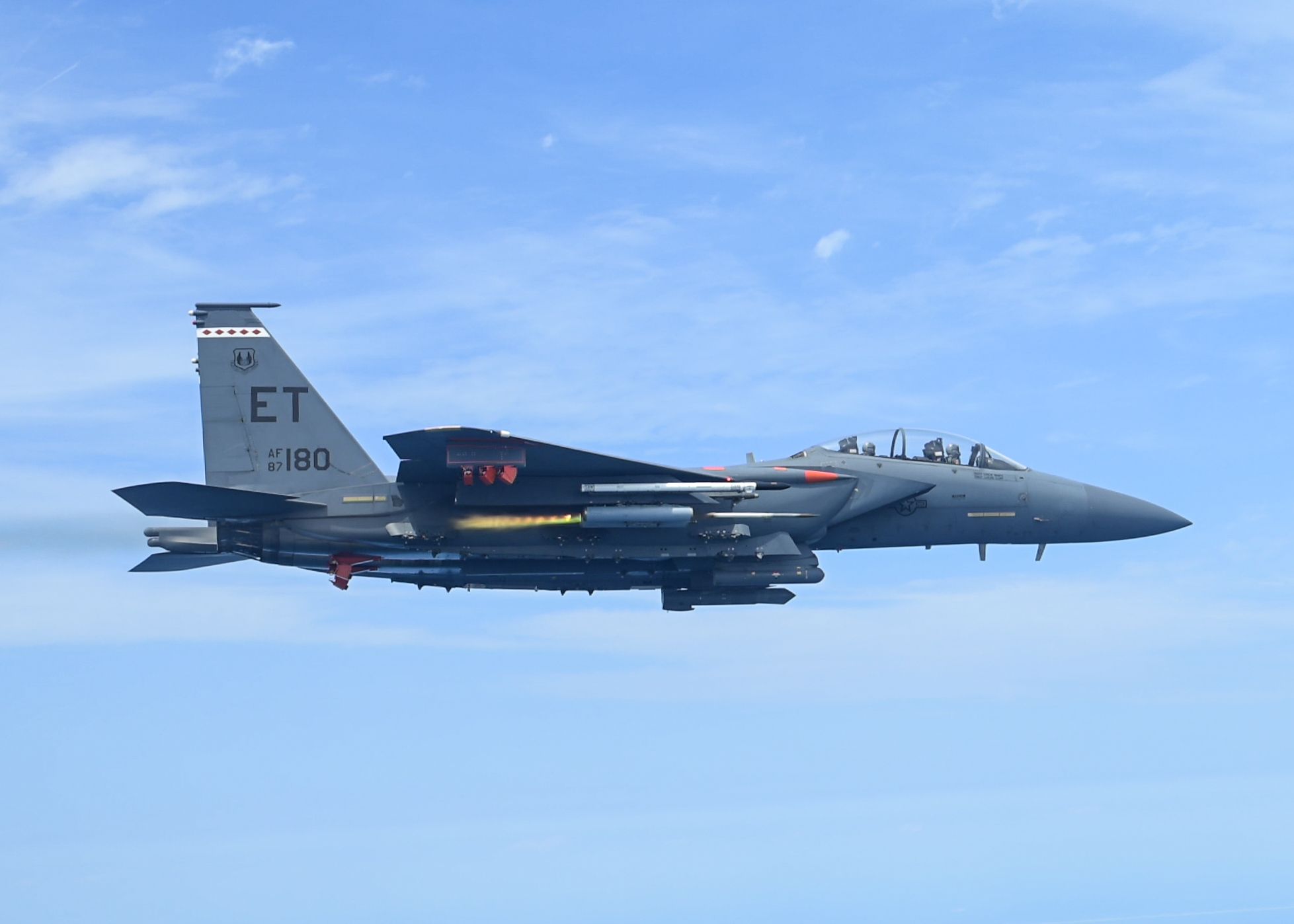
The air-to-air APKWS variant is designated AGR-20F FALCO. It was first used in this configuration on F-16s in 2024. Work to bring the weapon to the F-15E was conducted at Eglin Air Force Base, Florida, and was led by the 96th Test Wing’s Air Force Seek Eagle Office, or AFSEO, which had also supported the F-16 integration.
The team initially faced difficulties finding a method to mount the rocket system on the F-15E and connect it to the aircraft so it could be fired. Once a solution was identified in May 2025, the 96th Test Wing and 53rd Wing treated the work as a top priority. Personnel from the 40th Flight Test Squadron and the 85th and 422nd Test and Evaluation Squadrons flew test sorties and carried out live-fire events against targets over land and water.
Massaro said operational and developmental test teams flew overlapping missions on the same days. In the second week of the effort, maintainers and pilots were in theatre while operational testers continued to refine tactics. Those updated tactics were sent to the deployed force through phone and digital communications, he said. Following the initial demonstrations, the 53rd Wing and 96th Test Wing deployed equipment and provided training for Airmen assigned to use the weapon.
The Air Force has not identified the location where the F-15E capability was first fielded. U.S. officials confirmed to Air & Space Forces Magazine that air-to-air APKWS was first used in the Middle East, within U.S. Central Command’s area of responsibility. Massaro said the F-16 programme helped accelerate the F-15E effort because the service already understood the weapon system after approximately a year of F-16 operations with it, while the F-15E itself was a familiar aircraft platform.
Magazine depth and limits of laser guidance
APKWS is carried in seven-round pods, and aircraft can carry multiple pods. An F-15E can carry as many as 42 APKWS rockets, giving it substantially more potential engagements against drones than a comparable number of missile stations. Unlike a fire-and-forget missile, however, an APKWS rocket requires its target to be laser-designated. That requirement makes the weapon particularly suited to slower targets such as one-way attack drones rather than all airborne threats.
Air Forces Central began equipping F-16s in the Middle East with APKWS for drone interceptions in 2024, using the rockets against threats associated with the Houthis in Yemen. A U.S. F-16 achieved the first reported rocket kill of a drone that year. In October 2024, the 480th Expeditionary Fighter Squadron, deployed from Spangdahlem Air Base in Germany, arrived in the Middle East with limited advance notice that it would receive APKWS for use against drones and cruise missiles.
The 480th Expeditionary Fighter Squadron later recorded dozens of kills using the rockets, according to its commander, Lt. Col. William “Skate” Parks. The unit also used older AIM-9M Sidewinders and claimed the first air-to-air AIM-9M kill in more than 30 years. It reported 108 total aerial kills of drones and cruise missiles during the deployment. By April 2025, U.S. Air Forces in Europe had incorporated air-to-air APKWS into F-16 training, reflecting both regular European fighter deployments to the Middle East and concern over Russian drone incursions into NATO airspace.
The demand for lower-cost drone-defence weapons has continued to rise. Since the start of Operation Epic Fury on February 28, Iran has fired more than 6,000 drones and 1,500 ballistic missiles, with those figures continuing to grow, U.S. officials said. F-16s operating around the Strait of Hormuz, the Persian Gulf and the Gulf of Oman are flying with APKWS pods to engage drones. The source also reported that U.S. Army Apache helicopters can employ APKWS in an air-to-air role, another recently fielded capability.
Lt. Gen. Derek C. France, the former commander of Air Forces Central, described APKWS as significant both for the number of weapons an aircraft can carry and for the wider availability of defensive munitions across a theatre. He said the system provides a seven-round pod in place of a single AIM-9 missile and can help aircraft deal with drone swarms, while also improving the cost balance of counter-drone operations.
“I would say that APKWS is a step in the right direction, but it can’t be the final step,” France said. “The two things that we need to focus on are air domain awareness at range: where are the drones coming from? How many are there? What’s their target? What do I know about them? And then magazine depth, both individual airplanes and theater-wise, to have enough to shoot them down in a layered defense kind of way.”
Lt. Gen. Derek C. France, former commander of Air Forces Central
France said the drone threat was accelerating in its tactics, speed, technical development and scale. In that assessment, the F-15E and F-16 APKWS efforts provide an additional layer for defending forces and bases, but must be accompanied by improved long-range awareness of incoming unmanned threats and sufficient weapon stocks across the operational theatre.