The U.S. Air Force plans to bring its Collaborative Combat Aircraft into a large-force employment exercise for the first time in December, using the next Emerald Flag event to test how the autonomous drones operate alongside crewed fighters in a combined force package.
Lt. Col. Lyndon “OTTO” Bartlett, director of operations for the Experimental Operations Unit at Nellis Air Force Base, said the December exercise will mark the unit’s first “tip dip of the toe” into actual force integration with the aircraft. The event is intended to provide a live, end-to-end demonstration involving CCAs in a combined fourth- and fifth-generation offensive counter-air push, though Bartlett characterized the initial effort as small.
From prototypes to force integration
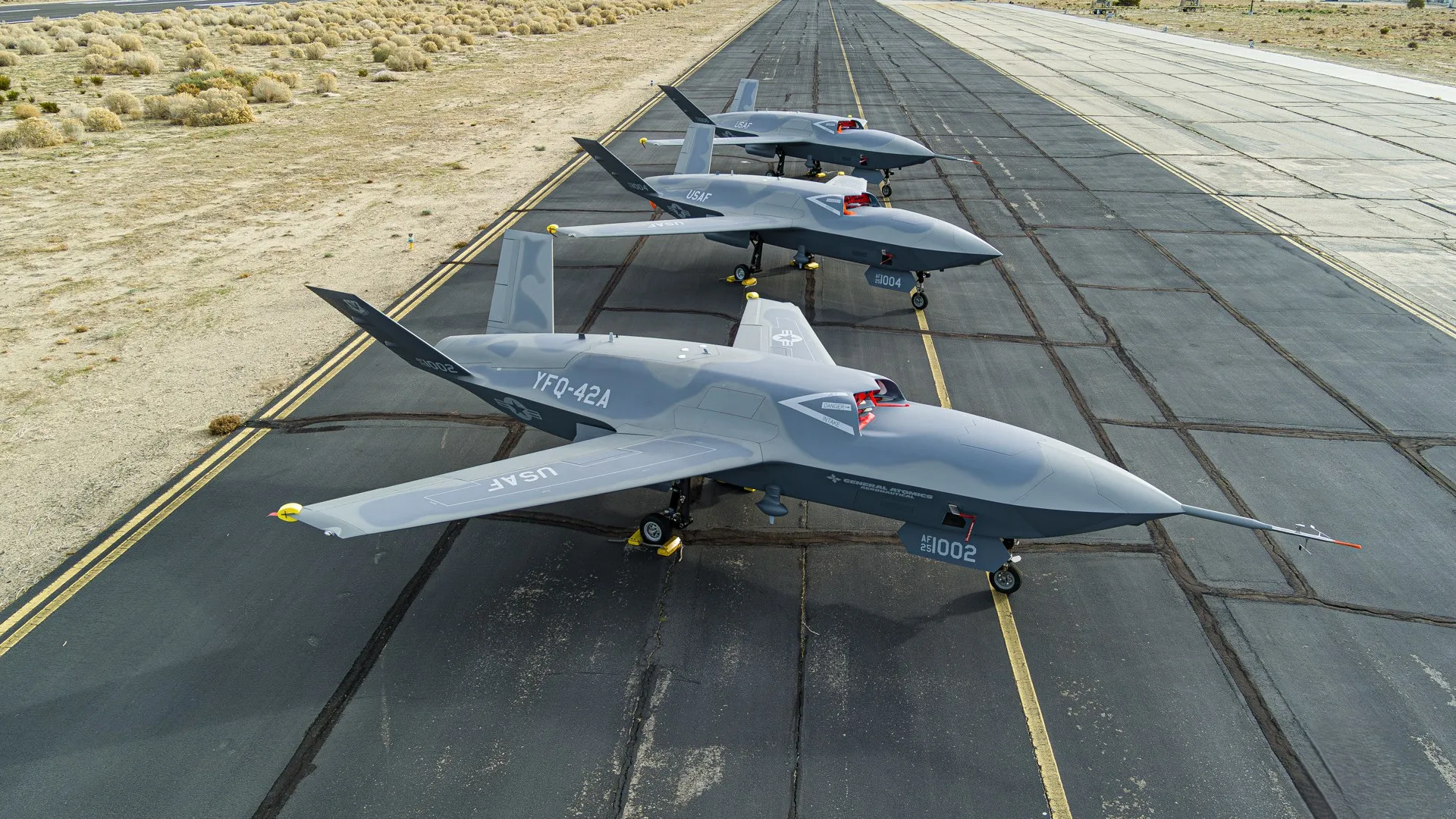
The Experimental Operations Unit has been helping establish the groundwork for future CCA operations while testing prototypes of the General Atomics FQ-42A Vengeance and Anduril FQ-44 Fury. The Air Force announced in June that its initial operational CCA fleet would include a mix of those two designs.
Emerald Flag, hosted by the 96th Test Wing at Eglin Air Force Base since 2020, has focused heavily on aerial networking architectures and command-and-control capabilities. Those functions are expected to be especially important for aircraft designed to collaborate with crewed platforms. The exercise is not limited solely to the air domain and is often connected with other large-force test events involving other U.S. military services.
A CCA-type aircraft has already appeared in another large-force exercise. Boeing’s MQ-28 Ghost Bat took part in Valiant Shield 26 earlier this year, with the Experimental Operations Unit also involved. But the MQ-28, originally developed for the Royal Australian Air Force, is not officially part of the Air Force’s CCA program. Emerald Flag will therefore be the first large-force employment exercise involving the service’s own CCA effort, according to Bartlett.
For Bartlett, the value of the event extends beyond verifying that radios, targeting commands and other technical links function as intended. He said the exercise can help develop trust in the aircraft and their autonomy among the people expected to employ them. That confidence is central to resolving broader questions about how the drones will be deployed, launched, recovered, supported and used tactically in real operations.
The unit and its government and industry partners have already used virtual environments to refine autonomous capabilities before live flight activity. Bartlett said simulated testing enables close and rapid interaction between operators and programmers, allowing feedback on mission-autonomy software to be incorporated immediately when possible or in a subsequent software iteration. Live testing adds questions that simulation alone cannot fully address, including weapons loading, maintenance and the practical demands of operating the aircraft in the field.
Autonomy, logistics and policy hurdles
The Air Force envisions deploying CCAs to dispersed locations, including airstrips with limited infrastructure and constrained logistics access. That approach aligns with the service’s evolving Agile Combat Employment concepts. The Experimental Operations Unit participated in at least two rounds of ACE-focused testing this year, at Edwards Air Force Base in California in April and Creech Air Force Base in Nevada in July.
Bartlett said testing to date has included sortie generation, maintenance demands and the size of the support footprint required to operate the aircraft. He described the drones as “extremely easy to maintain,” saying the effort has reached a one-to-one maintainer-to-aircraft ratio. He also said the Air Force has found that personnel from any Air Force Specialty Code can be trained to generate sorties and load weapons, while the unit continues to examine logistics, command and control, and battle management.
Significant obstacles remain. Bartlett identified integration with Federal Aviation Administration rules and policy as one of the two biggest problems facing the unit. Unlike remotely piloted aircraft or crewed fighters, he said, the CCAs have no pilots and are intended to operate with substantially less human engagement than many existing drones. The Air Force must develop policies that allow it to operate an autonomous fighter using a mission-autonomy agent while ensuring the broader enterprise is prepared to receive the capability.
The other challenge is developing Air Force policy and doctrine suited to the aircraft rather than adapting older rules without accounting for their specific characteristics. Bartlett said the service needs an approach that enables rapid movement, weighs operational needs and supports experimentation with novel forms of air superiority.
The degree to which CCAs will operate independently remains a central issue. Bartlett emphasized that the aircraft are collaborative by design, arguing that separating them from crewed force packages might be technically effective in some cases but would not deliver the integrated effect the Air Force seeks. The unit has identified the autonomous functions it believes are required and is using its experimentation plan to determine whether successive software versions can perform them.
Industry participants at the same conference panel described collaboration as a way to make the autonomy challenge more manageable while the capability is fielded and matured. Robert “Otis” Winkler, Kratos’ vice president for corporate development and national security programs, said more independent employment in support of operations could emerge further in the future. Jason Levin, Anduril’s senior vice president for air dominance and strike, said CCAs are designed to increase the survivability and lethality of current force packages.
December’s Emerald Flag will offer an early live test of those concepts in a force-level setting. The Air Force is aiming to begin bringing CCAs into operational service around the end of the decade and to have at least 500 aircraft in inventory by 2032. Bartlett said the service expects to learn a great deal over the next several years as it moves from virtual iterations and limited demonstrations toward integrated operations.