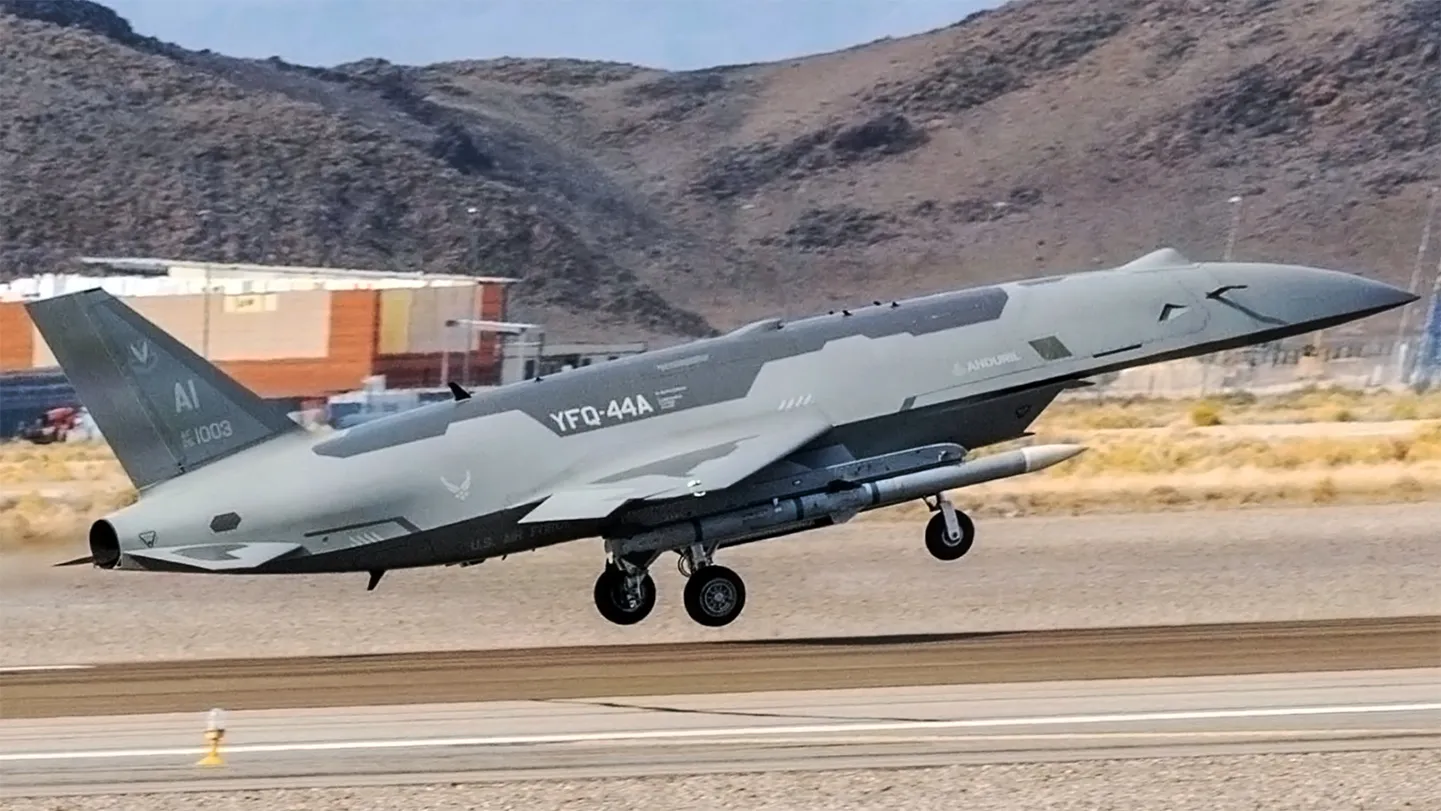
Anduril’s YFQ-44A Fury Collaborative Combat Aircraft has flown in formation alongside F-35 fighters during U.S. Air Force testing, according to company executives, marking a step toward the service’s goal of operating autonomous aircraft with crewed combat jets. The flights took place during a July exercise with the Air Force’s Experimental Operations Unit at Creech Air Force Base, Nevada, executives said during the Air & Space Forces Air, Space and Cyber Symposium.
The formation flights did not yet include an F-35 directing the Fury. Jason Levin, Anduril’s senior vice president for Air Dominance and Strike, said the company had begun flying “in formation alongside crewed” aircraft, including “fifth-gen fighters. F-35.” But, he added, “they’re not controlling it from the crewed fighter yet.”
That distinction is central to the Collaborative Combat Aircraft concept. The Air Force envisions relatively inexpensive autonomous aircraft operating alongside and supporting crewed fighters in contested airspace. Flying Fury near F-35s demonstrates that the aircraft and its autonomy system can share airspace with a fifth-generation fighter; having the fighter task and employ the uncrewed aircraft would be a more consequential demonstration of manned-unmanned teaming.
Autonomy testing and a missile shot
During the July event, Fury operated under Anduril’s Mission Autonomy system in airspace shared with crewed fighters, other CCAs and other aircraft, the company said. Air Force personnel conducted route and pattern work as well as more representative tactical scenarios. Anduril said service personnel could operate the autonomy system without company employees directly running the aircraft, though Anduril personnel remained on site in a supporting role.
The Creech exercise followed an April event at Edwards Air Force Base. In the earlier exercise, Air Force personnel received training on operating the aircraft and launched and recovered it using Anduril’s compact Menace-T setup, which the company described as a pair of ruggedized cases and a laptop rather than a conventional ground-control station.
By July, Anduril said the Air Force had further reduced the personnel and infrastructure needed for operations. A single Experimental Operations Unit operator could launch and recover Fury after only hours of training, while Air Force personnel independently operated its Mission Autonomy functions. The company also said the event demonstrated disaggregated operations, in which personnel at multiple locations could operate the same aircraft, and a “hot reload” in which two operators replaced an AIM-120 AMRAAM while the engine was running. Anduril said that reduced the interval between sorties to single-digit minutes.
The July testing also included a live weapons demonstration that Anduril characterized as an end-to-end kill chain. Fury launched from Edwards with a single operator, received a track from an external source over a beyond-line-of-sight connection, and ingested that track through Anduril’s Lattice AI-infused autonomy software system. An operator then tasked the aircraft to engage. Fury launched an AIM-120 AMRAAM and guided it to a simulated target, according to the company.
Anduril described the event as a demonstration extending from offboard targeting information through the aircraft’s mission systems and operator tasking to an air-to-air weapons engagement. The company’s released description of the test called it an “end-to-end, beyond-line-of-sight strike against a simulated target.”
Path toward crewed-aircraft control
Anduril said it has begun work on “quarterback integration,” its term for enabling a crewed aircraft to direct or task autonomous aircraft. The work has included hardware-in-the-loop and software-in-the-loop environments, as well as work on Fury itself. Levin said most of those events would be coming “in a matter of weeks or months,” and confirmed that planned quarterback-integration events would involve live flying.
How an F-35 would control Fury remains part of the development effort. Company executives pointed to integrating human-machine interfaces, initially centered on tablet-based control from the crewed aircraft. Anduril characterized the progression as a “crawl, run, build-up” process rather than a single leap from formation flying to direct fighter control.
The company is also developing Fury’s potential weapons and mission options. The production FQ-44 is designed with four external hardpoints and an intended capacity for four AIM-120s in the Air Force’s primary air-to-air mission set; the demonstration aircraft currently can carry two, Anduril said. The company said it has begun integration and fit checks involving 500-pound guided bombs, Small Diameter Bombs, low-cost cruise missiles including its Barracuda 500, other air-to-air weapons, rocket pods and targeting pods.
Those efforts are integration and engineering work, not claims that every listed weapon has been flight-tested from Fury. Anduril said the wider portfolio could support counter-drone, counter-cruise-missile and air-to-ground or air-surface strike missions, with additional sensors such as a targeting pod potentially added for some roles. More advanced areas including sensor fusion, track discrimination and tactical engagements remain under development and are being explored extensively in simulation, executives said.
Operations and production plans
Anduril has delivered a Fury aircraft to the Experimental Operations Unit at Creech, which it said makes Fury the first CCA permanently delivered to the unit. The Air Force is now flying the aircraft multiple times a day with a very limited Anduril presence, according to the company. The operational approach is intended to avoid a large ground-control footprint or a dedicated operator for every sortie, while supporting dispersed operations across multiple locations.
Assembly of Fury airframes has begun at Anduril’s Arsenal facility, and the company expects production aircraft to start coming off the line early next year. Anduril said it has arranged the facility and supply chain for a potential rate of 150 aircraft annually, though that is planned capacity rather than an existing Air Force order. It said current Air Force pricing is based on a much lower annual buy, while asserting that Fury’s unit cost is well below $20 million at the quantities now contemplated.
The Air Force earlier awarded production contracts for the FQ-44A Fury and General Atomics’ FQ-42A Dark Merlin, now formally named Vengeance. The service is aiming to field at least 500 CCAs by 2032, a target expected to include future increment-two aircraft as well as the initial designs. For Anduril, the next major test will be moving beyond co-located flying to showing that a crewed fifth-generation fighter can command and employ Fury in a live mission.