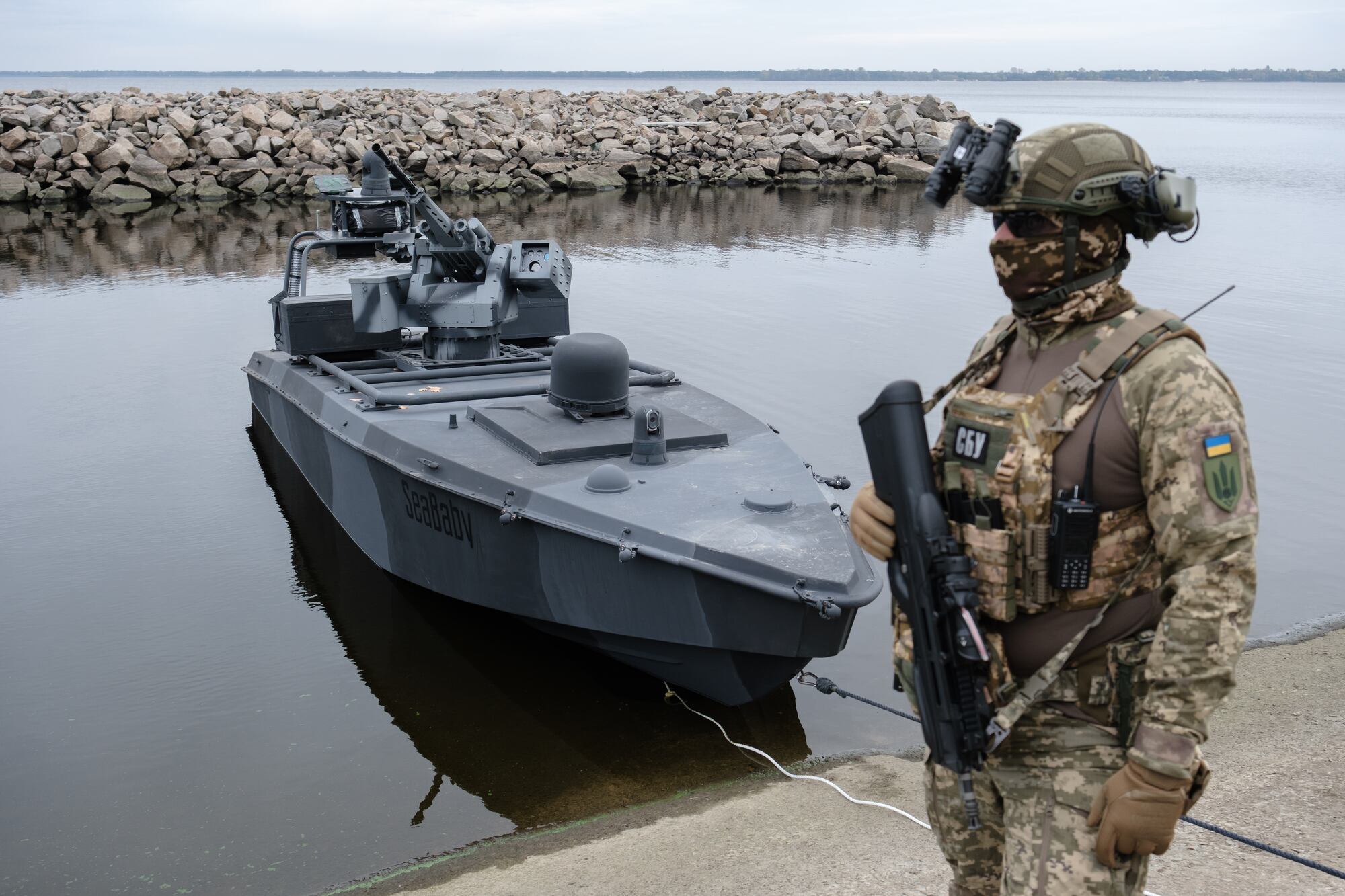
Ukraine has adapted its Sea Baby unmanned surface vessel into a launch platform for first-person-view attack drones, giving the Security Service of Ukraine, or SBU, another way to extend strikes from the Black Sea toward targets beyond the coast.
The strike boat can carry six to eight FPV drones in side compartments that open during an attack, according to Russian accounts of Sea Baby operations near the Kinburn Spit, about 40 miles east of Odesa, that were shared by Forbes. The vessels were also reported to carry thermobaric Shmel rockets.
A naval platform for aerial drones
The new configuration builds on Sea Baby’s established role as a remotely piloted strike boat. Ukrainian officials rely on the vessel’s ability to move closer to Russian military positions than a land-based launcher could. The SBU has cited a range of 930 miles, or 1,500 kilometers, with a 4,400-pound, or 2,000-kilogram, payload.
Some drones carried in the boat’s cargo hold are guided by fiber-optic cable, Forbes reported. That connection makes them immune to the radio jamming that can bring down conventional FPV drones, a significant consideration in the heavily contested electronic-warfare environment over the Black Sea.
Sea Baby is primarily controlled from a mobile ground station, but it also incorporates AI-assisted targeting and navigation intended to allow autonomous operation when communications are degraded or jammed. The SBU develops and operates the system as part of a broader Ukrainian effort to turn a range of platforms into FPV launchers.
Sea drones carrying fiber-optic FPVs struck the Russian ports of Tuapse and Novorossiysk in September, according to the report. Ukrainian companies have also fitted ground robots to launch FPVs, while both sides in the war have flown balloons carrying the drones.
“The SBU became the first in the world to pioneer this new kind of naval warfare, and we continue to advance it.”
Brig. Gen. Ivan Lukashevych, at the October 2025 unveiling of the latest Sea Baby generation
Separate from the Magura program
Sea Baby is one of two distinct Ukrainian naval-drone families. The SBU’s Sea Baby program is separate from the Magura, a system built by Uforce for Ukraine’s military intelligence directorate, the GUR. The two systems have different lineages and export paths, despite both contributing to Ukraine’s wider uncrewed maritime campaign.
Ukrainian naval drones have sunk or damaged roughly a dozen Russian warships since 2022 and helped force the Black Sea Fleet to move its main operations back to Novorossiysk, according to the U.S. Naval Institute. Defense News reported that each boat costs a few hundred thousand dollars, less than a single modern torpedo.
Interest beyond the Black Sea
The operational lessons from Ukraine’s maritime drones are drawing attention from U.S. forces and NATO. U.S. special forces used a Ukrainian Magura to sink a target ship during the Balikatan 2026 exercise off the Philippines on June 24, marking the technology’s first use in the Indo-Pacific. That demonstration involved Magura rather than Sea Baby, but reflected wider interest in small, expendable surface vessels able to carry weapons over long distances.
The U.S. Navy expects to field thousands of small uncrewed surface vessels across the Indo-Pacific by 2030, Capt. Garrett Miller, who leads Surface Development Group One, said at an April symposium, as reported by USNI News. NATO has also tested Ukrainian experience: Ukraine’s navy led a red team at the REPMUS naval-drone exercise in Portugal in September and defeated the alliance’s blue force in all five scenarios, according to the report.