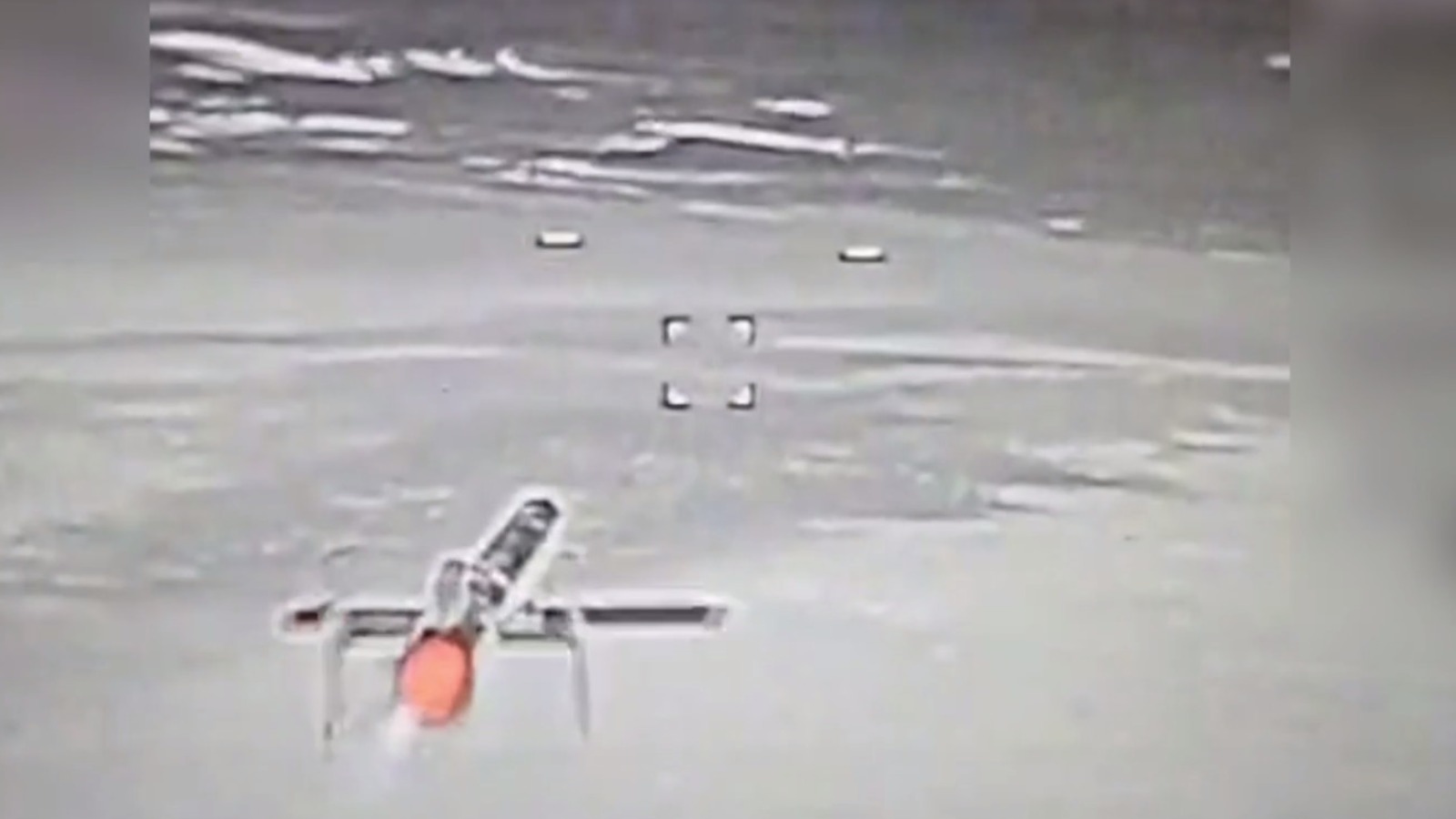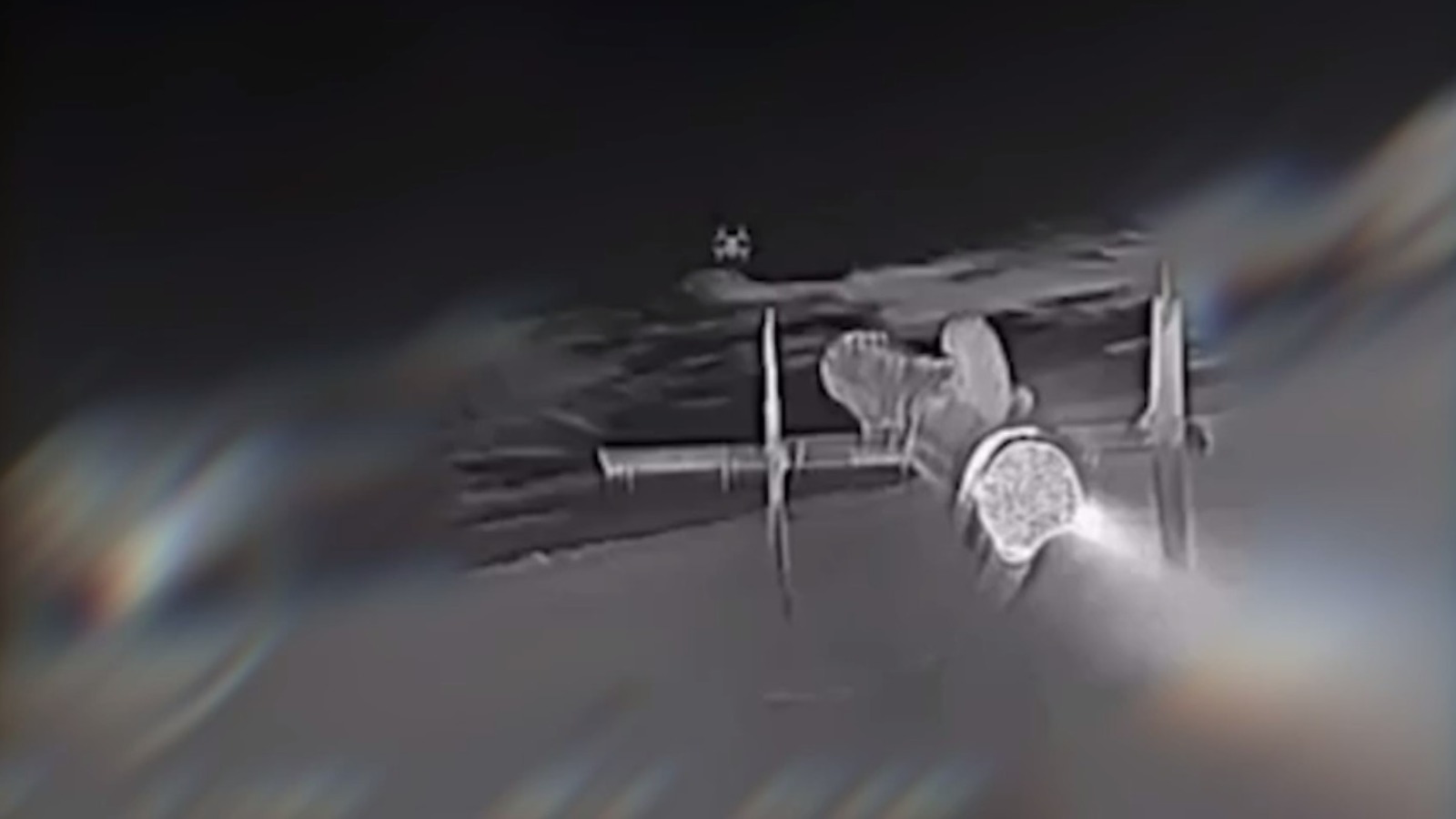
Russia appears to have revised the Geran-5 jet-powered drone-missile by relocating its turbojet propulsion system from an external nacelle to a compartment within the fuselage, according to Militarnyi’s analysis of footage recorded by Ukrainian interceptor drones. The footage was released by Ukraine’s Security Service and the Wild Hornets group.
The available imagery indicates a departure from the initial Geran-5 layout, in which the engine was carried in a nacelle above the airframe. Wild Hornets said in a post accompanying footage that personnel from the 1020th Anti-Aircraft Missile Regiment had downed a Geran-5 with a STING S interceptor drone. The group described the target as faster and carrying a larger explosive payload than other Geran variants, although the post did not provide supporting specifications.
Militarnyi assessed that the external installation likely simplified early development and integration of the propulsion unit, but created aerodynamic costs. The nacelle, its mounting structure and the junctions with the fuselage increase both frontal and wetted area. They can also produce localized airflow separation and vortices, adding drag.
Those effects become more consequential at the Geran-5’s reported cruise speed of 450–600 km/h, the outlet said, because aerodynamic drag rises approximately with the square of velocity. Housing the engine within the fuselage produces a smoother external profile and may reduce parasitic drag. According to Militarnyi, the resulting performance margin could be used to extend range, reduce fuel consumption or retain a higher cruise speed.
Aerodynamic and maintenance trade-offs
The former top-mounted configuration also placed the engine mass and thrust line above the vehicle’s longitudinal axis. Militarnyi said that geometry creates a pitching moment that must be continually offset by the flight-control system through control-surface deflection. Such corrections can add further drag.
The upper intake on the external-nacelle version was likely selected to shorten the intake duct while keeping the underside of the fuselage clear, the analysis said. Its position could also reduce the risk of dust and foreign-object ingestion during ground launch. The Geran-5 is reported to be launchable from ground-based equipment as well as airborne platforms, including Su-25 attack aircraft.
An internal engine could also provide a partial reduction in the weapon’s forward and lateral thermal signature. The fuselage skin can shield the heated engine casing and part of the hot-gas path, reducing their infrared contrast, Militarnyi assessed. The exhaust nozzle and plume would nevertheless remain the principal sources of infrared radiation.
The revised arrangement entails internal-design compromises. The engine, its mounting structure, thermal insulation and intake duct consume volume that might otherwise be available for additional fuel or payload. At the same time, Militarnyi assessed that the relocated arrangement may simplify ground testing, access to the propulsion system and engine replacement.
Reported Geran-5 configuration
The Geran-5 is approximately 6 metres long and has a wingspan of up to 5.5 metres, according to the report. It is said to use a Chinese-made TELEFLY TF-TJ2000A turbojet rated at 200 kgf of thrust. Militarnyi reported a maximum operating altitude of about 6 km, a 90 kg warhead and a stated strike range of roughly 1,000 km.
For guidance and targeting, the system reportedly incorporates a 12-channel Kometa satellite-navigation antenna described as resistant to jamming, together with a Raspberry Pi-based tracker and 3G/4G modems. The footage supports Militarnyi’s assessment that the propulsion layout has changed; the broader performance figures and equipment details remain reported characteristics rather than independently verified specifications.