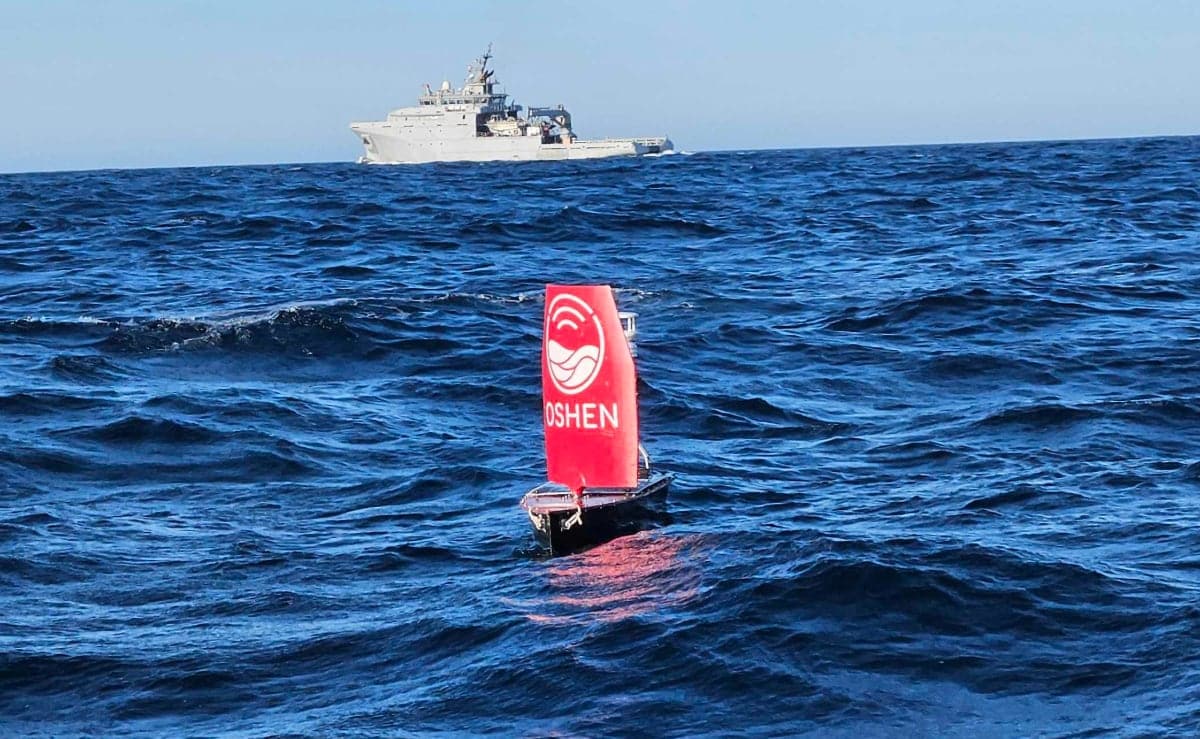
Plymouth-based maritime sensing company Oshen is demonstrating a distributed acoustic surveillance network at REPMUS26, using six autonomous C-Star robotic sailboats to form what the company describes as a world-first “acoustic picket line.” The month-long maritime robotics exercise is testing the network against live targets for the first time.
Small platforms, distributed sensing
Each C-Star is approximately 1.2 metres long and fitted with a hydrophone supplied by Systems Engineering and Assessment. Operating as a constellation, the boats can be distributed across a stretch of water and hold position to create an acoustic barrier. Oshen says the arrangement is intended to increase the chance of detection by placing numerous small sensors across a wider area rather than relying on a small number of concentrated sensing platforms.
The company contrasts the approach with conventional passive sonar monitoring, in which a surface vessel tows a platform carrying as many as 100 hydrophones. Such systems can provide strong local sensing and bearing-finding performance, Oshen says, but may be affected by noise from the towing vessel or nearby ships and cover a more limited area. A distributed C-Star network is designed to reduce dependence on any single platform and provide multiple perspectives on an acoustic contact.
According to Oshen, the network’s shape and sensor density can be adjusted in response to the threat picture. Multi-perspective observations may help determine a target’s location, rather than only its bearing, and could in turn support the employment of other assets, including towed arrays. The company has identified the Greenland-Iceland-UK gap as one example of a waterway where such an acoustic barrier could potentially be used.
Integration with a mixed naval force
REPMUS is also intended to examine command and control across a mixed fleet operating in a congested and kinetic environment. The participating systems range from 50-kilogram C-Stars to manned frigates displacing 3,000 tonnes, making coordination and interoperability central to the trial.
In preparation for the exercise, Oshen engineers worked with naval counterparts to integrate the company’s command software with NATO systems. The work included managing the volume of C-Star data so that communications channels would not be overwhelmed, while ensuring that information reached users at the appropriate time and in a suitable format. C-Star readings are being incorporated into a central database, with detailed forecasts shared among Alliance partners.
The integration effort also addressed the use of systems originally designed for large, powered vessels with the smaller sail-powered robots. Oshen says its C-Stars are designed for long endurance and difficult operating conditions. The company further states that the vessels are the only uncrewed surface vessels to have survived and transmitted data from inside a Category 5 hurricane, although no additional details of that event were provided in the announcement.
Further trials planned in the United States
Oshen characterises the network as resilient because the loss of individual boats would not necessarily disable the overall system. The company also says the vessels’ small size and low profile make them difficult to spot or attack, while the distributed arrangement makes it harder for an adversary to determine which units are active or identify the sensors they carry. These points are presented by Oshen as features of the concept rather than as independently assessed results from the REPMUS trial.
The REPMUS demonstration forms part of Oshen’s expanding work with naval defence organisations in the United Kingdom and overseas. The company says it has three active projects with the Royal Navy, including the UKDI DASA programme, and holds a Cooperative Research and Development Agreement with the US Navy covering single-beam sonar applications.
Eight C-Stars are scheduled to participate in the Maritime Big Play exercise in San Diego the following month. That event will provide a US-based test of the acoustic picket line concept, following the live-target demonstration at REPMUS26.