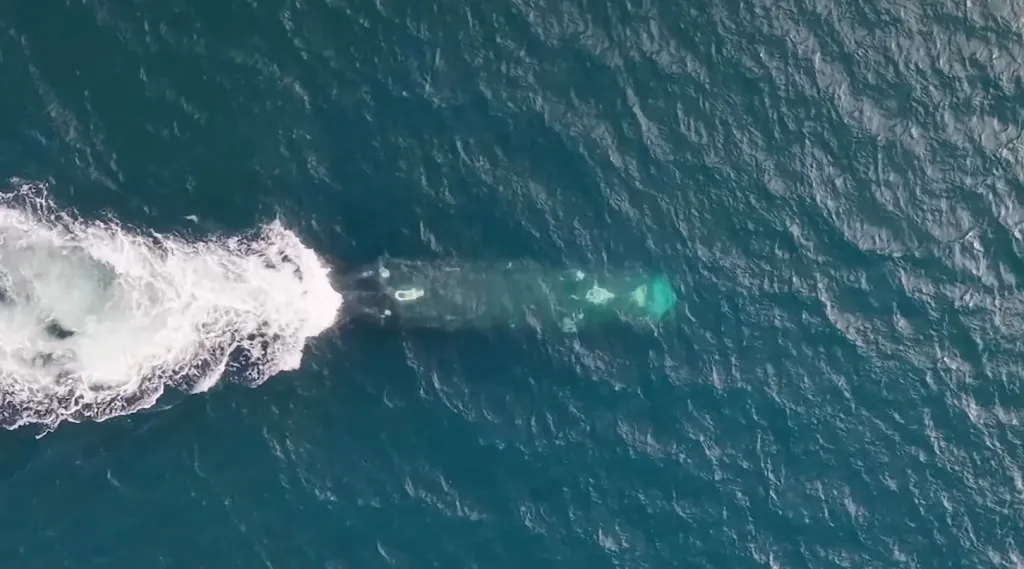
The U.S. Navy and Royal Navy have conducted a proof-of-concept launch of a U.S. Mk 48 heavyweight torpedo from a British extra-large unmanned underwater vehicle, completing a test the two services describe as a first for their countries. The September 13 trial used the Excalibur uncrewed underwater vehicle at the British Underwater Test & Evaluation Center in Scotland and was conducted under the technology-focused second pillar of the Australia-United Kingdom-United States, or AUKUS, defense partnership.
The exercise demonstrated the launch of a U.S. kinetic payload from an allied autonomous vessel. According to the U.S. Navy, the work validated mechanical, electrical and software integration between the weapon and the unmanned platform. The trial involved personnel from the Pentagon’s Defense Innovation Unit, the Naval Undersea Warfare Center Keyport Division and unspecified industry partners, in addition to U.S. and British naval personnel.
An external torpedo launch from Excalibur
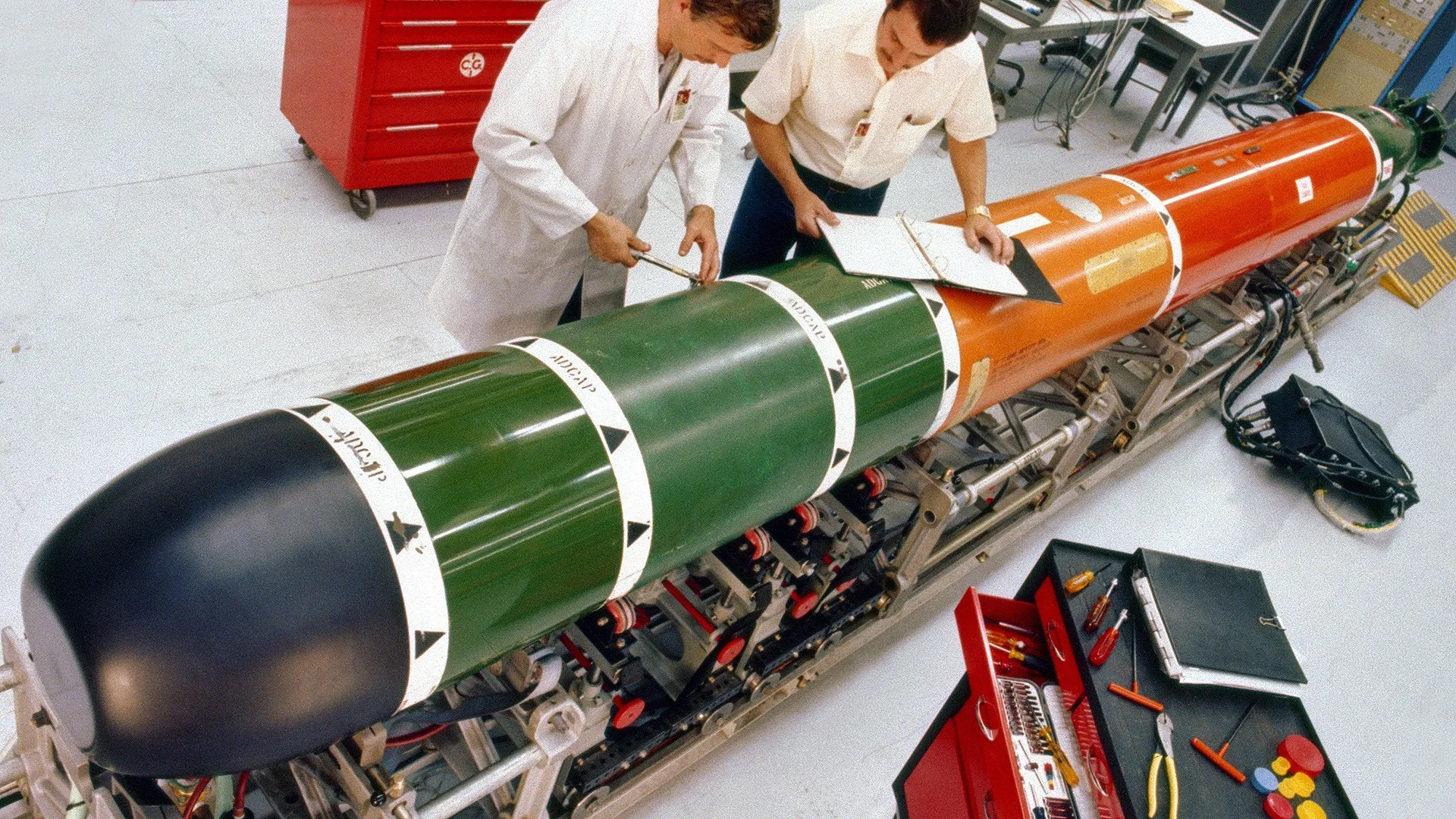
For the test, the Mk 48 was carried externally beneath Excalibur. The vehicle is nearly 40 feet, or 12 meters, long and has a mass of about 19 metric tons. It also has a large internal payload bay, but the bay is reportedly not large enough for the Mk 48, a 19-foot-long, 21-inch-diameter weapon that is the U.S. Navy’s standard heavyweight torpedo. The weapon has undergone successive upgrades intended to expand its capabilities and improve its resistance to countermeasures.
The Royal Navy formally unveiled Excalibur last year. The UUV was developed by the U.K.-based company MSubs under Project Cetus. The external torpedo-launch arrangement was produced through two additional efforts identified by the U.S. Navy as Project Broadsword and Trial Iron. The Navy’s account links those efforts specifically to the external carriage and launch capability demonstrated in Scotland.
The Navy said the trial was approved in February 2026 by the Department of the Navy Rapid Capabilities Office and completed in less than seven months. It characterized the work as a demonstration that allied forces can achieve weapon interchangeability rapidly, rather than as a fielded operational capability. The September 13 event therefore established an integration and firing milestone, but did not by itself establish that Excalibur has entered operational service as an armed attack system.
BROADSWORD is a great example of how AUKUS Pillar II drives interoperability in across the alliance. Demonstrating the launch of a US torpedo from a UK extra-large unmanned underwater vehicle (XLUUV) is an important early step in developing lethality in our undersea autonomous systems.
U.S. Navy Vice Adm. Robert Gaucher, director of submarine programs
Gaucher said the U.S. Navy intended to continue using the AUKUS partnership to examine the potential warfighting advantages of unmanned undersea systems. U.S. Navy Adm. Daryl Caudle, the chief of naval operations, separately described the trial as a validation of a shared goal of interchangeability between U.S. weapons and Royal Navy autonomous vehicles.
This successful test marks a historic first for allied undersea warfare. Proving that we can seamlessly launch a U.S. heavyweight torpedo from a Royal Navy autonomous underwater vehicle validates our shared vision for true interchangeability.
U.S. Navy Adm. Daryl Caudle, chief of naval operations
The Navy has not disclosed how Excalibur was controlled during the trial or whether the torpedo was fired at a test target. Those details leave open questions about the test’s command-and-control arrangements, the weapon’s precise launch sequence and the extent of the demonstrated engagement. The available information establishes the integration and launch event, but not an operational deployment of an armed UUV.
AUKUS and the move toward armed autonomous systems
The test falls under AUKUS Pillar 2, which covers cooperation on advanced technologies, with particular attention to uncrewed platforms and autonomy. The trilateral defense agreement was first announced in 2021. Its first pillar is focused on supporting Australia’s establishment of a nuclear-powered submarine force, while the second pillar addresses a broader group of emerging military capabilities.
The U.S. and British navies already operate several classes and tiers of unmanned underwater vehicles, but the source material identifies their principal current uses as mine sweeping, reconnaissance and surveillance. Adding a torpedo-launch capability changes the potential role of larger UUVs from sensing and route-clearance missions to direct attacks against vessels, although the Excalibur trial itself was only a proof of concept.
The British Minister of State for Defence Readiness and Industry, Luke Pollard, linked the test to the Royal Navy’s concept of a hybrid fleet in which crewed ships and submarines operate alongside uncrewed and autonomous vessels. In an interview with LBC radio, he said the demonstrated capability could extend torpedo employment beyond the Royal Navy’s Astute-class hunter-killer submarines to uncrewed systems.
This is a really important moment in our journey towards building a hybrid navy, which is where the Royal Navy will sail with crewed ships and submarines alongside uncrewed and autonomous vessels. It is a substantial increase in our lethality, to show that torpedoes can be fired not just by the Astute class hunter-killer submarines that we have in the Royal Navy, but also now by our uncrewed systems.
Luke Pollard, U.K. Minister of State for Defence Readiness and Industry
The source describes several possible operational applications for torpedo-carrying UUVs. When used alongside crewed surface ships and submarines, such vehicles could be sent into riskier areas ahead of those platforms and provide an immediate means of engaging threats they detect. A larger unmanned submarine such as Excalibur could also be harder to locate and track than a traditional attack submarine, according to the source’s assessment.
The combination of endurance, size and greater autonomy associated with larger UUVs could also support deployments that are more independent of crewed forces. The source presents one possible concept in which armed Excaliburs or similar vehicles are positioned around a maritime choke point, where they could monitor vessel movements and hold them at risk. That concept remains a future employment idea rather than a capability demonstrated by the September trial.
Regional surveillance and force capacity
The U.S. Navy’s release and Pollard’s comments also connect armed UUV development to the problem of maintaining undersea presence across large maritime areas. The source says unmanned platforms could expand total undersea warfare capacity more cost-effectively than acquiring and operating additional traditional submarines. A larger number of vehicles could provide more persistent coverage and create additional uncertainty and targeting problems for an opponent.
For the United Kingdom, Pollard specifically cited the North Atlantic and the Greenland-Iceland-United Kingdom gap, the route through which Russian Navy submarines travel between bases in the northwestern part of Russia and the Atlantic. He also referred to the English Channel and nearby Baltic Sea as relevant waters. The source says the Royal Navy has limited crewed-submarine capacity for monitoring these and other regional chokepoints, and that UUVs could reduce pressure on its Astute-class boats.
In securing the North Atlantic, especially against those nations that wish to do us harm, like Russia, the ability for us to now say it’s not just where our submarines are that you need to worry about – it is about how we create greater deterrence and question marks in the eyes of our adversary, with uncrewed systems there as well.
Luke Pollard in an interview with LBC radio
The U.S. Navy summarized the broader cost and force-generation argument by saying that converting commercial and allied uncrewed undersea hulls into high-end strike assets could change the cost-exchange ratio in contested maritime environments. The statement was presented as a program rationale, not as a reported measurement from the Excalibur trial. The same rationale would allow the navies to seek greater underwater presence without relying solely on additional crewed attack submarines.
Launch and recovery remain unresolved issues
The trial also highlights practical questions about how large armed UUVs will be transported, launched and recovered. Video released by the U.S. Navy shows the torpedo-equipped Excalibur being placed into the water in Scotland with a commercial truck-mounted crane. The source says that U.S. shipbuilders Huntington Ingalls Industries and General Dynamics National Steel and Shipbuilding Company, among others, have been working on options for launching and retrieving larger unmanned submersibles from surface warships.