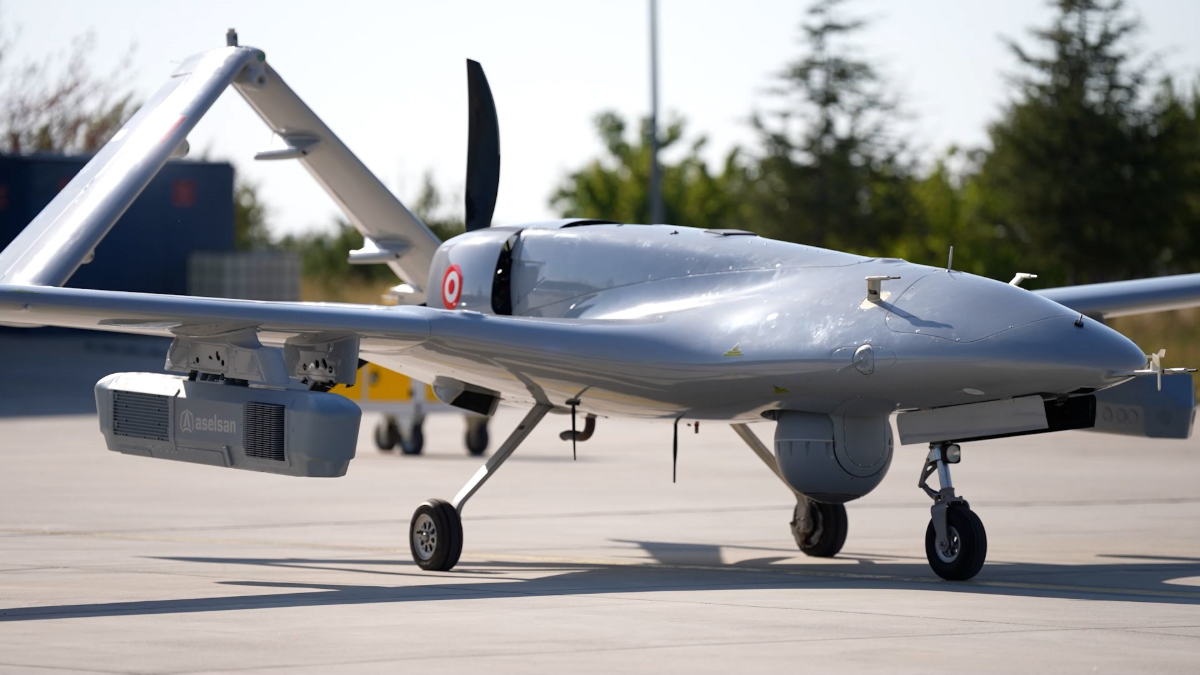
A cheap drone destroying an expensive tank has become one of the defining images of the war in Ukraine. It is also one of the most misleading ways to understand the economics of unmanned warfare.
The comparison is attractive because it is simple: a relatively inexpensive aircraft can damage or destroy a target worth orders of magnitude more. But militaries do not fight with price tags. They fight with fleets, ammunition stocks, trained personnel, sensors, electronic warfare, logistics, repair capacity and time.
The economic disruption created by drones is therefore larger than the familiar cheap-drone-versus-expensive-target equation. Unmanned systems are changing what counts as an acceptable loss, how precision is purchased, how quickly weapons must be replaced and how much a defender must spend simply to keep functioning.
The most important metric is no longer unit price. It is cost per useful effect — and the ability to generate those effects repeatedly at scale.
The price-tag comparison is real — but incomplete
At tactical level, the asymmetry is obvious. FPV drones can attack vehicles, artillery, antennas, logistics assets and individual positions at a price far below that of many of the targets they threaten.
That creates a powerful intuitive argument: if a low-cost munition can disable a high-value system, then the cheaper side has won the economic exchange.
Sometimes that is true. But the calculation becomes less obvious once the full kill chain is included.
A drone requires an operator, batteries, communications, transport, maintenance, a warhead, intelligence on the target and often several attempts. Electronic warfare can disrupt the mission. Weather can ground aircraft. Defences can intercept them. Some attacks damage rather than destroy. Others fail completely.
This is why the useful economic unit is not the cost of a single drone. It is the cost of producing a verified effect.
| Metric | What it measures | Why it matters |
|---|---|---|
| Unit price | Cost of one airframe or munition | Useful for procurement, but says little about whether the weapon succeeds. |
| Cost per useful effect | Total expenditure required to generate a verified reconnaissance, strike or defensive result | Captures failure rates, repeat attempts, support and mission reliability. |
| Cost imposed on the opponent | Resources the enemy must spend to detect, defend, repair and remain ready | Explains why a cheap threat can still be valuable even when intercepted. |
CSIS made the same distinction in its analysis of Russian Shahed-type one-way attack drones. It found that a very high proportion of the drones were intercepted or failed to reach their targets, yet the system could still be economically attractive because the relevant question was how much Russia spent for each target struck compared with alternative missiles.
Cheap precision changes what can be attacked
Traditional precision weapons are scarce because precision has historically been expensive.
A commander does not normally use a sophisticated missile against every truck, antenna or individual fighting position. The cost of the munition, the limited magazine and the value of keeping it for higher-priority targets all impose a threshold.
Mass-produced drones lower that threshold.
When a precision-capable weapon becomes cheap enough to be treated as expendable, targets that once would not justify a guided munition become economically viable. That expands the number of objects exposed to precision attack and allows lower tactical echelons to generate effects that previously depended on more expensive systems.
Ukraine’s Ministry of Defence reported more than 800,000 verified drone strikes against Russian targets in the first part of 2026. Whatever the exact combat-effectiveness ratio behind those engagements, the number illustrates the scale at which precision-capable unmanned systems are now being consumed and employed.
Precision has a support bill
The apparent cheapness of an FPV is partly a function of where the accounting boundary is drawn. The airframe may be inexpensive, but the military capability is not just the airframe.
Behind a single successful strike sits a support stack: trained operators, instructors, repair technicians, batteries and charging equipment, antennas, relay or communications infrastructure, transport, munitions integration, reconnaissance, target confirmation, software, replacement parts and the time required to move all of those elements to a unit that can use them.
Some of those costs are shared across hundreds of missions, which is precisely why mass matters. A trained crew and a functioning command network become cheaper per engagement as they support more sorties. Other costs rise directly with volume. Batteries age. Motors fail. airframes are consumed. Warheads and components have to be replenished. Large-scale drone warfare is therefore simultaneously cheap at the edge and expensive in aggregate.
This helps explain why comparing a $500 or $1,000 airframe with a multi-million-dollar vehicle can be directionally useful but analytically weak. The comparison highlights asymmetry, but it hides the denominator that matters to a military planner: how many aircraft, crews and attempts were required to produce the result, and what resources were consumed by the wider system.
The same problem appears on the defender’s side. An interceptor missile has a visible unit price, but a defensive failure can carry costs that are much larger than the price of the protected object: interrupted power generation, runway closure, damage to logistics, civilian casualties, production downtime or the need to disperse scarce assets. Cost exchange cannot be reduced to two numbers printed next to two weapons.
This is why mature drone economics has to move from platform accounting to system accounting. The platform remains important. But the real unit of comparison is the cost of creating or denying an effect over time.
The attacker can impose costs without hitting anything
The economics become even more disruptive in air defence.
A one-way attack drone does not need to destroy a target to impose a cost. It can force radars to track it, air-defence crews to respond, aircraft to launch, electronic-warfare systems to activate and interceptors to be expended. A cheap threat can therefore consume expensive defensive attention even when it is ultimately destroyed.
This is the logic behind Russia’s large-scale use of Shahed-type drones. CSIS describes the system as attractive not because each aircraft reliably penetrates Ukrainian air defences, but because low cost allows repeated mass salvos that probe, saturate and exhaust the defence.
That creates a fundamental asymmetry. The attacker chooses when and where to launch. The defender must protect a much larger set of possible targets and maintain readiness continuously.
If the defender repeatedly uses a high-end surface-to-air missile against a much cheaper drone, the interception may be tactically successful while the exchange remains economically dangerous.
The counter-drone economy is now trying to reverse the exchange
The response has been to build a cheaper defensive layer.
Ukraine has rapidly expanded the use of interceptor drones against Russian reconnaissance and one-way attack UAVs. The Ministry of Defence reported that by December 2025 deliveries of anti-Shahed interceptors had reached an average of nearly 950 per day.
The UK-Ukrainian Octopus programme makes the economic logic unusually explicit. The UK Ministry of Defence says each Octopus interceptor costs less than 10 percent of the drone it is designed to destroy and is intended for mass production in the thousands per month.
The important point is not the specific percentage. It is the restoration of a sustainable defensive exchange.
High-end missiles still matter for high-end threats. But if inexpensive drones are used against inexpensive drones, expensive interceptors can be preserved for cruise missiles, ballistic missiles and aircraft — targets for which their performance is actually required.
This is the logic of layered defence expressed in economic terms: match the cheapest adequate effector to each threat.
| Threat class | Defensive logic | Economic objective |
|---|---|---|
| Small reconnaissance or FPV drone | Use low-cost electronic, gun, interceptor-drone or point-defence options when adequate | Avoid spending scarce high-end interceptors on low-end threats. |
| One-way attack drone | Combine detection, EW, mobile fire teams and lower-cost interceptors | Keep the defensive cost closer to the attacker's cost while preserving coverage. |
| Cruise / ballistic missile or high-end aircraft | Use the high-performance interceptor required by the threat | Reserve expensive capability for targets that cheaper layers cannot reliably defeat. |
Magazine depth can matter more than individual efficiency
A defender can win every individual engagement and still lose the economic campaign if it cannot replace what it fires.
This is one of the central lessons of the Shahed problem. Russia can tolerate large numbers of losses because the system is designed around volume. CSIS has documented the way Russia increased Shahed-type launches from a pressure tool into a sustained campaign built around repetition and exhaustion. By early 2026, Russia was launching thousands per month.
The military value of that volume is not limited to the number of targets ultimately hit. Every attack tests detection, exposes patterns in air-defence coverage, creates alerts across a wide area and forces Ukraine to make decisions about which threats deserve which interceptors. A salvo can therefore generate information and defensive expenditure even when most of its aircraft are destroyed.
Magazine depth changes the meaning of efficiency. A weapon that is only moderately effective but available by the tens of thousands may exert more pressure than a technically superior weapon available by the hundreds. This does not mean quality is irrelevant. It means quantity determines how often quality can be brought to bear.
For air defence, the implication is uncomfortable: the economics of the next engagement are partly determined by what remains after the previous hundred engagements. Stockpiles, replenishment rates and production lines become operational variables rather than background logistics.
Scale is becoming a weapon
Cheap systems only transform warfare if they can be produced in large numbers.
Ukraine’s procurement data shows how far this shift has gone. In the first half of 2026, the Defence Procurement Agency signed drone contracts worth UAH 333.6 billion — twice the amount contracted in the same period a year earlier. FPV drones represented the largest share.
The ministry also reported that 95 percent of UAVs procured for the Defence Forces were Ukrainian-made and that procurement of unmanned systems had exceeded ammunition procurement in the previous year.
That is not merely a story about drones becoming important. It is a story about a new class of military expenditure moving from experimental budgets into the centre of wartime consumption.
Traditional defence procurement is optimised around expensive platforms purchased in limited quantities and operated for years or decades. The drone economy increasingly looks more like an ammunition economy: high throughput, high attrition, continuous replenishment and rapid model turnover.
Industrial throughput matters more than theoretical performance
Once weapons are consumed in very large numbers, the strategic question changes from 'which platform is best?' to 'which capability can still be produced, delivered and replaced after months of fighting?'
A weapon that is individually superior but difficult to manufacture may generate less military value over time than a less capable system that can be produced in large volume.
This is one reason Ukraine’s drone ecosystem is notable. DOT-Chain Defence has turned part of procurement into a marketplace in which frontline units can select systems directly from domestic manufacturers. By November 2025, more than 100,000 FPV drones had been delivered through the system in less than four months, with more than 180 FPV models from 40 manufacturers available and average delivery measured in days rather than months.
By mid-2026 the catalogue and delivery volume had expanded further, and the Ministry of Defence had begun using battlefield data from systems including DELTA, ePoints, Brave1 Market and Mission Control to determine which drones should be purchased.
This is economically significant because the procurement process itself becomes part of combat adaptation. Demand can shift toward systems that are performing well before a conventional multi-year acquisition cycle would even finish defining requirements.
The hidden cost stack: components, people and time
High-volume drone warfare shifts attention from finished platforms to the industrial stack beneath them.
RUSI has argued that Ukraine’s remarkable expansion in drone production still contains a strategic weakness: many critical components remain dependent on foreign suppliers, especially commercial electronics and subsystems sourced from China. A country may assemble millions of drones domestically while still depending on external motors, cameras, radios, chips, batteries or machine tools.
That dependence changes the economics in two ways. First, supply disruption can turn a cheap component into a bottleneck. Second, the value created by a domestic drone industry is not the same as sovereignty over the technologies inside the drone. Production capacity is therefore not just the number of finished airframes a factory can assemble; it is the resilience of the bill of materials behind them.
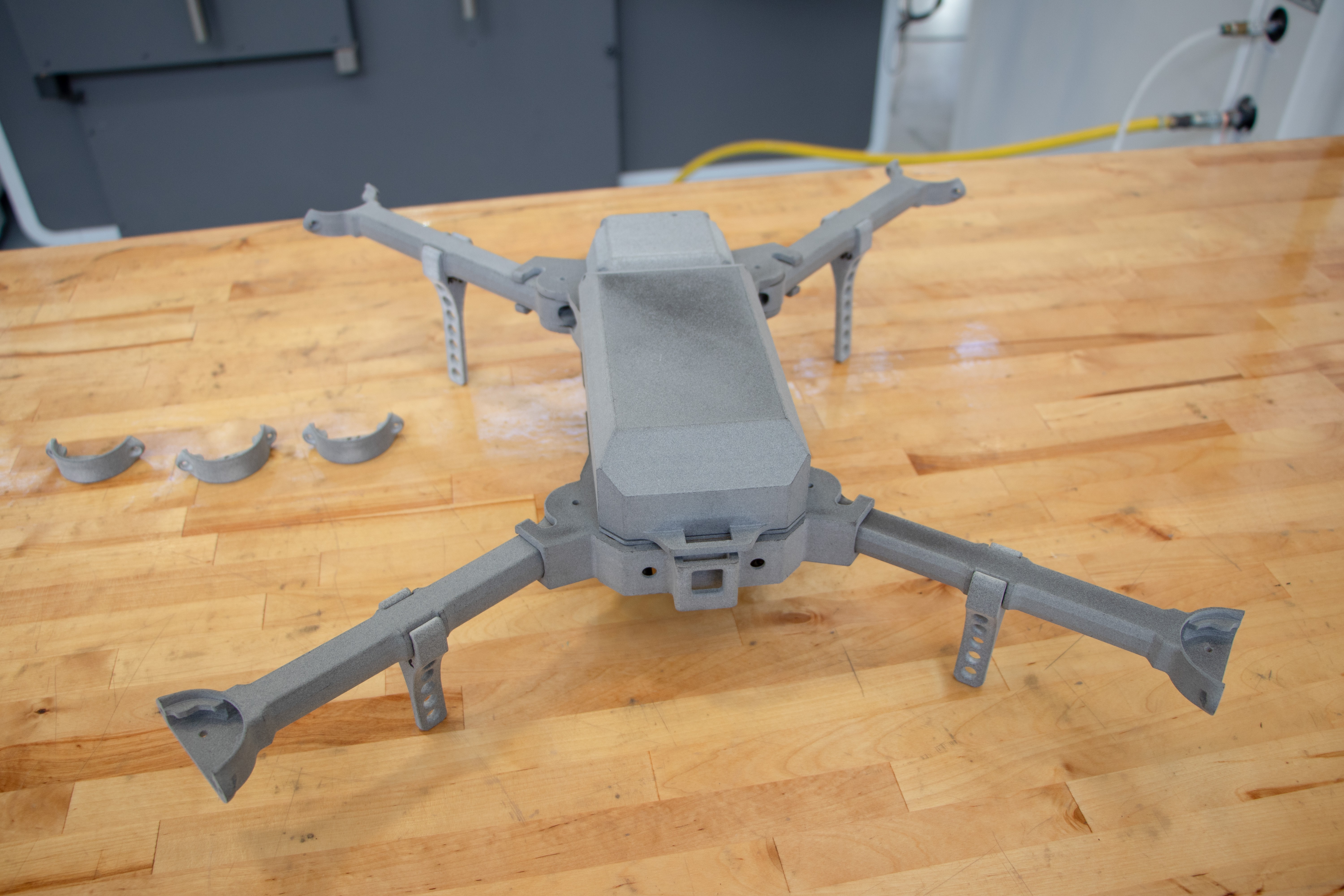
The U.S. Army’s work at Rock Island Arsenal illustrates another response to this problem: advanced and additive manufacturing aimed at reducing part counts and shortening the path from prototype to production. The Army describes the objective in terms of adaptability, cost-effectiveness and the ability to surge output when requirements change.
The attraction is not that 3D printing will replace every conventional production line. It is that some unmanned systems are structurally well suited to manufacturing methods that reduce tooling, enable rapid redesign and make smaller production batches economically viable.
That matters in a war where the successful configuration may change before a traditional production contract reaches maturity. A factory that can switch designs rapidly can have more military value than one optimised to produce a single design at the lowest possible unit price.
Time therefore has an economic value. A drone delivered in nine days rather than nine months may be worth more even if it costs more per unit, because the battlefield problem it solves may not exist in the same form a year later.
Obsolescence is now part of the cost
A conventional military platform may be expected to remain relevant for decades. A tactical drone may face a new electronic-warfare technique, interceptor or detection method within weeks.
That means the economic value of a drone is tied to its ability to evolve.
A cheap system that cannot be modified quickly can become expensive if thousands are purchased just before a countermeasure makes them ineffective. Conversely, a more costly system may offer better value if its software, communications or payload can be adapted without replacing the entire platform.
The UK’s Octopus programme describes a design updated on a roughly six-week cycle using battlefield data. Ukraine’s procurement system is likewise increasingly built around feedback from combat use.
The result is a new cost category that traditional procurement struggles to capture: the price of technological ageing.
The price of adaptation
Fast obsolescence creates an unusual depreciation curve.
Traditional weapons are normally expected to improve through scheduled upgrades over long service lives. Tactical drones often evolve through continuous substitution: a new radio, a different frequency, a new camera, a different flight controller, a fibre-optic link, a software update, a new interceptor profile.
In this environment, buying the lowest-cost configuration in very large quantities can be a mistake. If the configuration becomes vulnerable to a new jammer or interceptor before it is used, the apparent procurement saving turns into dead inventory.
The economically optimal system may therefore be the one that is cheap enough to lose but modular enough to change. That is a different requirement from both the traditional exquisite-platform model and the simplistic disposable-drone model.
Ukraine’s decision to allow frontline units greater flexibility to purchase drone components using general-fund resources reflects this logic. The Ministry of Defence explicitly tied the change to the need to upgrade and tailor systems as operating conditions evolve.
The UK-Ukrainian Octopus programme provides another example. British officials say the interceptor design is updated on roughly a six-week cycle using battlefield data. The industrial process is therefore designed around revision as a normal cost of production, not an exception.
This may become one of the defining economic distinctions between unmanned systems and traditional munitions: value is increasingly determined by how cheaply a weapon can be changed, not only by how cheaply it can be manufactured.
Cheap drones do not make expensive weapons obsolete
The strongest version of the drone-economics argument says that inexpensive unmanned systems will replace much of the traditional arsenal because the cost exchange is simply too favourable to ignore.
The evidence from Ukraine does not support that conclusion.
RUSI has warned specifically against treating massed drones as a substitute for conventional firepower. FPVs can inflict large amounts of attrition, but their payloads are limited, their effectiveness varies with weather and electronic warfare, and they often require multiple attempts. Artillery, missiles, mines, armoured vehicles and air defence still create effects that small drones cannot reliably reproduce.
The more accurate conclusion is that drones are changing the portfolio.
Militaries increasingly need a high-low mix: expensive systems for tasks that genuinely require their range, payload, survivability or speed, and large numbers of cheaper systems for the enormous volume of missions where exquisite performance is unnecessary.
The economic advantage comes from using the expensive weapon only when the expensive weapon is actually needed.
Procurement is becoming part of the sensing system
Ukraine’s experiments with digital procurement are important because they connect battlefield consumption to industrial demand.
DOT-Chain Defence lets units select equipment from a marketplace rather than waiting for every purchasing decision to be centrally specified. In its first months, the system moved from pilot scale to more than 100,000 FPV deliveries, dozens of manufacturers and hundreds of available products. By 2026, the Ministry of Defence reported hundreds of thousands of UAVs and other items delivered through the platform.
The deeper innovation is the feedback loop. The ministry says procurement decisions are increasingly informed by digital battlefield systems including DELTA, ePoints, Brave1 Market and Mission Control. In principle, that allows demand to follow observed performance rather than brand reputation alone.
If that model works as intended, procurement becomes a form of sensing: the state observes which systems units choose, how rapidly they are consumed, which products generate results and where demand is moving. Manufacturers receive clearer demand signals, while poorly performing systems can lose orders more quickly.
There are obvious limits. Combat data can be incomplete, incentives can distort reporting, and a marketplace does not automatically solve quality control or corruption. Some capabilities also require central planning because their value only appears at theatre level rather than unit level.
But the economic principle is significant: procurement speed itself can become combat power. A military that can redirect spending toward a successful adaptation in weeks has an advantage over one that needs years to rewrite requirements.
For unmanned systems, the acquisition process is no longer separate from the adaptation cycle. It is one of the mechanisms that determines whether adaptation reaches scale.
The economics of defence are becoming an industrial contest
NATO’s response shows that this is no longer a uniquely Ukrainian procurement problem.
At the 2026 Ankara Summit, Allies announced more than $40 billion in counter-drone investment over five years and plans for a NATO counter-drone marketplace intended to accelerate procurement. The UK has separately launched low-cost air-defence programmes explicitly designed around the problem of large quantities of inexpensive drones overwhelming slower and more expensive traditional defences.
This points to a broader shift in military economics.
The decisive question is not simply whether a weapon is cheap. It is whether the entire system around it — manufacturing, training, sensing, command, logistics and replenishment — can operate at the same scale as the threat.
An army with cheap drones but too few trained operators does not have mass. A country with inexpensive interceptors but no production capacity does not have sustainable air defence. A military that buys millions of drones but cannot update them as electronic warfare changes has purchased rapidly depreciating inventory.
What a sustainable drone economy actually requires
Mass production is often discussed as though it were simply a factory problem. In practice, a sustainable drone economy is a network problem.
A manufacturer can have enough assembly benches and still be unable to increase output because cameras are delayed, batteries are unavailable, flight controllers are caught in export restrictions or the military cannot test and accept new configurations quickly enough. A state can fund millions of drones and still struggle to turn that money into combat power if units lack trained operators, repair capacity or secure communications.
This creates a series of bottlenecks that behave differently from the bottlenecks associated with traditional platforms. Some can be solved by buying more commercial components. Others require sovereign production, software integration, regulatory change or a larger training pipeline.
- Component availability: motors, batteries, optics, radios, processors and specialist materials have to arrive in the same production rhythm as airframes.
- Working capital and demand visibility: manufacturers need enough confidence in future orders to expand lines without creating unsold inventory.
- Testing and acceptance: rapid design changes are only useful if updated systems can be evaluated and fielded quickly.
- Operators and maintainers: hardware volume has little value if units cannot employ, repair and replace it at comparable scale.
- Data and software: battlefield results need to return to designers and procurement authorities fast enough to affect the next production batch.
- Distribution and repair: the last kilometres from factory to frontline, and from damaged system back to repair, are part of the industrial system.
The interaction between these bottlenecks explains why industrial capacity cannot be measured only in nominal annual output. A factory rated for one million airframes has not created one million usable combat systems if a single imported subsystem is unavailable or if half the output reaches units after the relevant electronic-warfare environment has changed.
It also explains why demand visibility matters. Ukraine’s marketplace approach gives manufacturers a clearer signal about what units are actually ordering, while pre-order mechanisms can show where future demand is forming. In commercial industry this would be ordinary supply-chain information. In wartime procurement it can materially affect whether a company invests in additional capacity.
The economic contest is therefore partly about synchronisation. The winning industrial system is not necessarily the one with the biggest factory or the cheapest bill of materials. It is the one that can keep components, capital, testing, software, training and delivery moving at roughly the same speed.
This is a demanding standard because the target is moving. As countermeasures change, the production system has to absorb engineering revisions without collapsing throughput. As demand changes, contracts have to shift without destroying the supplier base. As new mission types emerge, training and logistics have to follow.
For that reason, the most important industrial advantage may be neither low labour cost nor a single breakthrough design. It may be the ability to repeatedly convert battlefield information into a manufacturable revision and then distribute that revision at scale before the opponent adapts again.
That capability is expensive to build, but once established it changes the meaning of 'cheap drone'. The low-cost airframe becomes the visible end product of a much more sophisticated economic system.
The model is spreading beyond Ukraine
The industrial response outside Ukraine suggests that other militaries are beginning to internalise the same economics, even if their force structures and threat environments are different.
NATO’s 2026 Drone Edge initiative pairs more than $40 billion in planned counter-drone investment with a marketplace intended to speed acquisition and a major expansion in operator training. The combination is revealing: equipment, procurement and people are being treated as one capacity problem rather than separate programmes.
The UK’s Octopus production plan follows a similar pattern. The attraction is not simply that the interceptor is inexpensive. It is designed to be manufactured by the thousands per month, updated quickly and used against a threat whose economics would otherwise push defenders toward more expensive missiles.
Ukraine is also exporting production models rather than only finished products. Joint ventures and co-production projects with European partners move Ukrainian designs into allied factories, increasing capacity while giving partners direct exposure to battlefield-driven development cycles.
This does not mean every NATO military should reproduce Ukraine’s wartime marketplace or force structure. Peacetime regulation, export controls, industrial concentration and different operational requirements will produce different systems.
But the direction is clear: the defence industrial base is being asked to produce larger quantities of cheaper systems, shorten upgrade cycles and make procurement responsive to real operational data. Those are economic changes before they are technological ones.
Where the numbers can mislead
Drone warfare generates an enormous amount of numerical rhetoric: price ratios, strike counts, production targets, interception rates and claims about the percentage of battlefield losses caused by unmanned systems.
Many of these figures are useful, but they should be handled carefully. Wartime statistics are often reported by belligerents, definitions vary, and the same word — 'strike', 'hit', 'destroyed' or 'intercepted' — may refer to different levels of effect.
Unit-cost estimates can be equally unstable. A prototype purchased in small batches, a system produced at wartime scale and an export version of the same weapon may have very different prices. Public estimates often mix manufacturing cost, contract price and complete system cost.
This article therefore treats exact prices as evidence only when they come from an identifiable source and uses them to illustrate economic mechanisms rather than to claim universal exchange ratios.
The important findings survive that uncertainty. Low-cost precision has expanded the target set. Mass creates pressure even when individual systems fail. Defenders need cheaper layers. Industrial throughput and adaptation speed increasingly affect combat power. Those conclusions do not depend on pretending every drone has a single stable price.
The real cost exchange
The most useful way to think about drone economics is therefore not 'cheap weapon versus expensive target.'
The real competition is between two systems of expenditure.
One side is trying to generate reconnaissance, strike or defensive effects as cheaply and repeatedly as possible. The other is trying to deny those effects without spending itself into an unsustainable position.
That competition rewards four things: low cost per useful effect, deep magazines, fast production and rapid adaptation.
Drones matter because they have pushed all four variables closer to the centre of warfare.
The famous image of a cheap FPV destroying an expensive vehicle is therefore real, but it is only the surface of the transformation.
The deeper change is that military power is increasingly being measured not only by the sophistication of individual weapons, but by how many useful effects a force can generate, how quickly it can replace what it loses, and whether it can force the opponent to spend more to stop it than it spends to attack.
That is the new economics of unmanned warfare.