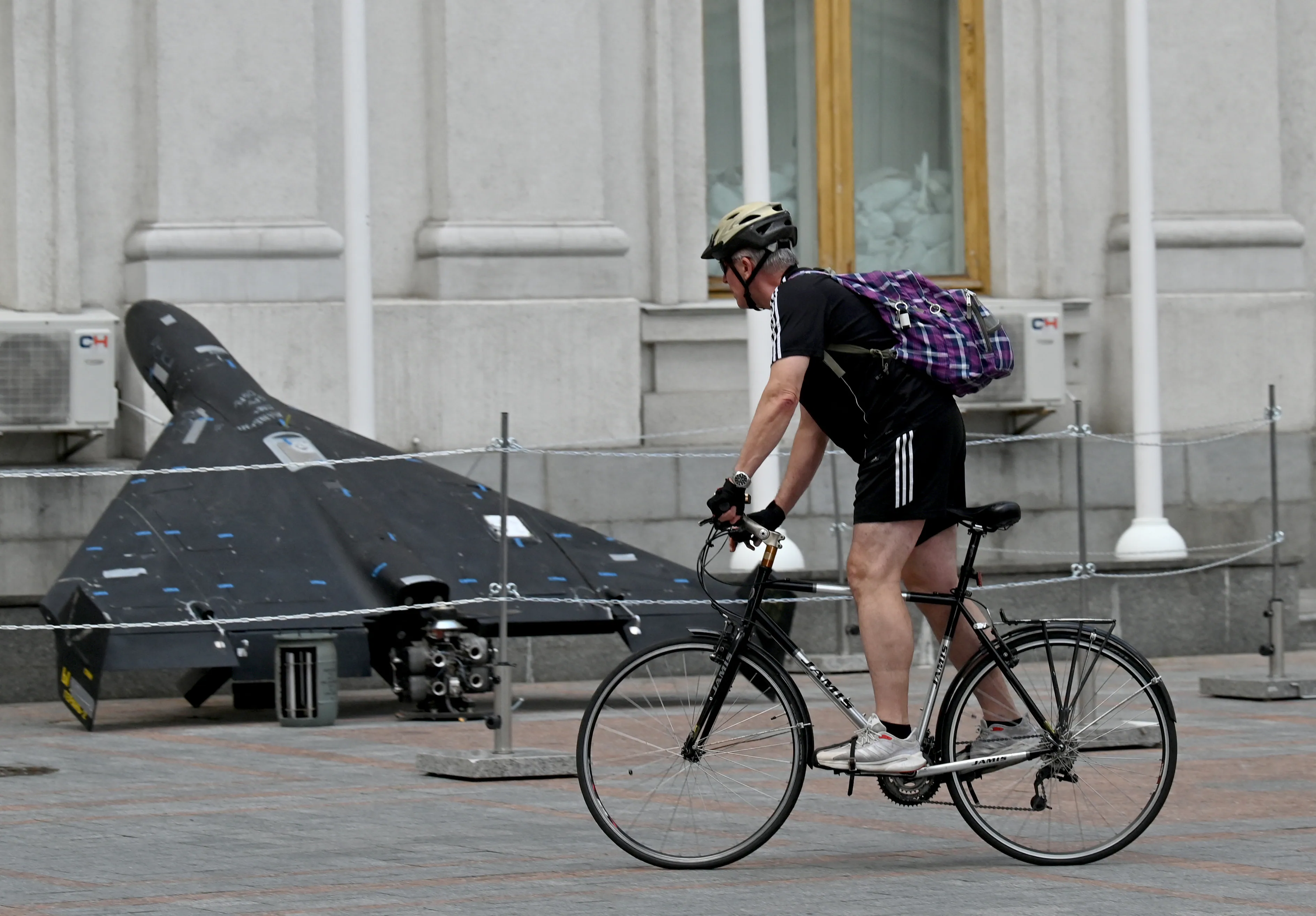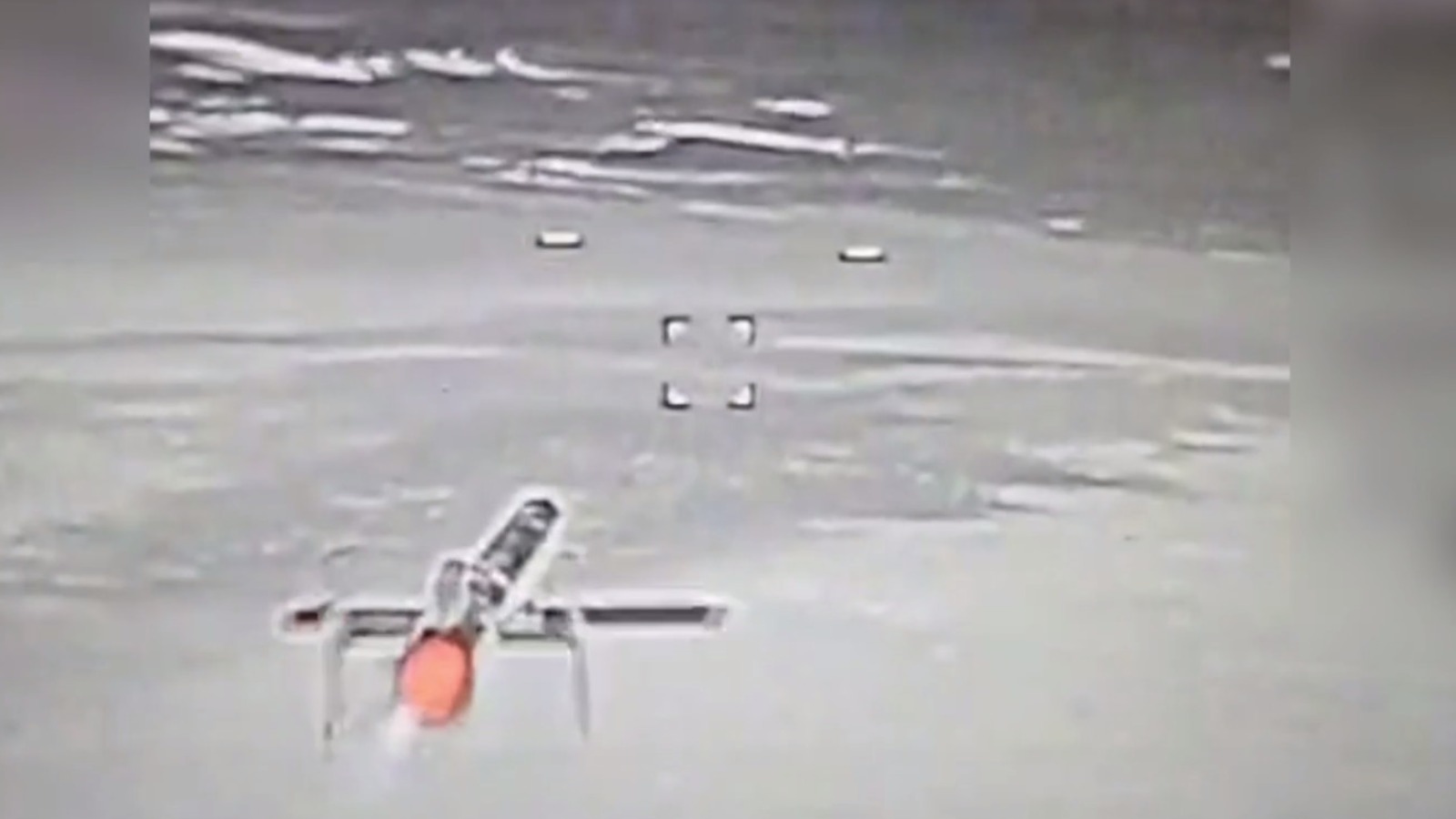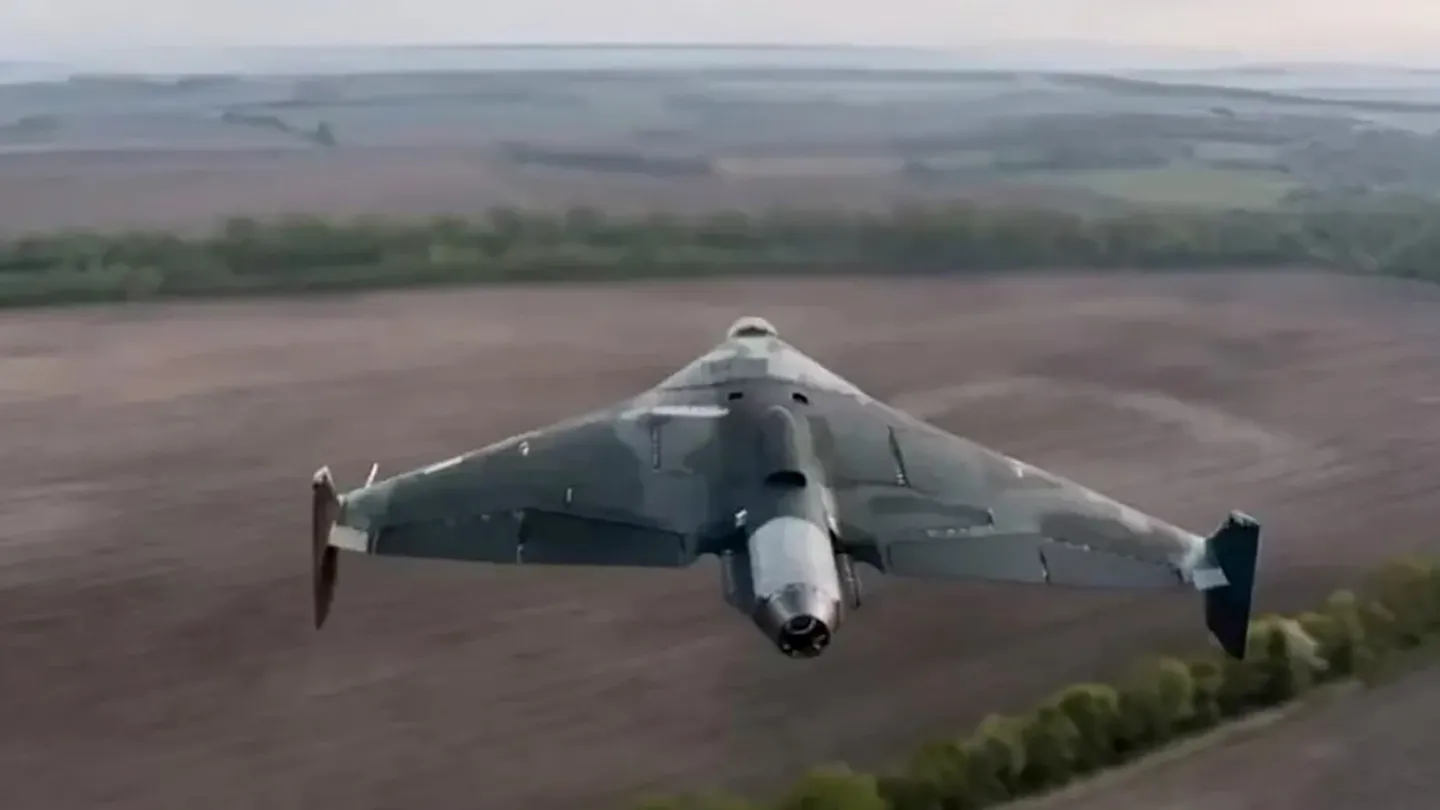
Russia has intensified the use of jet-powered one-way attack drones against Ukraine, introducing a faster and higher-flying threat that Ukrainian officials and independent reporting say is placing greater pressure on the country’s air-defense network. The Geran-4, identified by Ukraine’s Defense Intelligence Directorate, or GUR, is described as a substantially revised successor to earlier Shahed-derived drones, combining a purpose-built airframe with turbojet propulsion and, in at least some examples, cameras and communications equipment that may support operator involvement during a mission.
The new aircraft follows Russia’s earlier jet-powered Geran-3, which appeared over Ukraine in early 2024. Both systems trace their lineage to Iran’s Shahed-238, itself an adaptation of the propeller-driven Shahed-136. Russia calls its Shahed-136 copies Geran-2s. While the piston-powered designs have been used for years, the jet-powered variants present a different interception problem because of their reported speed and operating altitude.
The War Zone reported that Russia’s employment of the jet-powered weapons increased over the summer, after the Geran-3 had become a more significant problem for Ukraine by the middle of 2025. The subsequent Geran-4 is reported to have added further demand on Ukrainian air-defense resources while strikes by the systems have caused damage across the country. These assessments concern an active conflict and are drawn from Ukrainian intelligence, official reporting and the outlet’s reporting.
According to GUR, the Geran-4 first appeared in May. The agency says the drone was designed specifically for higher-speed flight rather than relying on the largely modified Shahed-136 airframe used for the Geran-3. Ukrainian intelligence assessed that the structure of the earlier design was not sufficiently strong for sustained high-speed operations or maneuvering under high g-loads.
In an overnight attack reported to have continued into Monday, Ukraine’s Air Force said Russia launched 165 drones, of which 79 were jet-powered. The service reported that air defenses shot down or suppressed 112 drones and that impacts were recorded at 14 locations. A social-media video circulating after the attack was said to show the aftermath of a jet-powered Shahed strike on a residential building in Odesa; the claim and footage could not be independently verified from the supplied reporting.
A redesigned airframe and turbojet propulsion
GUR has described the Geran-4 as having a blended air intake, a strengthened structure, improved aerodynamic efficiency and a higher-thrust turbojet engine. The agency said the wings are permanently integrated into the center section, rather than fitted in a manner that creates additional discontinuities, and that the number of fuselage access panels has been reduced to lower aerodynamic drag. Together, those reported changes distinguish the Geran-4 from the Geran-3’s more directly adapted Shahed-136-based configuration.
A teardown by Radio Free Europe/Radio Liberty, or RFE/RL, of a surviving Geran-4 provided additional detail on the claimed design changes. The outlet identified the turbojet as one of the system’s principal upgrades and said it enables the drone to operate at altitudes of up to eight kilometers. RFE/RL characterized that as twice the altitude of older propeller-powered attack drones. It also cited specialists who said drones using this type of engine had flown from Russian-occupied Crimea to Lutsk in northwestern Ukraine, a route exceeding 700 kilometers.
RFE/RL reported speeds of roughly 450 to 500 kilometers per hour over Ukraine, with the possibility of higher speeds in some circumstances. Those reported performance figures, combined with higher flight profiles, help explain why Ukrainian defenses have found the jet-powered drones more difficult to engage than the earlier propeller-driven Shahed-derived weapons. The source material does not provide an independently confirmed range, payload or endurance specification for the Geran-4.
The turbojet examined by RFE/RL was made in China, according to the outlet. It added that investigations had identified cases in which such engines were assembled in Russia from Chinese components. The reporting did not establish whether every Geran-4 engine follows the same production route or component supply chain, nor did it identify the specific engine model in the recovered aircraft.
The difference in speed is operationally important because Ukraine’s earlier interceptor drones had reportedly been used successfully against piston-powered Shahed-type systems but were largely unable to keep pace with the jet-powered variants. The source reporting describes the newer aircraft as reducing the time available for an interceptor to detect, approach and engage its target. That restricted engagement window is one reason Ukrainian developers are pursuing higher-performance interceptor drones specifically intended for the jet-powered Geran threat.
Camera, cellular links and mesh-network equipment
The Geran-4 inspected by RFE/RL also carried a camera with daylight, night-vision and infrared modes. The outlet reported that the camera has 10-times optical zoom and up to 32-times digital zoom, which it said could allow an operator to observe terrain from an altitude of eight kilometers. The presence of such equipment indicates that at least some drones are fitted with sensors beyond those required for a purely pre-programmed strike profile.
RFE/RL said that, if a relay station is available and connected to a network, an operator based at an automated workstation in locations such as Bryansk, Oryol or Crimea could control the aircraft and steer it toward a target. The outlet further reported that ordinary cellular SIM cards may help maintain connectivity after a drone enters Ukraine. Two GSM modems were found in the Geran-4 it examined, and RFE/RL said such devices could transmit the drone’s position through mobile networks, enabling real-time tracking by an operator.
Investigators who examined drone remains told RFE/RL they had encountered SIM cards from Ukraine, Russia, Belarus and European Union countries, as well as a growing number of foreign-made components deeper within the systems. The reporting does not state that every Geran-4 has a camera, cellular modems or comparable communications architecture. Indeed, the source notes that most Shahed-type drones do not carry cameras or modems and instead follow a set of preloaded coordinates before diving onto a target.
The examined drone also contained a Chinese mesh modem, which RFE/RL said supports radio and video communications. According to the outlet, the equipment can provide a near-real-time video feed to the operator, has a range of up to 300 kilometers and can serve as a signal relay. If multiple drones are operating in proximity, the devices could relay and reinforce signals between aircraft, potentially extending control over greater distances. These are capabilities reported for the recovered system; their availability and reliability across the wider Geran-4 fleet were not independently established.
The development is part of a broader Russian effort to add man-in-the-loop, or MITL, control options to Shahed/Geran-family systems, according to the source reporting. Standard Shahed-type weapons generally fly autonomously along preplanned routes and are intended to strike preset targets without continuous operator control. Cameras and cellular modems, followed by antennas for direct line-of-sight control near the front, have been identified as steps toward more dynamic employment.
The source reporting says direct line-of-sight links have allowed some Shahed-type drones to attack dynamically in a manner resembling first-person-view, or FPV, drones, while retaining the more substantial strike effect and potentially longer loiter time associated with the larger Shahed-derived design. It also describes an apparent progression from opportunistic use of patchy cellular networks, through line-of-sight antennas, toward the possible use of airborne relays and a network of linked radio connections.
However, the reporting cautions that the stability of cellular and other wireless connectivity remains uncertain. It also says that consistently providing long-range, real-time operator guidance for strikes may be beyond the capabilities of some configurations. A social-media post cited in the reporting appeared to show a Geran-4 gliding after its micro-turbojet stopped before a terminal dive, but the post’s suggestion that this was intended to conserve fuel or improve optical target search was not independently verified.
Ukrainian presidential adviser on defense technology Serhii Beskrestnov, known as Flash, has separately said Russia has installed mesh repeaters on these weapons to record and immediately transmit video of attacks. If employed as described, the capability could give Russian forces rapid battle-damage assessment from Geran-type one-way attack drones or related cruise-missile systems. The assertion is attributed to Beskrestnov and is not independently verified in the supplied material.
Foreign components, production and the Geran-5
RFE/RL reported that the Geran-4 it disassembled contained components from outside Russia, including circuit-board parts bearing markings associated with U.S. company Texas Instruments. Some markings were partly worn, but the outlet said the manufacturer remained identifiable. RFE/RL said the finding illustrated continued foreign content in Russian weapons despite international sanctions and pointed to gaps in export-control enforcement.
Specialists cited by the outlet assessed that the predominantly Russian contribution to the drone consisted of the airframe and final assembly. They said the particular Geran-4 examined had been manufactured and assembled at Alabuga, a major Russian drone-production site. Satellite imagery of the facility emerged in 2023, according to the source material. The reporting did not independently quantify what share of the recovered aircraft’s components was made in Russia or abroad.
Ukraine’s military intelligence estimates that Russia is producing about 3,000 Geran-4 and Geran-5 drones per month across Alabuga and other Russian facilities. That figure is an intelligence assessment, rather than independently verified production data. The supplied reporting does not break the estimate down by variant, nor does it specify the period over which that monthly output was measured.