For most of modern military history, unmanned aircraft were treated as specialised assets. They were scarce, relatively expensive, and usually concentrated at higher command levels for intelligence, surveillance and precision strike.
The war in Ukraine has broken that model.
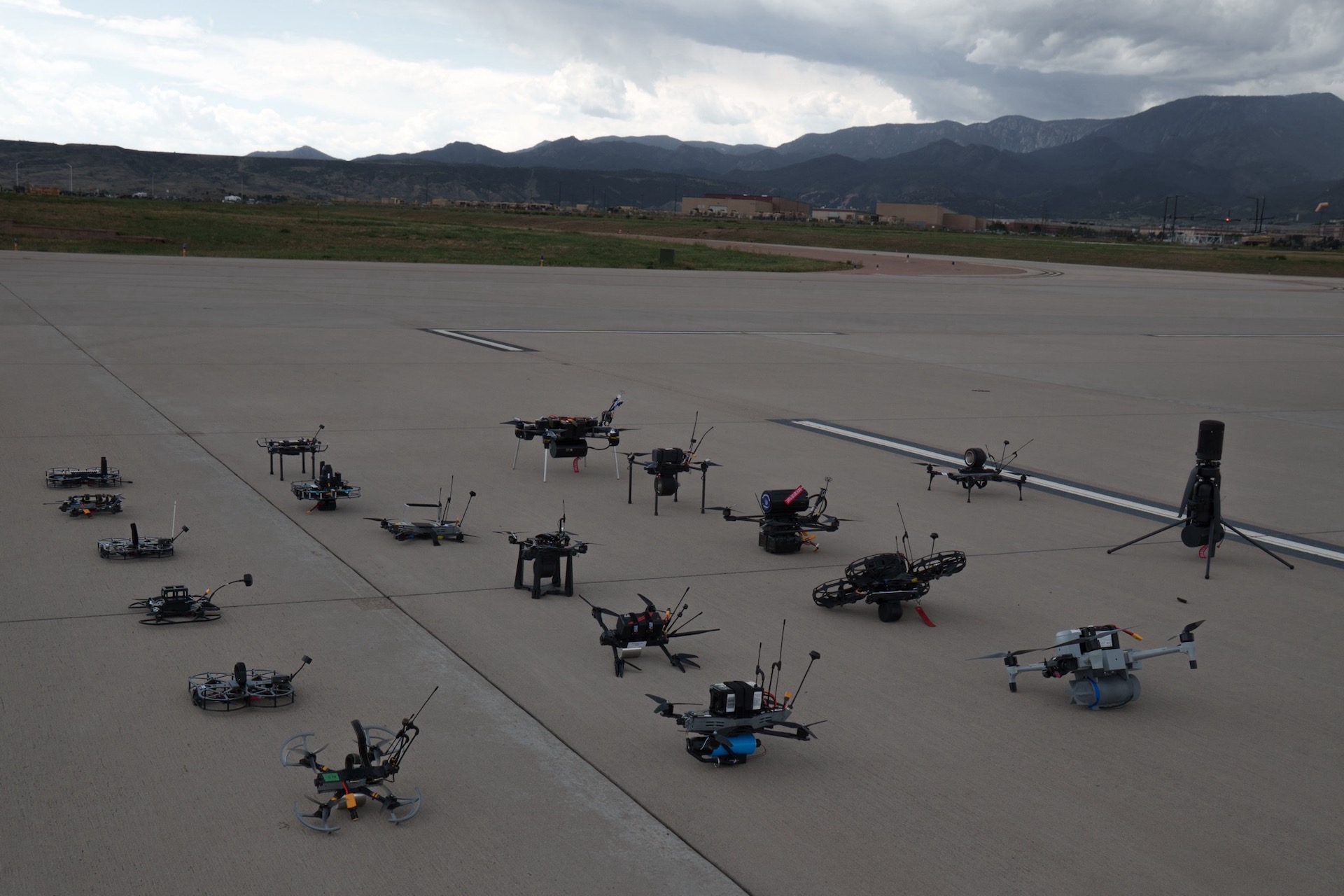
Small unmanned aircraft now operate at a scale that makes the word drone almost misleadingly broad. The same category includes reconnaissance quadcopters hovering a few kilometres behind the front, first-person-view aircraft attacking individual vehicles, heavy multirotors delivering supplies, longer-range one-way systems striking hundreds of kilometres away, interceptor drones hunting other drones, and increasingly autonomous platforms designed to continue functioning when radio links or satellite navigation fail.
NATO lessons-learned material describes the conflict as a case of the sudden and massive penetration of UAVs into many combat functions, accompanied by an unusually rapid cycle of technological adaptation. IISS similarly describes a transformation not merely in the number of UAVs employed but in their role: from traditional ISR and niche strike assets into ubiquitous battlefield systems.
That distinction matters. The most consequential change is not the emergence of a new weapon. It is the emergence of a new battlefield layer.
From aircraft to infrastructure
A useful way to understand the current drone war is to stop thinking about unmanned systems as individual platforms.
Their real effect comes from networks.
A reconnaissance drone detects movement. Its video or coordinates are passed through digital command systems. A strike asset is assigned. Electronic-warfare teams attempt to protect the mission or disrupt the opposing system. Another drone observes the result. Data from the engagement feeds back into future targeting and tactical adaptation.
The aircraft is only one element.
IISS describes Ukraine as having built what amounts to a tactical reconnaissance-strike complex through large numbers of unmanned aircraft combined with command-and-control systems able to exploit their data. The sheer density of small sensors has created a level of battlefield observation that would previously have required far more expensive and scarce reconnaissance assets.
RUSI describes the resulting operating environment as one of battlefield transparency. UAVs are the most visible part of this change, but they operate alongside satellite communications, electronic sensors, acoustic detection and digital processing tools. The effect is that large movements are increasingly difficult to conceal and concentrations of troops or equipment are exposed to rapid targeting.
This does not make the battlefield literally transparent. Terrain, weather, camouflage, electronic warfare and deception still matter. But it changes the baseline assumption.
A unit must increasingly operate as though observation is persistent rather than occasional.
That has consequences far beyond drone units themselves.
The battlefield is becoming wider
Traditional descriptions of the front often imagine a relatively clear distinction between the forward line, supporting positions and rear areas.
Unmanned systems have blurred those boundaries.
RUSI field research describes Ukrainian forces developing concepts around a contested zone, a middle battle area and deeper support areas. Persistent UAV reconnaissance and strike systems make roads, logistics nodes, artillery positions, command posts and drone operators behind the immediate line of contact part of the same targeting problem.
Ukraine's Ministry of Defence describes the Drone Line concept as an attempt to create a continuously contested belt roughly 10–15 kilometres deep, combining unmanned systems with infantry support and persistent engagement. RUSI, looking at broader battlefield effects, describes an attrition belt extending roughly 30 kilometres in some contexts. These figures should not be interpreted as universal or fixed ranges; they illustrate how the effective danger zone around the front has expanded.
This expansion changes basic military problems. Moving ammunition becomes harder. Rotating infantry becomes harder. Recovering damaged vehicles becomes harder. Evacuating casualties becomes harder. Establishing a command post close to the front becomes riskier.
A relatively inexpensive aircraft with a camera can reveal an activity. Another low-cost system can attack it. The consequence is not simply more strikes. It is a reduction in the amount of physical activity that can be conducted safely near the front.
The resulting pressure favours dispersion, concealment, smaller movements and increasingly remote logistics.
Uncrewed ground systems are part of this same transition. RUSI's fieldwork documents their growing use for supply and casualty-related tasks in areas where repeated human movement is exposed to observation and strike.
Mass changes the economics of precision
The second transformation is economic.
Precision-guided weapons were historically associated with expensive missiles, sophisticated aircraft and limited inventories. Small unmanned systems have created a different pathway to precision.
An FPV aircraft can deliver a relatively small warhead against a specific vehicle, fighting position or piece of equipment while being inexpensive enough to lose.
That does not mean every cheap drone destroys an expensive target. Many fail because of electronic warfare, weather, pilot error, interception, technical faults or target protection. The relevant economic calculation is not the sticker price of one drone against the value of one target.
It is the cost of generating a useful battlefield effect across thousands of attempts.
This distinction is important because it explains why mass matters as much as sophistication.
Ukraine's procurement system increasingly reflects this logic. The Ministry of Defence reported in June 2026 that 95 percent of UAVs procured through its Defence Procurement Agency were Ukrainian-made, and that procurement of unmanned systems had exceeded ammunition procurement in the previous year. In July, the ministry said drone contracts signed in the first half of 2026 alone totalled UAH 333.6 billion, with FPV systems accounting for the largest share.
Those numbers illustrate an institutional change.
Drones are no longer an experimental side programme. They have become a major consumption category.
And unlike a traditional combat aircraft expected to remain in service for decades, many tactical drones are treated as attritable: losing them is part of the operating model.
That alters procurement incentives. Unit cost still matters, but so do production volume, delivery speed, repairability and the ability to modify systems after battlefield conditions change.
If a countermeasure can make a platform ineffective within months, technological perfection at the moment of procurement is not enough.
The real arms race is adaptation
Perhaps the most important lesson from Ukraine is therefore not a particular drone design.
It is the speed at which designs become outdated.
Radio-controlled drones create demand for jamming. Jamming creates demand for frequency changes, stronger links, relays and fibre-optic control. GNSS interference drives inertial and visual navigation. Reconnaissance drones create demand for interceptor drones. Interceptor drones create pressure for better detection, higher speed and new flight profiles.
Each adaptation creates the next countermeasure.
NATO's early lessons from the war explicitly warned that specific techniques and technologies would lose relevance quickly even if the broader requirement for militaries to rapidly test, field and adapt low-cost UAVs remained. That observation has become more important, not less, as the war has progressed.
RUSI reporting shows this dynamic operating at tactical level. Radio-frequency FPVs can be denied by electronic warfare. Fibre-optic systems remove that specific dependency but do not eliminate vulnerability: aircraft can still be physically intercepted, operators can be located, payload and range remain constrained, and weather continues to matter.
The result is a defence-industrial problem very different from the traditional model of slowly developing a platform, producing it at scale and operating largely unchanged for years.
The competitive advantage increasingly lies in the ability to shorten the loop between battlefield observation, engineering change, manufacturing and redeployment.
Ifri's 2026 study of wartime military technology identifies this combination of scale, survivability and economic sustainability as a recurring lesson from Ukraine. In its assessment of deep strike, effectiveness comes from layered systems that can be produced and repeatedly employed, rather than from dependence on one exquisite weapon.
The drone war is therefore also a manufacturing war.
Force structures are changing around the technology
When a technology becomes central enough, organisations begin to restructure around it.
Ukraine formally began creating a separate Unmanned Systems Forces branch in 2024. The decision was not limited to buying more aircraft; the stated tasks included specialised positions, dedicated units, training, systematisation of battlefield experience and the scaling of production.
That is a significant distinction.
A military can possess drones without being organised for drone warfare.
Mass unmanned operations require pilots, technicians, payload specialists, electronic-warfare support, intelligence analysts, software, communications infrastructure, repair chains and large flows of replaceable hardware. They also create a new demand for command systems capable of coordinating thousands of objects and their data.
This is why the longer-term transition is likely to be as organisational as it is technological.
The same effect is appearing outside Ukraine.
In July 2026, NATO launched its Drone Edge initiative. Allies announced more than $40 billion in counter-drone investment over five years and a goal of training five times as many drone operators by the end of 2027. NATO also announced mechanisms intended to accelerate procurement and expand testing and training infrastructure.
The United Kingdom separately announced more than £5 billion for its own drone transformation over four years.
These programmes do not prove that every feature of the Ukrainian battlefield will transfer directly to another war.
They do demonstrate that governments and alliances increasingly treat unmanned systems as a structural military requirement rather than a niche capability.
Cheap does not mean simple
One risk in discussing the drone war is to reduce the transformation to a slogan: cheap drones defeat expensive weapons.
The battlefield is more complicated.
A small FPV aircraft is inexpensive relative to many conventional weapons, but successful employment depends on an ecosystem that is not free.
Operators require training. Communications infrastructure is vulnerable. Electronic warfare creates constant technical pressure. Large numbers of batteries, antennas, controllers, airframes and munitions must move through supply chains. Reconnaissance data must be processed. Pilots themselves become targets. And the majority of the battlefield remains affected by weather, terrain, concealment and the physical limitations of small aircraft.
RUSI's research is particularly valuable here because it pushes against the most simplistic interpretation of the drone war. FPVs are highly useful, but they carry small payloads, can be disrupted or intercepted, perform poorly in some weather conditions and cannot efficiently destroy every target. RUSI's field research argues that their greatest value emerges when they are integrated with artillery, electronic warfare, air defence, ground forces and other forms of strike rather than treated as substitutes for them.
This is the central counterargument to the idea that drones have made conventional forces obsolete.
They have not.
Instead, they have altered the conditions under which conventional forces operate.
Artillery can still deliver effects that an FPV cannot. Armoured vehicles still provide protection and firepower that small drones cannot. Infantry still occupies terrain. Electronic warfare can determine whether an unmanned system can function at all. Air defence increasingly has to protect not only against aircraft and missiles but against large populations of much smaller targets.
The emerging battlefield is not replacing combined arms with drones.
It is forcing combined arms to absorb them.
Software is becoming part of the weapon
The next stage of the transformation is already visible.
Mass unmanned warfare creates a human-scaling problem.
Every remotely controlled aircraft requires some amount of operator attention. As fleets grow from tens to hundreds or thousands of platforms, the number of people required to control, coordinate and interpret them becomes a limiting factor.
This is one reason autonomy matters.
CSIS research on Ukraine found significant progress in partial autonomy, including machine-vision functions, target tracking and navigation assistance, while stressing that fully autonomous warfare remained much more limited than the term often implies.
The relevant transition is unlikely to happen in a single leap from human pilot to independent robot.
It is happening function by function.
A drone can stabilise itself. Then navigate between waypoints. Then maintain navigation without reliable GNSS. Then recognise or track a visual object. Then continue a terminal approach after losing the control link.
Each of these reduces one part of the operator's workload or one vulnerability in the system.
At the same time, software above the individual platform becomes increasingly important. Large fleets require systems to combine sensor data, maintain a shared operational picture, assign missions and prevent thousands of unmanned systems from becoming thousands of disconnected devices.
CSIS argues that this orchestration layer may ultimately be as important as the aircraft themselves.
The logic is straightforward: mass creates data, and data without coordination can become another form of friction.
The battlefield advantage therefore shifts from possessing drones to possessing a system of drones.
Ukraine is a laboratory — not a universal template
There is a temptation to treat every lesson from Ukraine as a prediction of all future warfare.
That would be a mistake.
The conditions of this war are specific.
It involves an unusually long and heavily fortified front, extensive electronic warfare, large mobilisation systems, significant access to commercial technology and a defence industry forced to adapt under sustained attrition.
IISS explicitly cautions that the degree to which Ukraine represents a general template for future UAV warfare remains open to debate.
A conflict in the Pacific, for example, would involve very different distances, maritime geography, logistics and communications challenges.
A war fought under overwhelming friendly air superiority would create different conditions for small drones.
A short, high-intensity campaign would not necessarily produce the same industrial adaptation cycle as a multi-year attritional war.
The useful lesson is therefore not that every military should copy Ukraine's current force structure.
It is that future militaries must expect unmanned systems to interact with nearly every other element of combat — and must be capable of adapting faster than the opposing side.
That is already becoming an institutional lesson.
NATO's Joint Analysis, Training and Education Centre is now running programmes specifically designed to evaluate which Ukrainian tactical and command lessons are transferable to Allied forces.
The question is no longer whether drone warfare will influence conventional militaries.
It is which lessons will survive outside Ukraine.
The durable change
Individual platforms will disappear. Frequencies will change. Countermeasures will improve. Today's successful aircraft may be obsolete in a year.
That is precisely why focusing on individual drone models misses the larger transformation.
The more durable shift is structural.
Battlefields are becoming more persistently observed. Precision effects are becoming available at lower echelons. Large numbers of attritable platforms are changing procurement economics. Electronic warfare has become inseparable from unmanned operations. Software increasingly connects sensors to weapons. Manufacturing speed and engineering iteration have become operational variables. And militaries are reorganising personnel, training and procurement around systems that were peripheral little more than a decade ago.
The drone itself is therefore not the revolution.
The revolution is the system that forms around it.
Ukraine has demonstrated what happens when unmanned platforms become cheap enough, numerous enough and adaptable enough to move from the margins of the force into its everyday operating logic.
The modern battlefield has not become unmanned.
But it is becoming increasingly difficult to fight on it without unmanned systems.