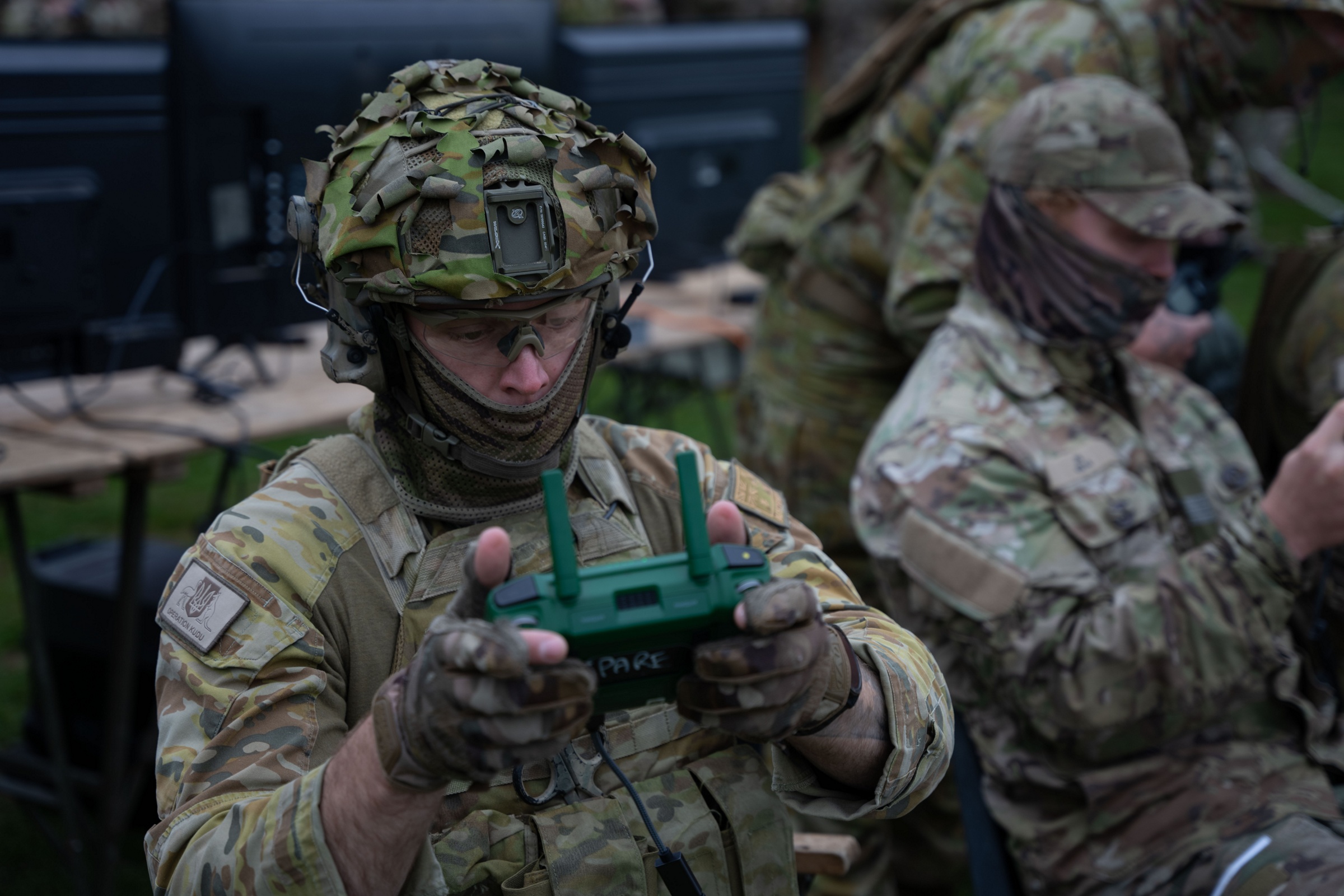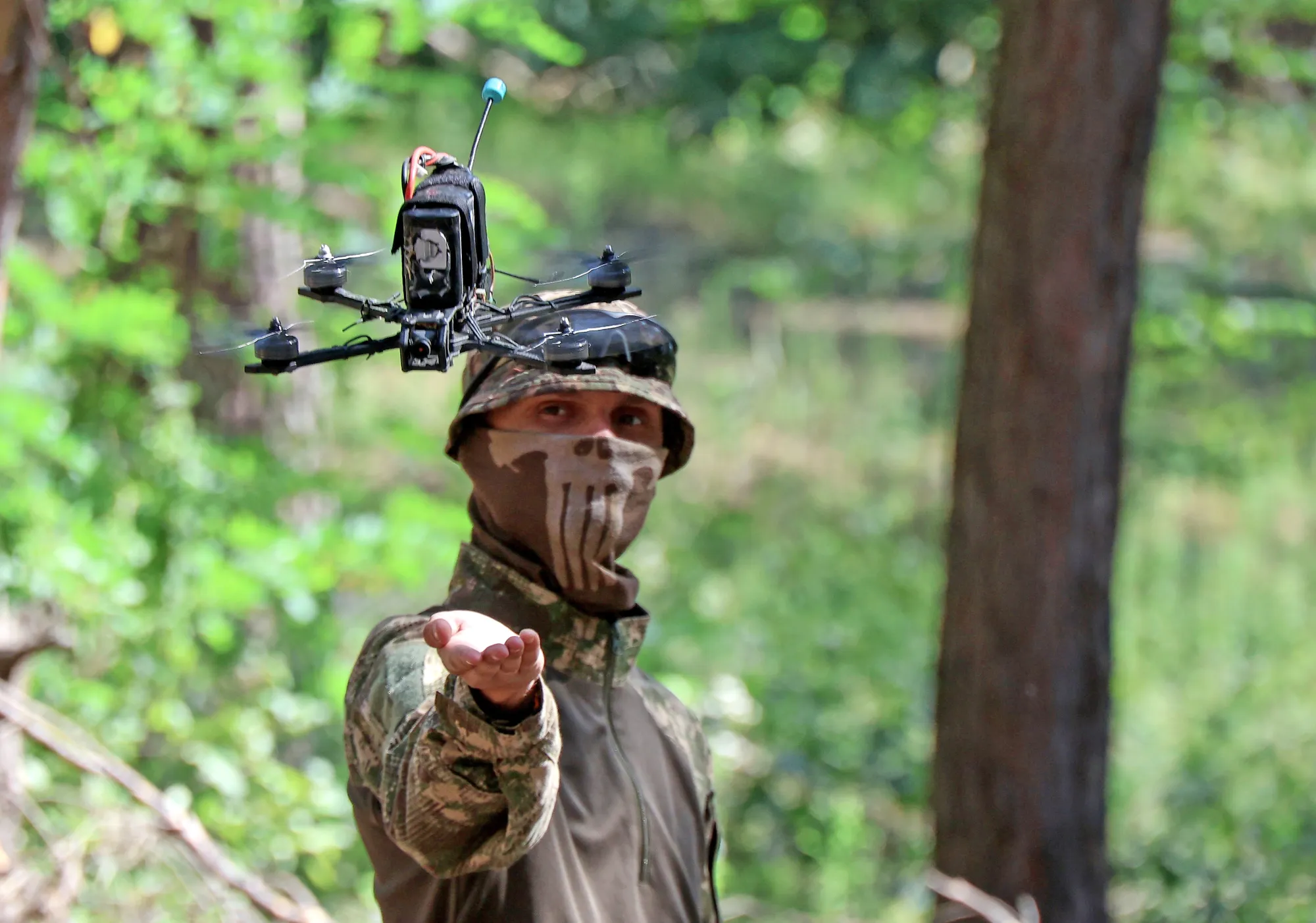
Ukraine’s 7th Artillery Brigade is restructuring how it uses guns, drones and battlefield logistics as uncrewed systems assume the dominant role in strike operations, according to its commander. Lt. Col. Vitalii Korniienko, who leads the Ukrainian National Guard formation, said drones now conduct roughly 95% of current strikes, but argued that artillery remains indispensable for targets and conditions that aircraft cannot address reliably.
In an interview with Ukrainian outlet Oboronka, Korniienko described a battlefield in which conventional artillery concentrations and prolonged fire missions have become difficult to sustain. Drones can observe gun positions, guide attacks against them and make every artillery shot a potential signature of a firing location. His brigade is consequently employing short, tightly controlled fire missions, preparing concealed firing sites in advance and combining artillery with drone units under one command structure.
The unit also is moving some resupply work away from pickup trucks and onto ground-based robotic systems, Korniienko said. The vehicles are already delivering ammunition to drone and artillery positions, as well as food and fuel for generators. He presented the shift as part of a wider effort to reduce exposure during logistics activity near forward positions.
From massed guns to limited fire missions
Korniienko said earlier practices of grouping guns to create large barrages have largely disappeared. Rather than expending large volumes of artillery ammunition against a target, he said a commander may choose a group of first-person-view, or FPV, drones. In his comparison, 20 FPV drones could be used for a $20,000 mission, whereas firing 200 artillery shells would be substantially more expensive.
The economic calculation is not the only constraint. Korniienko said that firing 100 shells from a single gun in one day would make the weapon unlikely to remain in place until evening. Drones are pervasive above the battlefield, he said, and gunfire reveals a position that can then be located and attacked by available means. Under those conditions, a typical artillery task uses no more than 10 rounds: three to five shells to range the weapon, followed by fire for effect. He said even the minimum five-round mission involves shells costing at least $2,000 each.
The commander contrasted those missions with the earlier pattern of putting multiple guns at one firing position. At the outset of Russia’s full-scale invasion, he said, Ukrainian and Russian forces could place two or three guns together, and Russian forces continued to do so into 2023. That approach declined because a concentration of as many as six guns could be eliminated within an hour, he said. Artillery crews no longer simply drive into an open field, because a gun may be detected before it reaches the position.
Instead, Korniienko said a firing site is prepared ahead of time. Anti-drone teams first work to clear enemy reconnaissance drones from the airspace above the intended location. The gun position itself is built as an underground dugout caponier, with access routes concealed by camouflage. The brigade places significant emphasis on avoiding loss of a gun, which Korniienko described as a major setback for the unit.
A combined drone-artillery model
The 7th Artillery Brigade’s organization combines artillery and drone capabilities in a single brigade, a concept Korniienko said had been approved. In the model he described, drones are assigned to attack enemy artillery and logistics, while guns support infantry, engage targets and keep opposing forces pinned in dugouts. The intent, he said, is to offset the limitations of each system and improve the formation’s overall effectiveness.
The brigade’s main operations are focused within its corps area of responsibility, including targets 10 kilometers deep or farther behind enemy lines, according to the commander. It can also engage closer targets when requested by the brigade holding a defensive sector. Korniienko’s description places drone and artillery activities alongside the adoption of uncrewed ground vehicles for resupply, rather than treating fire support and logistics as separate adaptations to the drone threat.
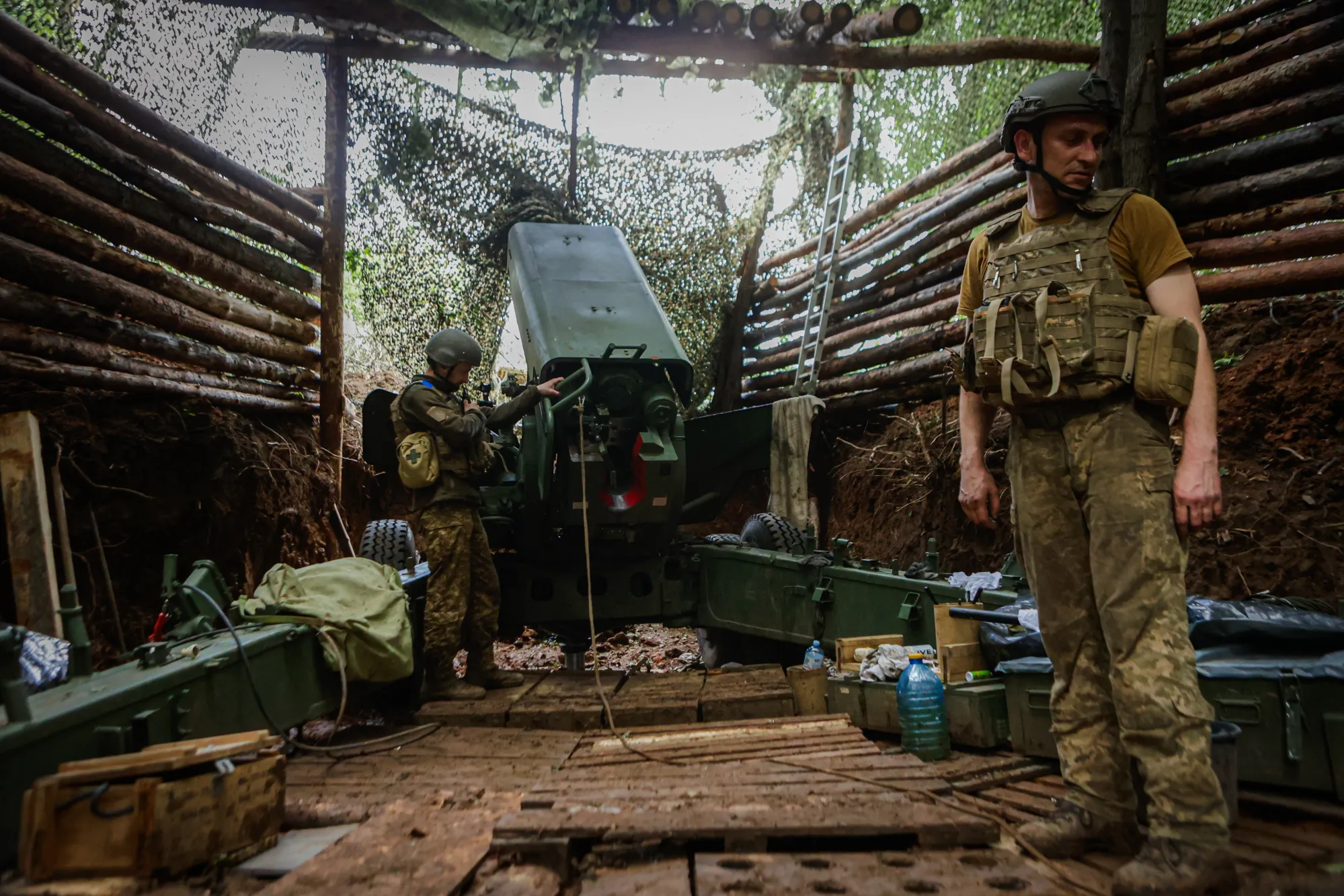
Although Korniienko said drones account for the overwhelming majority of strikes, he said artillery cannot simply be retired. He identified the destruction, suppression and halting of assault groups and armored columns as missions in which artillery remains critical. His account reflects a shift in emphasis from broad, repeated area fire toward effects against particular formations and battlefield actions.
Electronic warfare is one reason artillery retains that role, he said. In the Kupyansk sector, his unit has encountered targets that drones could not reach because of electronic interference. Slow fiber-optic drones, which are not reliant on radio links in the same way as other systems, were also being shot down in those cases, he said. Artillery could be called in instead. Korniienko said guns remain able to operate in fog, strong winds, snow and headwinds, conditions that can constrain drone operations.
Range, ammunition and concealment trade-offs
Korniienko also addressed the debate over whether Ukrainian artillery should stop using shorter-range projectiles in favor of longer-range ammunition, partly to keep guns farther from drone threats. He said the M107 155mm projectile is considered a short-range shell. It is relatively inexpensive, is mass-produced by Ukraine and its partners, and is available in sufficient stocks for operations, he said. Depending on the propellant, its range is 14 to 18 kilometers.
He identified the M795 and comparable foreign rounds as longer-range alternatives. Those projectiles are longer, heavier and more expensive, he said, and can reach 30 kilometers with high-quality propellant. A base-bleed unit can extend their reach further. However, Korniienko said both the rounds and the propellants needed for them are in short supply.
The commander opposed abandoning M107 ammunition altogether. In his assessment, long-range rounds accelerate barrel wear and can make a firing position easier to detect, because a long-range charge creates a large muzzle flash that can be seen over considerable distances around dawn or dusk. An 18-kilometer range remains useful, he said: a gun positioned 15 kilometers behind the line would still retain a three-kilometer margin for engaging frontline infantry. For most brigades, he said his preferred balance would be 60% long-range ammunition and 40% standard M107 rounds.
Korniienko also argued that 105mm artillery still has value. He said he operated 105mm guns near Serebryanka on the Kharkiv axis, where intercepted communications indicated Russian forces believed they were facing mortars and searched within a five-to-six-kilometer radius. The howitzers were actually positioned eight or nine kilometers away and firing to distances of 10 to 12 kilometers, he said.
According to Korniienko, 105mm guns produce little visible muzzle flash beyond dust, and the target may receive the shell without hearing the sound of the shot. Their compact size and lower weight also allow them to be moved in a pickup truck, he said. He also called for continued development of 203mm artillery. The brigade retains Soviet-era 2S7 Pion self-propelled systems, whose approximately 100-kilogram projectiles, he said, can penetrate at least two floors of a building or a bunker. Korniienko characterized the systems as reasonably accurate.
Gun support and shell quality
The brigade fields a mixture of domestically produced Bogdana 155mm systems, donated M777 howitzers, remaining Pion weapons and other artillery. Korniienko said his unit was among the first to test the Bogdana and provided manufacturer feedback that was incorporated into later refinements. He said the Bogdana is now his preferred gun, citing the availability of support and repair service rather than claiming it was superior in every respect.
Korniienko said Ukraine should maintain competition in artillery development. In his view, the Bogdana’s evolution under wartime conditions has been positive, but momentum could slow in later years if the system faced no pressure to receive substantial upgrades. He said the changing nature of warfare made continued innovation necessary. The comments represent the commander’s assessment of procurement and industrial-development priorities rather than an announced program decision.
For a Bogdana breakdown requiring a manufacturer repair team, Korniienko said he expects the weapon to be repaired by the following day, with technicians arriving in the morning and completing the repair by midday. Returning the gun to its firing position can take another one or two days, he said. He contrasted that turnaround with his experience obtaining parts for donated Western systems, including the U.S.-made M777. While expressing gratitude for foreign support, he said a gun could remain idle for six months while awaiting a component such as a sensor. He also said crews cannot attempt certain repairs themselves because doing so would void the warranty.
Ammunition quality presents another operational concern, according to the commander. He said the brigade uses shells supplied by many countries and described Western-produced rounds as satisfactory, while declining to identify an Asian country whose ammunition he said had poor quality. The stated projectile weight might be 46 kilograms, but actual measurements could be 46.9 kilograms or 45.4 kilograms, he said. In his account, differences of about half a kilogram can materially affect where a shell lands.