The drone factory is becoming a weapon system in its own right.
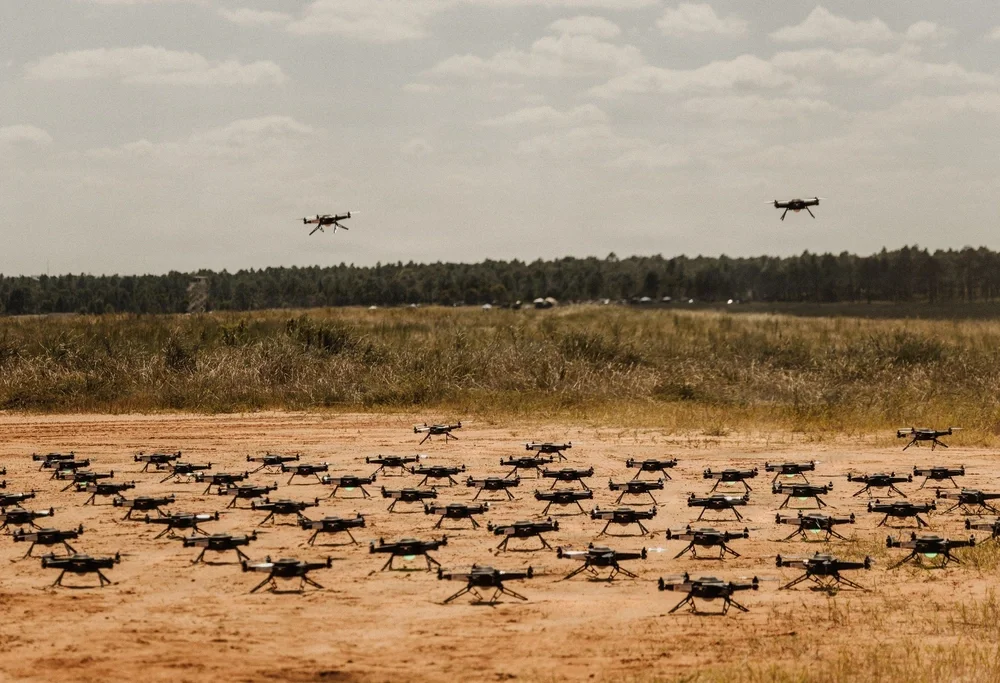
Modern unmanned warfare consumes aircraft quickly, changes designs quickly and punishes manufacturers that cannot change with the battlefield. The result is an industrial problem unlike traditional aircraft production. Instead of building a relatively small fleet around a stable configuration, militaries increasingly need thousands of inexpensive systems whose radios, sensors, navigation and software may change before the production line has fully stabilized.
Ukraine has made this industrial logic visible at scale. By mid-2026, 95 percent of UAVs procured through the Defence Procurement Agency were Ukrainian-made, while contracts signed in the first half of the year exceeded UAH 333 billion. The largest share was FPV drones. By late September, troops had ordered more than 590,000 UAVs through Brave1 Market alone.
Those figures describe more than procurement volume. They reveal a new relationship between battlefield demand and industrial output.
Mass production no longer means one frozen design
Traditional mass production works best when the product changes slowly. Tooling, suppliers, quality control and maintenance all benefit from stable specifications.
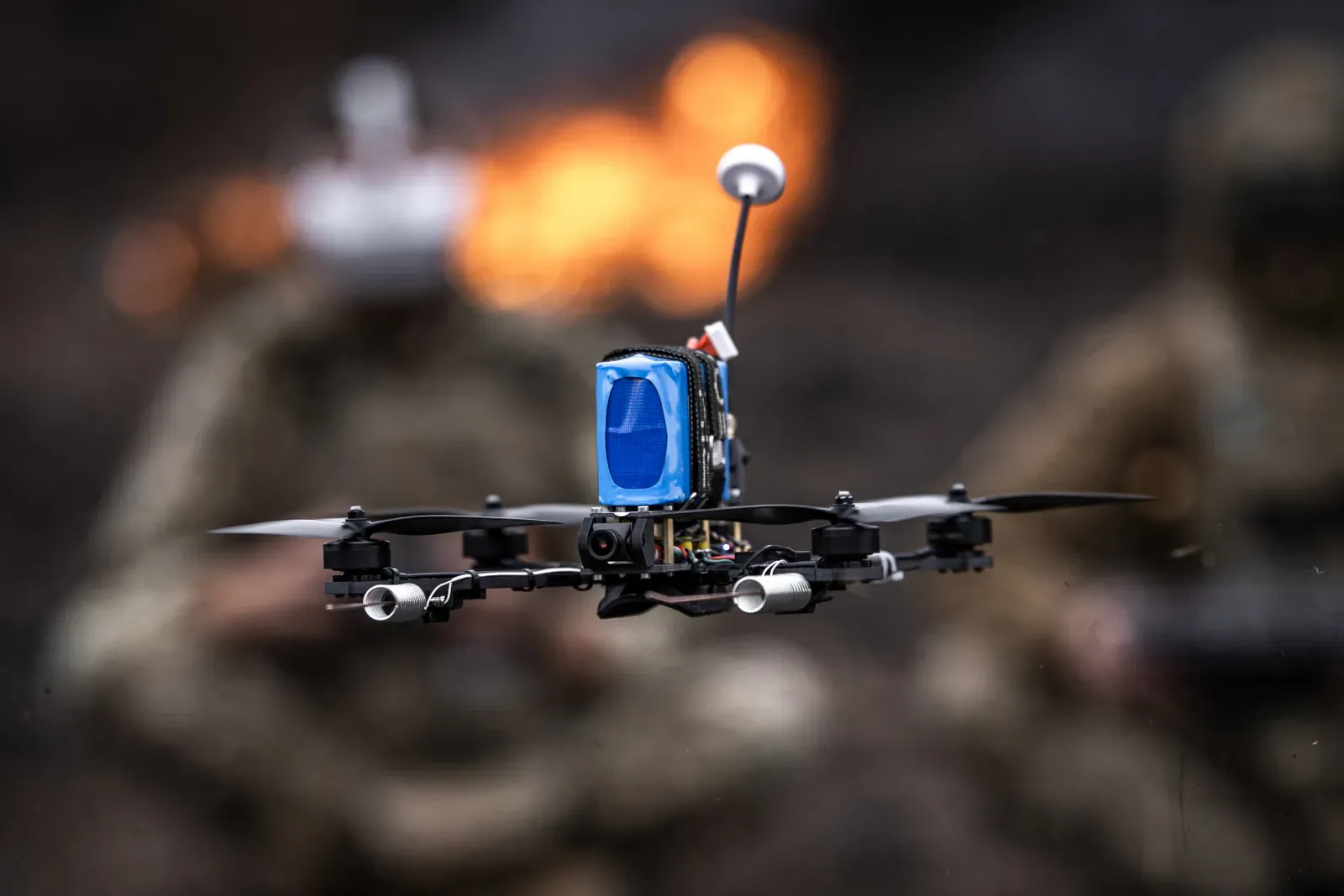
Drone warfare creates the opposite incentive. A radio that worked last month may face a new jammer. A camera may be replaced because operators need better low-light performance. A frame may change because a component became scarce. Navigation software may be updated because GNSS conditions changed.
The challenge is to scale output without freezing the product in a configuration that the battlefield has already learned to defeat.
The industrial unit is becoming a modular stack
One answer is modularity. The airframe, propulsion, communications, navigation, payload and software can be treated as layers that evolve at different speeds.
This does not mean every component is interchangeable. Interfaces still need engineering discipline. But modular architectures reduce the cost of changing one subsystem without redesigning the entire aircraft.
Ukraine's Brave1 Market now allows units to order not only complete drones but components including communications equipment, cameras, receivers, repeaters, navigation and power systems, controllers and software. That procurement model reflects an industrial reality: adaptation frequently happens below the level of the finished platform.
| Industrial factor | Traditional model | High-volume drone model |
|---|---|---|
| Configuration | Relatively stable over long production runs | Frequent component and software changes. |
| Supply chain | Long-qualified supplier relationships | Rapid substitution and multiple commercial/dual-use inputs. |
| Feedback | Formal test and upgrade cycles | Continuous frontline feedback and short redesign loops. |
| Unit economics | High-value platform, long service life | Attritable or consumable system, high replacement rate. |
| Software | Important but often tied to platform blocks | Continuous update layer that can alter performance between hardware revisions. |
Demand data is becoming a production signal
The more unusual change is on the demand side.
Ukraine's DOT-Chain Defence and Brave1 Market systems give combat units a more direct role in selecting equipment. The Ministry of Defence says battlefield data from ePoints, DOT-Chain, Brave1 Market, DELTA and Mission Control is used to rank systems and influence procurement.
That creates a shorter feedback loop between use and production. Manufacturers can see which systems are being ordered and which configurations continue to attract demand.
DOCUMENTUkraine's expanding domestic drone production baseOPEN ↗In industrial terms, the battlefield is becoming a continuously updating market signal.
Production capacity means little if components do not scale
A drone assembly line is only as strong as the components feeding it.
Motors, batteries, processors, cameras, RF components, navigation hardware and optical fibre can become bottlenecks even when airframes are easy to manufacture.
This is why component sovereignty and supply-chain resilience matter more as volumes rise. A manufacturer may be able to assemble ten times more frames and still fail to increase output if one imported sensor or radio cannot be sourced at the same rate.
The economic advantage of inexpensive drones therefore depends on industrial depth, not merely low assembly cost.
Advance payments change who can scale
Working capital is another hidden production constraint.
The Ukrainian Ministry of Defence introduced advance payments of up to 70 percent for products procured through ePoints, explicitly linking the mechanism to faster production scaling.
That matters for a young defence-industrial sector where manufacturers may not have the balance sheets required to buy components for very large orders before receiving payment.
In other words, procurement finance becomes part of production capacity.
Speed of delivery is becoming a performance metric
A system that takes a year to arrive may be technically excellent and operationally late.
DOT-Chain Defence reports average delivery times of roughly nine days for in-stock products. Brave1 Market has reported similar short delivery cycles for some equipment.
The exact figure varies by product, but the principle is significant: procurement speed becomes part of the weapon's battlefield relevance.
This is particularly true when the threat adapts in weeks rather than procurement cycles measured in years.
Distributed manufacturing offers another model
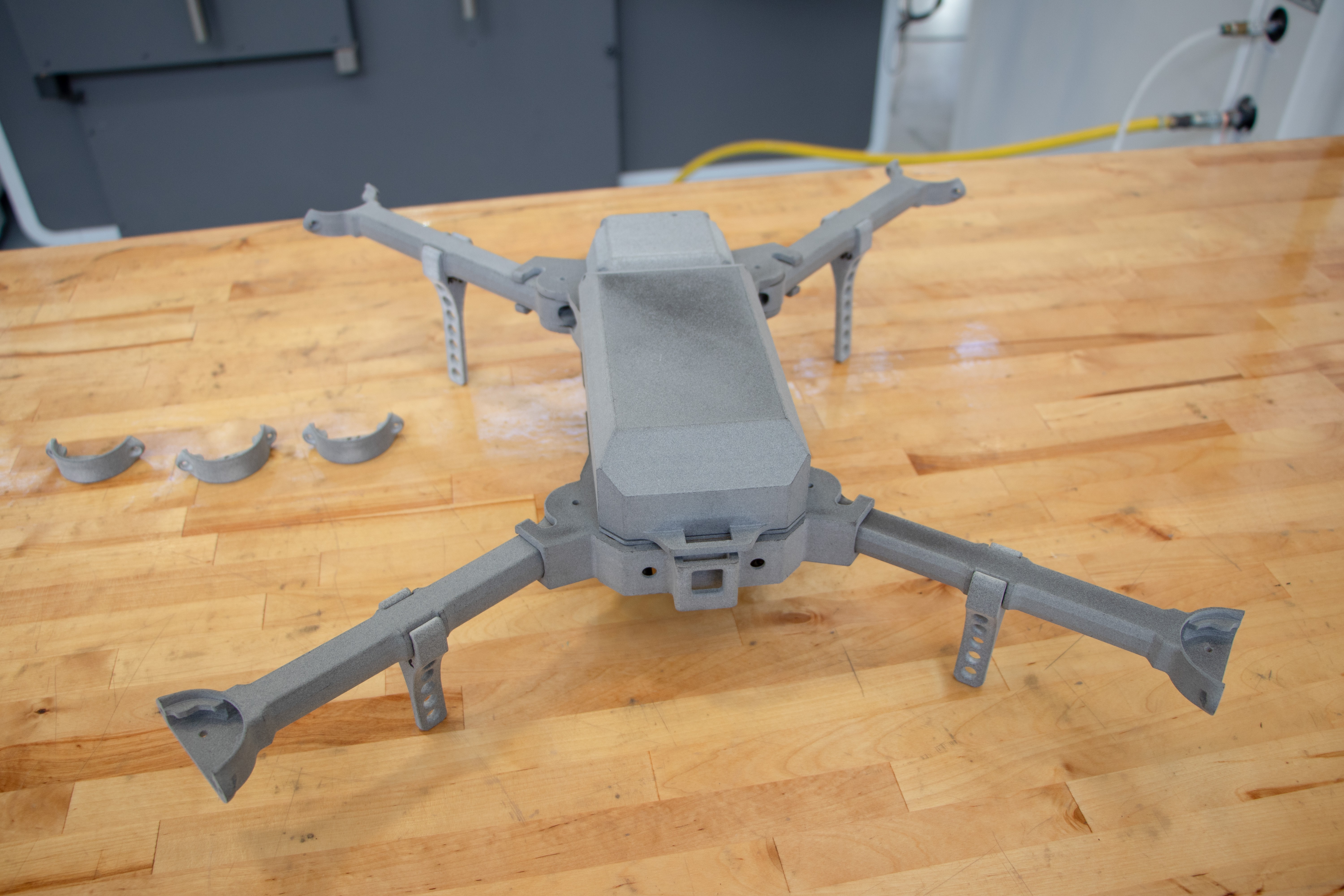
The U.S. Army's Rock Island Arsenal work on 3D-printed drones illustrates a different approach to scaling.
Rather than depend entirely on a single dedicated drone factory, the Army has explored using the Organic Industrial Base to manufacture airframes rapidly and distribute electronics integration across existing facilities.
Additive manufacturing is not automatically cheaper or better for every component. Its value is flexibility: low tooling burden, rapid design changes and the ability to produce smaller batches close to changing requirements.
The factory itself needs to be software-defined
As configurations change more quickly, factories need digital control over bills of materials, firmware versions, test procedures and supplier substitutions.
DOCUMENTU.S. Army 3D-printed drone production initiativeOPEN ↗A production line that cannot trace which radio, controller or software version is installed in a particular batch creates operational and maintenance problems downstream.
The more a drone fleet evolves, the more manufacturing data becomes part of readiness.
Quality control becomes harder at scale
High production volume creates pressure to accept variation.
But small differences in batteries, motors, RF components or assembly quality can produce large differences in flight time, reliability and signal performance.
A mature drone industry therefore needs test infrastructure that is fast enough not to destroy production speed but strict enough to prevent low-quality batches from overwhelming units with maintenance and failures.
This is a different kind of quality problem from traditional aerospace. The goal is not necessarily decades of service life. It is predictable performance across very large numbers of relatively inexpensive systems.
Obsolescence is part of the cost model
An attritable drone can be lost in combat. It can also become obsolete while sitting in storage.
If electronic warfare or a new defensive technology makes a configuration ineffective, inventory loses value before it is physically consumed.
That creates an incentive for smaller production lots, modular upgrades and procurement systems that can redirect demand rapidly.
The industrial objective becomes less about maximizing one production run and more about sustaining a production system that can change continuously.
The defence industry is moving closer to consumer-electronics tempo
Drone production increasingly borrows from industries that are comfortable with rapid product cycles, commercial components and software updates.
That does not make military requirements disappear. Security, reliability, environmental tolerance and supply assurance still matter. But the competitive advantage shifts toward companies that can combine defence-grade discipline with commercial development speed.
Production scale is now a strategic variable
A drone programme is no longer credible simply because a prototype flies.
The relevant questions are how quickly it can be manufactured, how quickly its components can be replaced, how fast field feedback reaches engineers and how many units can be delivered before the configuration becomes obsolete.
This is why the drone factory is reshaping defence industry. Manufacturing is no longer the final stage after design. It is part of the adaptation loop.
In high-volume unmanned warfare, the side that can redesign, finance, source, build, test and deliver faster has created a combat advantage before the drone ever launches.