Jamming and spoofing are often grouped together as if they were the same anti-drone technique. They are not.
Jamming attempts to deny or degrade a signal by making the receiver unable to use it reliably. Spoofing attempts something subtler: make the receiver accept false information as though it were genuine.
For unmanned systems, both effects can matter because many drones depend on several electronic relationships at once — command links, video links, telemetry and satellite navigation. The result of electronic attack depends on which dependency is affected and how the aircraft is designed to respond.
A drone does not have one radio problem
A typical remotely piloted drone may receive commands from the operator, send video back, transmit telemetry and use GNSS for navigation. These functions can use different radios, frequencies and protocols.
That means the phrase the drone was jammed is incomplete. The useful question is: which function was denied?
A drone can lose video while retaining control. It can lose command while retaining a navigation solution. It can lose GNSS while continuing under inertial or visual navigation. The operational result is determined by the system architecture, not by the word jamming itself.
Jamming is denial through interference
At a conceptual level, jamming raises interference in a part of the electromagnetic spectrum until the receiver cannot reliably distinguish the intended signal.
The effect can range from reduced range or unstable video to complete loss of a link. Whether that happens depends on the target receiver, antenna, waveform, environment and geometry.
This is why a jammer should not be imagined as a universal bubble in which all drones simply stop. It affects particular electronic dependencies under particular conditions.
Spoofing is deception rather than denial
Spoofing works differently. Instead of preventing the receiver from obtaining a usable signal, the attacker attempts to provide a false signal that the receiver accepts as legitimate.
GNSS is the most familiar example. A receiver that trusts false positioning or timing information can produce a navigation solution that is internally coherent but wrong.
That distinction matters because the response to jamming is often obvious — the system knows a signal has disappeared or degraded. Spoofing can be more difficult because the system may still receive data that looks plausible.
| Effect | What it tries to do | Typical system response |
|---|---|---|
| Command-link jamming | Make operator commands unreliable or unavailable | Link-loss logic, return mode, hover, landing or autonomous continuation depending on the aircraft. |
| Video-link jamming | Degrade the operator's view or telemetry return | Operator may lose situational awareness even if aircraft control continues. |
| GNSS jamming | Prevent reliable satellite navigation reception | Navigation falls back to inertial, visual or other sources if available. |
| GNSS spoofing | Cause the receiver to accept false navigation or timing data | Robust systems compare sources and reject implausible fixes. |
The command link is only one vulnerability
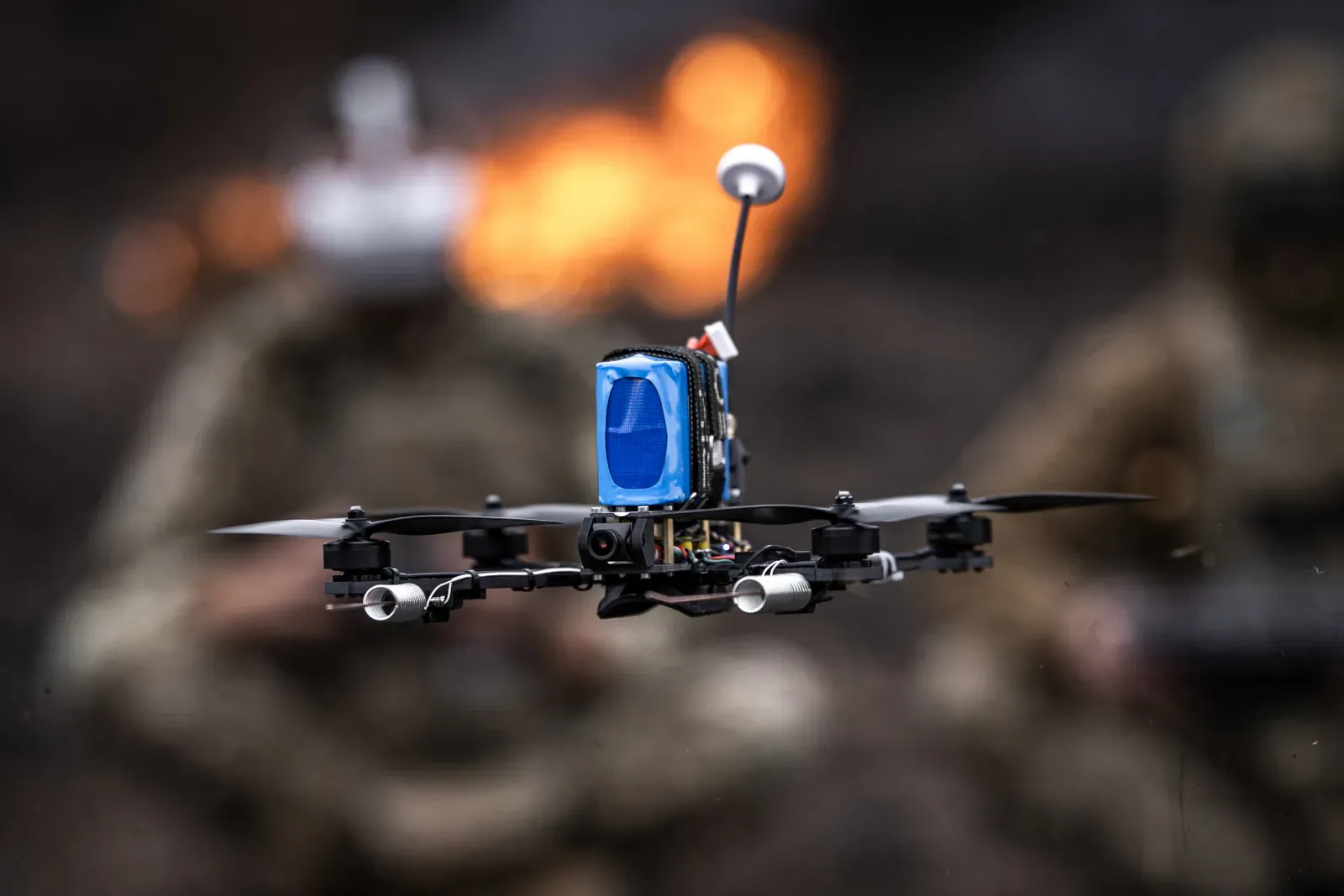
The tactical popularity of FPV drones made command-link jamming highly visible. Many first-generation systems depended heavily on continuous radio control and video.
That created a natural defensive opportunity: disrupt the link and the aircraft becomes difficult or impossible to control.
But the adaptation cycle was predictable. Radios changed. More frequencies were used. Relays and different link architectures appeared. Fibre-optic FPVs removed the RF control link entirely.
GNSS denial is a different problem
Satellite navigation signals arrive at receivers at low power and can be vulnerable to interference. This makes GNSS denial attractive in counter-UAS environments.
But losing GNSS does not produce one universal outcome. Some aircraft rely heavily on it; others can continue with inertial navigation, visual odometry, map matching or other sources.
The effect therefore ranges from complete mission failure to a gradual loss of positional accuracy.
Spoofing creates a trust problem
The hardest part of spoofing is not generating false information. It is making the target believe it.
Resilient navigation systems compare independent sources. If GNSS reports movement that disagrees sharply with inertial and visual estimates, the system can reduce its trust in the satellite solution.
This is why modern assured-PNT architectures focus on sensor fusion rather than replacing GPS with one alternative.
Electronic support is part of electronic attack
A defender cannot adapt jamming effectively without understanding the spectrum.
Electronic-support systems detect and classify emissions, helping the force understand which links are present and how the threat has changed. That information can guide electronic attack and also indicate when an RF-based countermeasure is unlikely to work.
The EW contest therefore runs as a loop: observe, classify, configure, attack, assess and update.
Why fibre-optic drones matter
Fibre-optic FPVs demonstrate the limitation of treating RF jamming as universal counter-drone defence.
DOCUMENTNATO fibre-optic drone countermeasure challengeOPEN ↗A physical fibre carries command and video between operator and aircraft, so conventional RF interference against that specific link has nothing useful to attack.
The drone still has physical, optical, acoustic and potentially other electronic signatures, but the defensive architecture has to shift toward different sensors and effectors.
Autonomy changes what link loss means
A remotely piloted drone that cannot make useful decisions without the operator is highly sensitive to communications loss.
A more autonomous aircraft can maintain flight, navigate or continue part of a mission locally. That does not make it immune to electronic warfare. It reduces the importance of one particular connection.
Jamming has costs for the defender too
Electronic warfare is not free simply because it does not consume a missile.
Power, antennas, spectrum management, training and electromagnetic deconfliction all matter. Friendly drones and communications can be disrupted by poorly coordinated EW.
This makes spectrum management part of counter-UAS command and control. The defender has to suppress hostile links without making its own unmanned force unusable.
The right way to understand electronic attack
Jamming is denial. Spoofing is deception. Both are useful only when they target a dependency the drone actually has.
Modern unmanned systems are reducing single points of electronic failure through new links, sensor fusion and autonomy. That does not end electronic warfare. It makes it more specific.
The future electronic contest is therefore less about one powerful jammer and more about continuously understanding which signals still matter.