A modern unmanned surface vessel is not simply a boat with the crew removed. It is a stack of propulsion, navigation, sensing, communications, onboard computing and mission payloads built around the assumption that the craft must continue to function with limited human attention.
The exact design varies enormously. A small reconnaissance craft and a 40-metre medium USV solve different problems. But the architecture is surprisingly consistent: the hull keeps the system afloat, propulsion moves it, sensors estimate the environment and vessel state, autonomy software translates a mission into behaviour, communications connect it to the wider force, and the payload gives the vehicle a reason to be at sea.
The hull is the mission envelope
The hull determines more than seaworthiness. It sets the volume available for fuel, batteries, sensors, computers, cooling and payloads.
Small USVs can be cheap and easy to deploy but have less endurance and payload capacity. Larger platforms can operate farther and carry more capable sensors or mission modules, but they begin to inherit the cost, maintenance and port requirements of conventional ships.
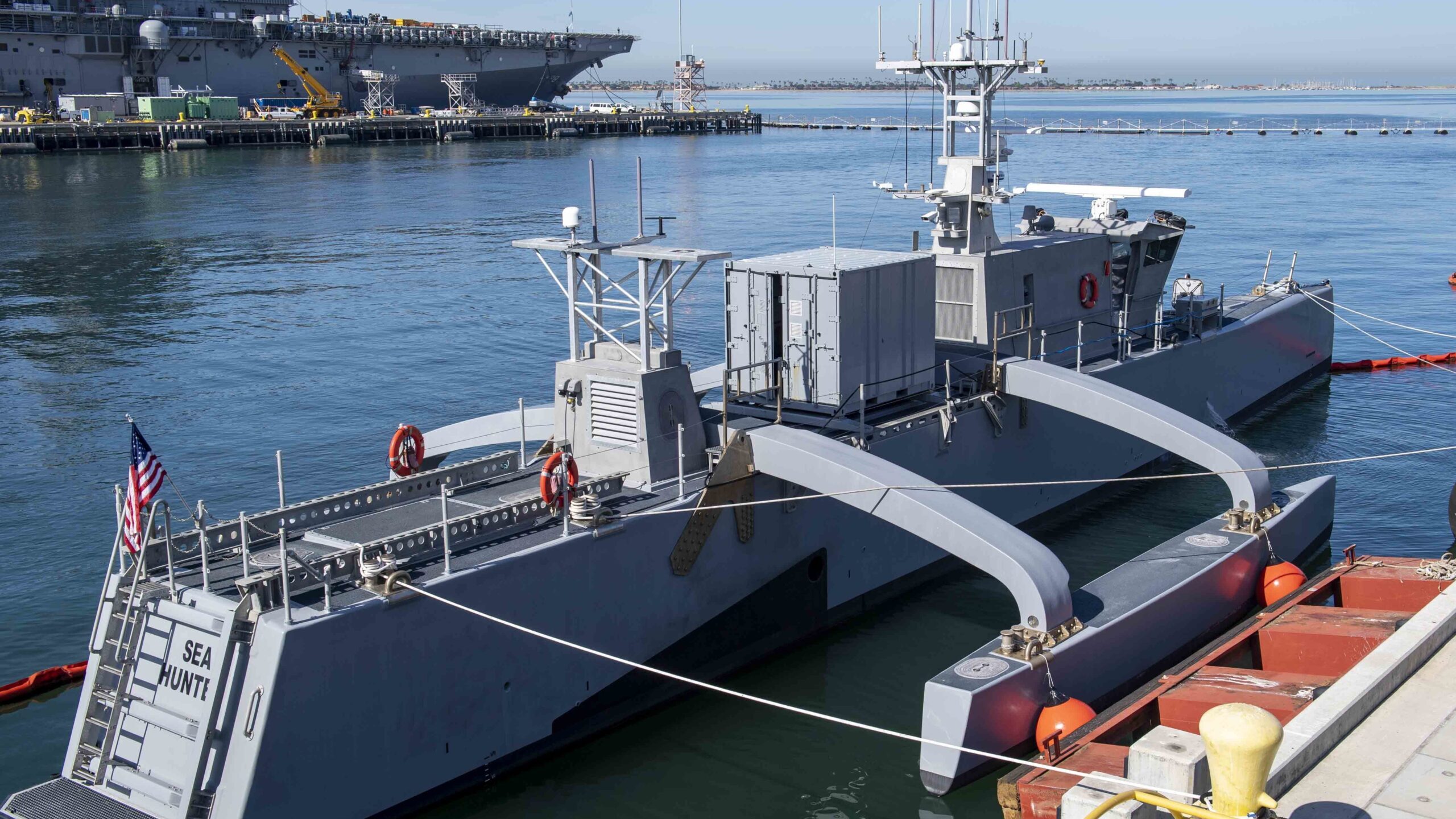
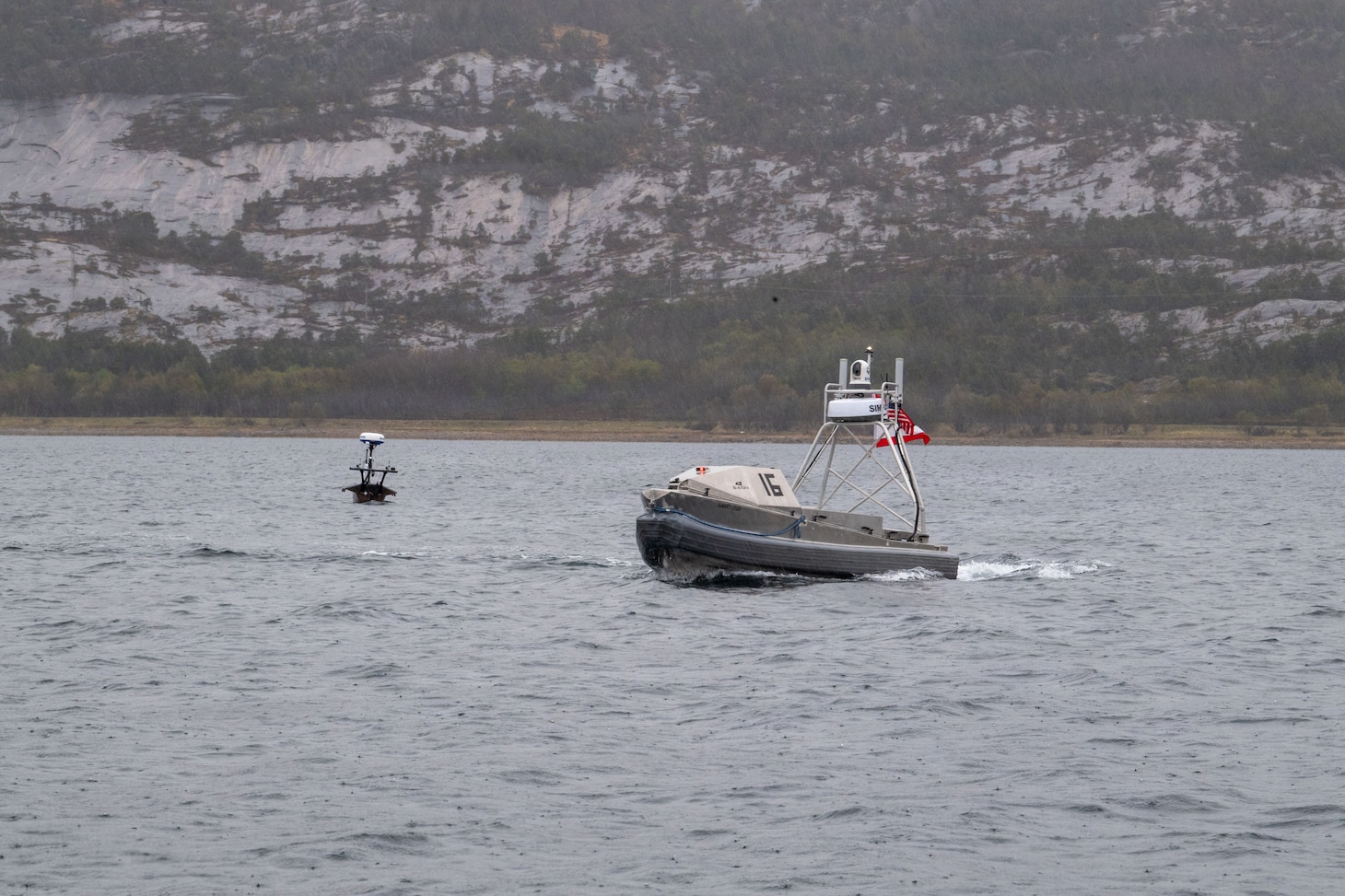
U.S. Navy programmes show both ends of the spectrum. Global Autonomous Reconnaissance Craft and Lightfish are relatively small systems used for distributed maritime sensing, while Sea Hunter and Seahawk are roughly 41 metres long and displace more than 140 tonnes at full load.
| Layer | What it does | Design pressure |
|---|---|---|
| Hull and structure | Provides seaworthiness and space for systems | Size, stability, signature, endurance and payload volume. |
| Propulsion and energy | Moves the vessel and powers onboard systems | Range, speed, fuel/battery endurance and maintenance. |
| Navigation and vessel control | Keeps the craft on a safe route | GNSS availability, inertial sensing, collision avoidance and maritime rules. |
| Perception | Detects traffic, coastline, hazards and mission-relevant contacts | Radar, EO/IR, AIS and other sensors must be fused into a usable picture. |
| Autonomy computer | Turns mission goals into vessel behaviour | Reliability, fail-safe logic and operation during communications gaps. |
| Communications | Links the USV to operators and networks | Bandwidth, range, satellite dependence and contested connectivity. |
| Mission payload | Provides the reason for the sortie | Sensors, relay equipment, mine warfare, logistics or other modular systems. |
Propulsion determines endurance and tactical behaviour
A USV's propulsion system is closely tied to its mission.
High speed is useful for rapid movement and some high-risk missions, but it consumes energy quickly. Long-endurance reconnaissance vessels prioritize fuel efficiency and reliability instead.
This is why a craft intended to remain at sea for weeks may look very different from one intended for a short coastal sortie. The propulsion choice affects fuel volume, maintenance burden, acoustic signature and how much electrical power remains available for sensors and communications.
Long-duration unmanned operation also changes reliability requirements. A crewed vessel can inspect machinery and improvise repairs. An unmanned vessel needs better health monitoring and a plan for what happens when propulsion degrades without anyone onboard.
Navigation is more than following waypoints
An unmanned vessel needs to know where it is and also understand how to move safely through a dynamic maritime environment.
GNSS can provide global position, but the vessel still needs inertial and other onboard measurements to maintain stable navigation. It also has to understand coastline, water depth, restricted areas and other vessels.
For long missions, the difficult problem is not holding a straight line in open water. It is responding appropriately when the route encounters traffic, weather, communications loss or an unexpected obstacle.
This is where autonomy becomes vessel-control software rather than a remote-control convenience.
Perception turns the sea into a machine-readable environment
A crewed ship has people continuously interpreting radar, visual observations, AIS information and navigation instruments. A USV needs software to combine equivalent sources.
Radar provides range and bearing to surface contacts. Electro-optical and infrared cameras can add visual classification. AIS can identify cooperating commercial traffic. Other sensors can support mission-specific tasks.
No single sensor is enough. AIS can be absent or misleading. Cameras depend on visibility. Radar returns can be ambiguous around coastlines or clutter.
The autonomy stack therefore works from a fused picture with uncertainty rather than one perfect source.
Collision avoidance is a defining autonomy problem
At sea, an autonomous vessel does not operate in an empty test range.
It shares water with commercial ships, fishing vessels, small boats and navigational hazards. The system has to maintain safe behaviour under maritime rules even when other vessels behave unpredictably.
This requirement separates a useful operational USV from a remote-controlled craft. Long-endurance deployment becomes practical only when routine navigation does not require a human to steer continuously.
The U.S. Navy's years of experimentation with Sea Hunter, Seahawk and Overlord have focused heavily on exactly this kind of fleet integration and autonomous operation.
The autonomy computer is the vessel's virtual watch team
Autonomy software combines the vessel's mission, navigation state, sensor picture and operating constraints.
At a basic level, it maintains course and speed. At a more advanced level, it can re-plan routes, manage sensors, hold station, respond to traffic and continue operating through temporary loss of communications.
The goal is not necessarily a vessel that acts without human command. It is a vessel that does not require constant human steering.
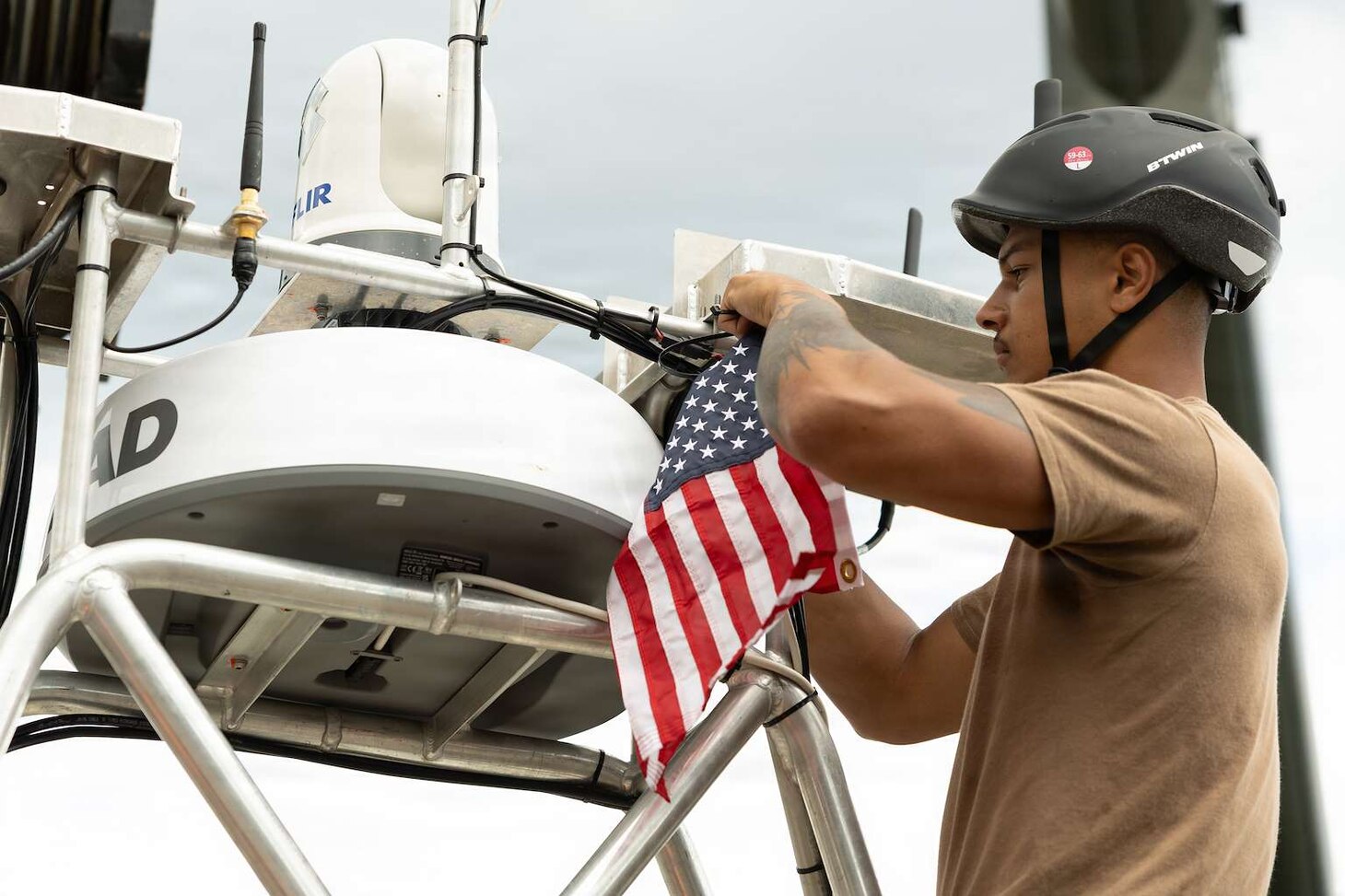
This distinction becomes essential as fleets scale. One operator can supervise multiple USVs only if the software handles routine behaviour locally.
Communications determine how independent the vessel really is
Many USVs can physically travel far beyond the range of a local radio link, which pushes them toward satellite or other over-the-horizon communications.
But long-range connectivity is neither unlimited nor guaranteed. Bandwidth can be expensive. The link can be intermittent or contested. High-volume sensor feeds may exceed what is practical to transmit continuously.
A mature USV therefore separates what must happen onboard from what needs human or network input.
Instead of streaming every sensor continuously, the vessel can process data locally and send tracks, alerts or selected imagery. Instead of waiting for a steering command every second, it can execute a mission plan until a supervisor changes it.
Payload modularity is what makes one hull useful for several missions
A USV without a mission payload is simply an autonomous boat.
The payload might be surveillance sensors, communications equipment, mine-countermeasure gear, oceanographic sensors or another mission module.
The U.S. Navy's Overlord and MUSV concepts emphasize reconfigurable platforms because mission electronics can change faster than hulls.
This modularity is economically attractive. The same vessel architecture can support several mission packages rather than requiring a new ship design for each role.
It also creates integration work: power, cooling, data interfaces, physical mounting and software all have to be standardized enough that payload changes do not become major shipyard projects.
Small and medium USVs are becoming different product classes
The label USV covers craft ranging from systems that can be launched from a pier or another vessel to platforms comparable in length to patrol craft.
Small USVs can scale rapidly because they borrow heavily from commercial marine technology. The U.S. Surface Navy said in 2026 that it had grown its small-USV inventory into the hundreds.
Medium USVs require a different acquisition model. The Navy's 2026 marketplace selected seven companies for at-sea demonstrations, with successful designs eligible for follow-on production.
The distinction resembles aerial drones: a small quadcopter and a large unmanned aircraft are both UAS, but almost every engineering and operational assumption differs.
Launch and recovery are part of the system
A USV still needs to reach the water, receive fuel or charge, be inspected and eventually be recovered.
That support architecture affects where the vessel can operate. Some small craft can deploy from a partner ship. Others require a port, trailer or dedicated support team.
DOCUMENTThe Navy’s Sea Hunter and Seahawk fact file provides a concrete reference for medium-USV scale, endurance and fleet-integration goals.OPEN ↗During Cutlass Express 2026, U.S. Sixth Fleet launched a Lightfish USV from a Seychelles partner vessel, demonstrating how the deployment method itself can expand operational reach.
The most autonomous vessel in the world is still constrained by the logistics needed to put it to sea.
Maintenance becomes predictive rather than hands-on
Removing the crew means removing the people who normally notice leaks, vibration, overheating or unusual machinery behaviour.
USVs therefore need remote health monitoring and enough instrumentation to tell maintainers when something is deteriorating.
For long missions, this can be as important as navigation autonomy. A vessel that can plan around traffic but cannot recognize its own propulsion failure is not operationally autonomous.
The support model also has to decide which failures can be tolerated until recovery and which require the mission to abort.
The control station matters less as autonomy improves
Early unmanned systems often recreate the bridge ashore: many screens, dedicated operators and constant control.
That model works for prototypes but scales poorly.
A mature fleet needs mission-level interfaces. Operators should assign areas, routes or tasks and supervise exceptions rather than steer rudder and throttle continuously.
This is one reason the Navy's unmanned experimentation increasingly focuses on common command-and-control and specialist personnel rather than only vessel performance.
What is actually inside a modern USV
A modern USV is therefore best understood as a distributed computer system wrapped in a marine vehicle.
The hull and propulsion provide endurance. Navigation sensors maintain state. Radar and cameras observe the environment. The autonomy computer fuses those inputs and controls the vessel. Communications connect it to a wider force. Modular payloads determine the mission.
The engineering challenge is not making each component work separately.
It is making the vessel remain safe and useful when sensors disagree, connectivity drops, weather changes, traffic behaves unexpectedly or one component begins to fail.
That is the difference between an unmanned boat and an operational unmanned ship.