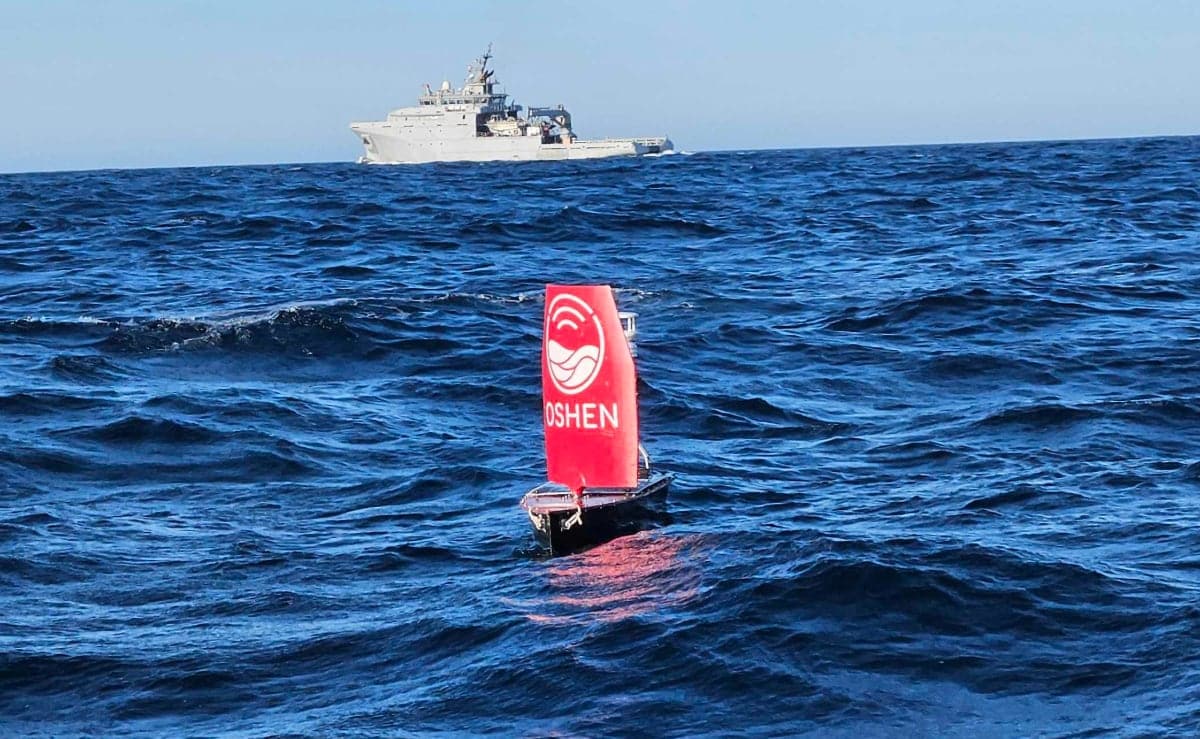
Stark and MBDA have unveiled a Vanta-12 uncrewed surface vessel configured to carry MBDA’s Sea Venom anti-ship and land-attack guided weapon, presenting the combination as a potential contribution to NATO requirements for distributed strike capability and deterrence in the North Atlantic. Stark revealed the 12-metre vessel on 28 September 2026, following its participation in the REPMUS 2026 maritime experimentation activity in Portugal.
The first Vanta-12 completed construction, entered the water and began sea trials in mid-2026. Those trials included harbour and sea acceptance activities, while the company also worked with MBDA to integrate the Sea Venom launch configuration. Stark said the vessel is designed as an artificial-intelligence-enabled USV for persistent patrol, sensing, targeting and strike missions against maritime threats. The company also describes its architecture as modular and adaptable, with the intention of enabling rapid production and later capability upgrades.
A modular strike and sensing platform
In the configuration presented by the two companies, four Sea Venom missiles are installed in a box launcher at the aft end of the vessel. A separate forward launcher contains 10 cells for Stark’s Cascade loitering munition. Stark states that Cascade carries a 5 kg warhead and has a range of 100 km. The arrangement gives the Vanta-12 both a missile payload and a separate loitering-munition capability, while retaining the platform’s ability to accept other systems.
Stark said the Vanta-12 is intended to integrate a broad range of warfare systems, including missile, loitering-munition and anti-submarine effectors, electronic-warfare equipment and intelligence, surveillance and reconnaissance sensors. The company has also completed integration work for a laser weapon, according to Stephen Brian, Stark’s Maritime Director. He said the modular design could support additional payloads such as towed-array sonars or lightweight torpedoes.
The Vanta series includes the four-metre Vanta-4 and six-metre Vanta-6, as well as the 12-metre Vanta-12. Brian said the series is designed to be sensor- and effector-agnostic. In practical terms, that means the intelligence, surveillance and reconnaissance fit could be selected according to a customer’s requirements rather than being fixed to one sensor package.
Stark gives the Vanta-12 a patrol-speed range of 1,200 nautical miles and a sprint speed exceeding 40 knots. The company says the vessel can remain at sea for weeks. In its current configuration, it is intended to operate effectively in Sea State 4 and remain on station in conditions up to Sea State 6.
The vessel was conceived in October 2025, according to Stark. The first hull then moved from construction into waterborne testing in mid-2026. Brian said the company had integrated with MBDA during that period to place Sea Venom on the platform and begin developing the associated launch and control architecture.
Sea Venom moves toward surface launch
Sea Venom is already in service on French Navy and Royal Navy maritime helicopters. MBDA is adapting the weapon for launch from a surface platform, citing increased demand among NATO and other navies for precision strike capabilities in complex littoral environments. The weapon is 2.5 metres long and uses a solid-propellant motor, according to information attributed to Janes in the source material. It carries a 30 kg high-explosive semi-armour-piercing blast and fragmentation warhead, while MBDA Naval Systems Executive Andrew Blackburn said its range is up to 30 km depending on environmental conditions.
The Vanta-12 and Sea Venom integration is not yet described as a completed, fully mature system. Blackburn said the companies were working through the full integration process. Brian characterised the work as having moved beyond initial concepts, saying that two laptops were connected and communicating as part of the early integration effort.
Vanta’s sensor and effector combinations are managed through Stark’s Minerva command-and-control and mission-autonomy software. Stark presents Minerva as the central command-and-control element in an open, modular architecture, with additional software drivers introduced for each integrated system. The companies are also seeking to connect the architecture with other command-and-control infrastructures, including the United Kingdom’s digital targeting web.
“Ultimately, we want to be able to have a ‘system-of-systems’ solution that can plug into a digital targeting web and provide a really usable capability,” Blackburn said at the REPMUS briefing. He added that MBDA did not consider that objective to be far away, although the source does not state that the connection has already been completed.
Stark said it has regularly test-fired Cascade, but the REPMUS event marked a further step in its use from the Vanta platform. Brian said one Cascade munition was launched fully digitally through Minerva from a Vanta vessel. Stark also stated that Vanta-12 took part in simulated combat missions involving integration with surface ships and other USVs.
REPMUS and NATO hybrid force development
The Vanta-12 announcement followed REPMUS 2026, an annual operational experimentation activity co-hosted by the Portuguese Navy and NATO. The event uses robotic experimentation and prototyping to examine maritime uncrewed systems and takes place around Portugal’s Tróia peninsula each September. Its activity is increasingly focused on complex serials involving crewed and uncrewed platforms, reflecting the shift by NATO navies toward hybrid force structures.
One REPMUS 26 serial involved the Portuguese Navy M-frigate NRP Bartolomeu Dias working with about 30 uncrewed aerial vehicles and USVs to defend a maritime exclusion zone against more than 60 opposing UAVs and USVs. The exercise therefore provided a setting for testing the interaction of crewed ships, uncrewed surface craft and aerial systems rather than treating the USV as an isolated platform.
Stark and MBDA are positioning the Vanta-12 within broader European and NATO efforts to combine crewed and uncrewed capabilities. The source identifies Denmark, Germany, the Netherlands, Norway and the United Kingdom among the NATO navies at different stages of establishing and balancing these force structures.
The United Kingdom’s Royal Navy is developing an ‘Atlantic Fleet’ structure that combines several mission areas. Within that structure, Atlantic Bastion focuses on underwater warfare, Atlantic Shield on integrated air and missile defence, and Atlantic Strike on long-range power projection intended to deter attacks. Stark says the Vanta-12, with its current and potential payload options, could contribute to all three elements.
For Atlantic Shield, the Royal Navy announced in 2025 that it intended to trial uncrewed escort platforms for crewed surface ships within two years. In April 2026, the UK Ministry of Defence announced plans to accelerate delivery of a large uncrewed surface vessel. The source presents these developments as part of the wider context for considering armed USVs alongside conventional naval assets.
Production scale and distributed magazines
Stark argues that an uncrewed platform can be produced in larger numbers than more complex crewed assets, allowing navies to increase the number of launch platforms and effectors available across an operating area. Brian said MBDA became involved because the companies recognised that future requirements would include the ability to launch missiles from such vessels. The Sea Venom fit is intended to demonstrate how the platform can contribute to that approach.
Brian described the Vanta-12 operating with a Royal Navy Type 45 destroyer or Type 23 frigate as an example of a high-low force mix. He also applied the same logic within the uncrewed platform itself: a Vanta-12 carrying Cascade and Sea Venom would combine different levels of capability on one vessel. The source links this model to the need to generate and disperse launch platforms while large quantities of conventional ordnance and uncrewed systems are being expended in current conflicts.
MBDA’s Blackburn said the Vanta-12’s range, payload options and lack of a crew could allow a navy to adopt a more forward threat posture and increase deterrent effect. Stark’s stated concept is also intended to expand magazine depth by distributing weapons across more platforms rather than concentrating all launch capacity in a smaller number of crewed ships. These are company and executive claims about the capability’s intended operational value, not reported combat results.