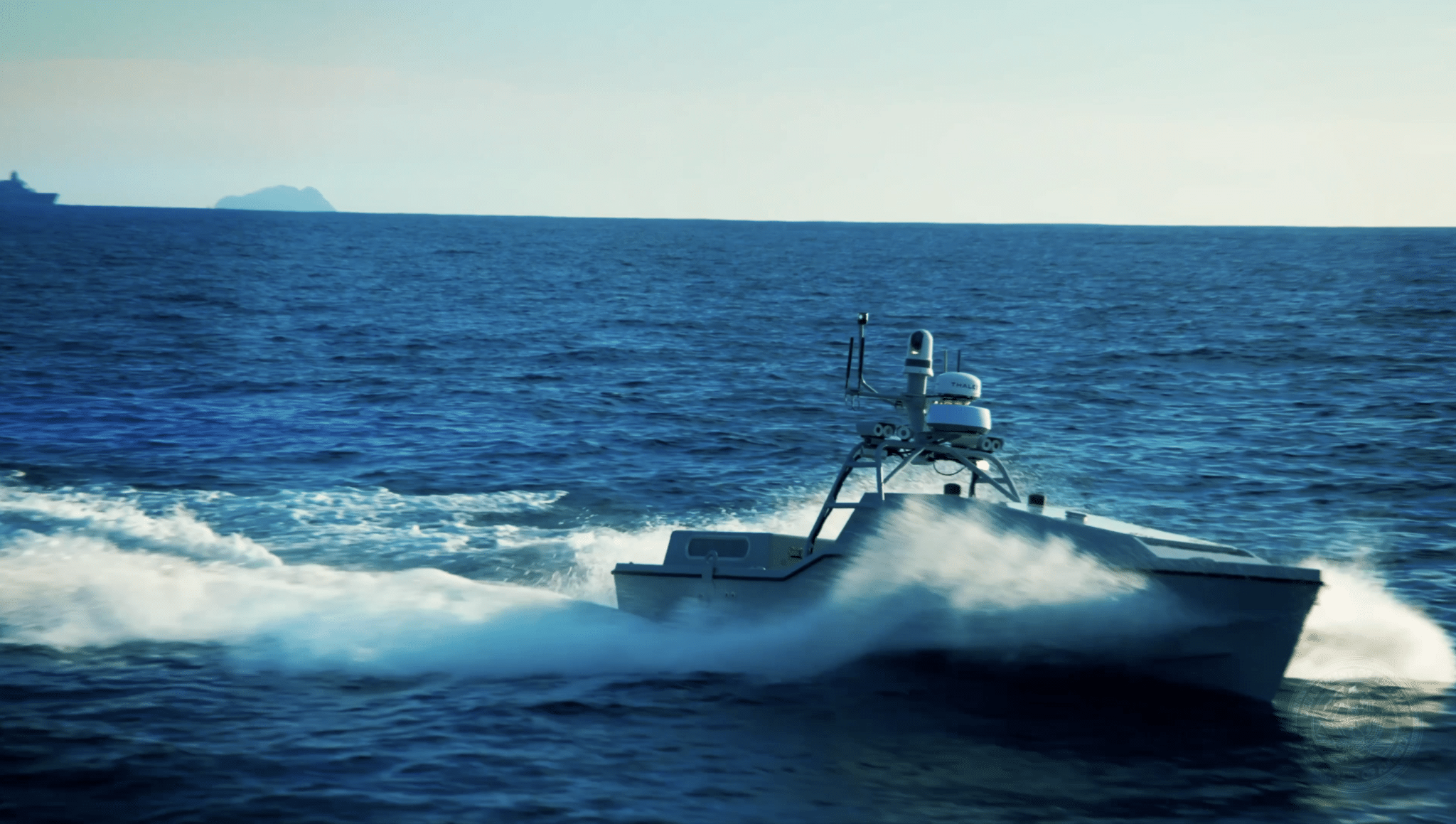
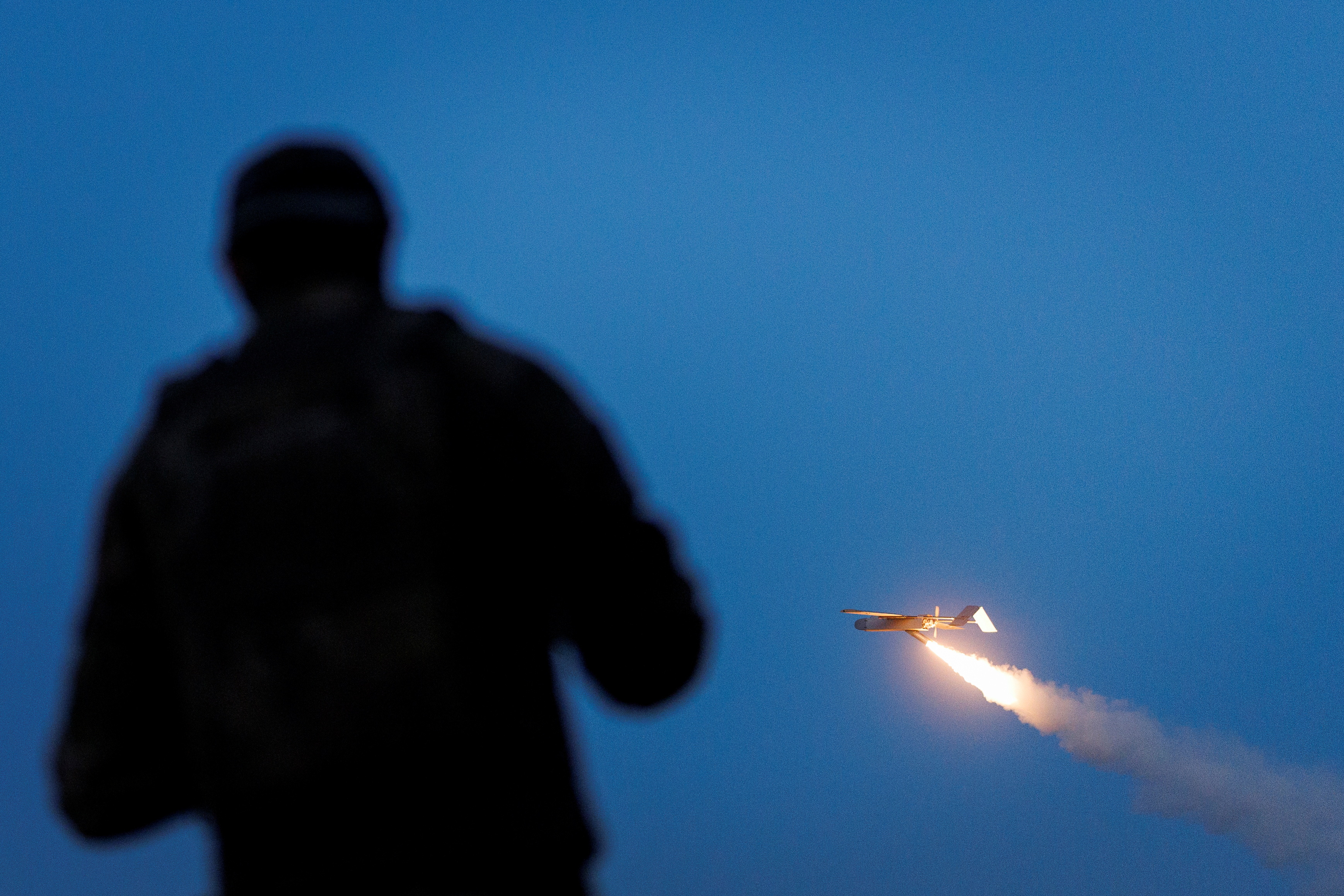
The most important change in military drones may not be range, payload or speed. It may be the gradual removal of continuous human control from the flight itself.
For most of the modern drone era, an unmanned aircraft was still deeply dependent on a pilot. The person moved from the cockpit to a ground station, but the control relationship remained familiar: the aircraft sent information back, the operator interpreted it and the operator continuously told the aircraft what to do.
That model is now being stretched.
Drones increasingly stabilize themselves, follow routes, avoid obstacles, track objects, fuse sensor data, continue through communications interruptions and coordinate with other systems. At the high end, the U.S. Air Force is testing Collaborative Combat Aircraft intended to operate as semi-autonomous partners to crewed fighters. At the tactical end, Ukraine is training AI models on battlefield data so unmanned systems can perform more of the perception and terminal mission locally.
The direction is clear, but the phrase 'autonomous drone' hides too much. Autonomy is not a single switch that turns a remote-controlled aircraft into an independent robot. It is a spectrum of functions, authorities and dependencies.
Remote control was the first generation of unmanned warfare
The basic remote-control model moves the human out of the aircraft without moving the human out of the control loop.
The operator still handles navigation, sensor pointing, target interpretation or mission decisions through a data link. The aircraft may have an autopilot underneath, but the mission is structured around continuous human interaction.
This architecture has obvious strengths. Human judgment remains immediate. The aircraft can be relatively simple. Operators can adapt to unexpected situations using context that is difficult to encode in software.
It also creates a hard scaling limit.
Every additional aircraft consumes communications capacity and human attention. If one operator must continuously fly one drone, a force that wants ten times as many drones eventually needs something close to ten times as much piloting capacity.
Electronic warfare exposes another weakness. A remote-controlled system depends on the link between aircraft and operator. When that link becomes unreliable, the quality of the aircraft itself may matter less than what it can do on its own.
Autonomy begins with functions, not with independent weapons
Most military autonomy is better understood as automation of specific functions.
An aircraft may hold altitude automatically. It may navigate between waypoints. It may return to a safe location after losing a link. It may track an object selected by an operator. It may detect obstacles and alter its path. None of those capabilities necessarily gives the system authority to choose a military objective or decide to use force.
This functional view matters because autonomy can be distributed through the mission.
One system may automate flight but not sensing. Another may automate perception but require a human to approve every action. A third may receive a mission objective and plan its own route while a human supervises several aircraft.
The transition from remote control to autonomy is therefore a transfer of workload, not automatically a transfer of command responsibility.
| Function | Remote-control model | More autonomous model |
|---|---|---|
| Flight control | Operator continuously commands movement | Aircraft maintains stable flight and executes basic manoeuvres locally. |
| Navigation | Operator relies on live control or waypoint supervision | Aircraft fuses onboard sensors and adapts its route when external navigation is degraded. |
| Perception | Human interprets most sensor imagery | Onboard or networked AI detects, classifies or tracks objects for human review or mission logic. |
| Mission management | Operator sequences tasks directly | Aircraft can plan or re-plan parts of the mission within defined constraints. |
| Multi-vehicle coordination | Operators manage aircraft individually | Software allocates tasks or coordinates multiple vehicles with less human micromanagement. |
| Use of force | Human directs or approves engagement | Policy and system design determine where human judgment and supervision remain required. |
The first payoff is reducing pilot workload
Autonomy is attractive because human attention is expensive.
A trained operator is a limited resource. The larger the unmanned fleet becomes, the harder it is to sustain a model in which every aircraft requires continuous individual control.
DARPA's ALIAS programme approached autonomy from this labour problem. Rather than designing a new unmanned aircraft, it developed an automation suite intended to perform many cockpit functions and reduce crew workload in existing aircraft. In March 2026, DARPA transferred an H-60Mx Black Hawk equipped with the MATRIX autonomy suite to the U.S. Army for advanced operational testing.
The significance is broader than helicopters. The programme demonstrates that autonomy can be treated as a software-and-sensor layer placed on top of an existing vehicle architecture.
That concept scales into unmanned systems. If flight, navigation and routine mission management move onboard, a human can potentially supervise more vehicles or focus on decisions that require context rather than stick-and-rudder control.
Mission autonomy is different from flight autonomy
A drone that can take off, fly a route and land by itself is highly automated, but it may still be mission-dependent on a human.
DOCUMENTDARPA’s ALIAS transition shows autonomy as a transferable flight-management layer rather than a capability tied only to purpose-built unmanned aircraft.OPEN ↗Mission autonomy begins when the system can interpret higher-level objectives and choose among permissible actions to achieve them.
That can include route re-planning, sensor management, task allocation or cooperation with other vehicles. The system is no longer simply following a fixed sequence of commands; it is selecting from options within boundaries set by humans.
DARPA's EVADE work illustrates this direction. The programme uses standardized autonomy software to manage flight control and navigation across entire missions while minimizing user interaction during long transit phases. DARPA describes a model in which small units can task an air asset through familiar battle-management tools without maintaining a dedicated ground-control station.
The objective is not to make the human irrelevant. It is to move the human to a higher level of abstraction.
Communications denial makes autonomy operationally valuable
The move toward autonomy is not driven only by a desire to save operators.
Contested communications create a second pressure.
A remotely piloted aircraft becomes fragile when every meaningful decision has to travel over a link. Jamming, terrain or distance can interrupt that relationship.
If the aircraft can maintain navigation, avoid hazards and continue a defined mission locally, temporary loss of communication becomes degradation rather than immediate failure.
This is one reason autonomy and GNSS-denied navigation are converging. A system that already processes camera and inertial data to navigate without reliable satellite positioning has much of the onboard compute infrastructure needed for more sophisticated local decision-making.
Ukraine's Ministry of Defence describes Avengers Labs models supporting scenarios in which an unmanned system enters a designated area, autonomously detects a target and acts according to mission logic. The ministry presents these as a way to reduce dependence on continuous manual control in real combat conditions.
Perception is the gateway to useful autonomy
A system cannot act independently in a meaningful environment if it cannot perceive that environment.
This is why computer vision sits at the centre of many autonomy programmes. Cameras and other sensors produce raw data; machine-learning models convert that data into objects, tracks, terrain features or other representations useful to the mission.
Ukraine has built a particularly large battlefield-data pipeline around this problem. The Ministry of Defence says Avengers Labs contains an annotated dataset of five million battlefield frames, largely derived from DELTA, and is being used by Ukrainian defence companies to train AI models for unmanned systems.
The ministry says related models process more than 100,000 video streams per month in DELTA and automatically detect a substantial share of enemy objects in those feeds. Those are Ukrainian official figures rather than independently reconstructed measurements, but they illustrate the scale at which battlefield perception is becoming a data problem.
The key resource is no longer only the aircraft. It is labelled experience.
Data is becoming part of the weapons industrial base

Traditional defence production is organized around factories, components and supply chains. Autonomous systems add another industrial input: training data.
An AI model improves by learning from examples that resemble the environment in which it will operate. A company with access only to clean test-range imagery may struggle to reproduce the noise, damage, weather, camouflage, sensor artefacts and rapid equipment changes of a real battlefield.
Ukraine's decision to open controlled access to battlefield-derived datasets through Avengers Labs is therefore strategically significant. It converts accumulated combat data into an industrial resource.
The model also changes over time. New target types appear. Camouflage changes. Sensors change. The environment changes. A perception system trained on last year's visual world can degrade even if the code itself is untouched.
Autonomy therefore requires a feedback pipeline similar to the electronic-warfare adaptation cycle: collect data, identify failures, retrain or update, validate, deploy and repeat.
Hardware and autonomy software are beginning to separate
One of the most consequential procurement experiments is happening in the U.S. Air Force's Collaborative Combat Aircraft programme.
In June 2026, the Air Force awarded contracts for both CCA air vehicles and mission-autonomy software. It described the approach as intentionally decoupling hardware from software — effectively treating mission autonomy as a separately competed layer.
That is a major departure from the classic aircraft model in which the airframe, mission systems and control logic mature together inside one long programme.
Separating the layers creates the possibility that autonomy software can improve faster than the aircraft structure. A mission-autonomy supplier can be replaced or updated without replacing the entire vehicle.
It also creates new integration demands. Interfaces have to remain stable. Software has to understand the sensors and performance limits of different platforms. Safety and verification become continuous rather than one-time certification tasks.
The payoff is speed. The Air Force is attempting to apply software competition to a hardware fleet that may remain in service much longer than any one autonomy model.
Collaborative Combat Aircraft show what scaled autonomy looks like
CCA are useful because they reveal that the purpose of autonomy is not simply to make an aircraft pilotless.
The Air Force describes them as semi-autonomous aircraft intended to operate alongside crewed platforms, extending reach, awareness and combat capacity.
DOCUMENTUkraine is turning annotated battlefield data into shared infrastructure for training perception and autonomy models across defence companies.OPEN ↗By mid-2026, YFQ-42A and YFQ-44A aircraft had moved beyond isolated test flights into exercises at Creech Air Force Base focused on sortie generation, logistics, distributed operations and integration with crewed aircraft.
That operational focus matters. A useful autonomous aircraft has to fit into maintenance, command-and-control, mission planning and airspace procedures. Autonomy that works only inside a laboratory is not military capability.
The programme also preserves an explicit human role. During a July 2026 live-fire milestone, Air Force reporting emphasized human oversight for weapon release even as the aircraft itself demonstrated increasingly autonomous operation.
That combination — autonomous platform behaviour with retained human authority over particular decisions — is likely to remain common.
The human is moving from in-the-loop to on-the-loop
The language of control is evolving with the technology.
A human 'in the loop' directly participates in the sequence that produces an action. A human 'on the loop' supervises a system that can execute more steps itself and intervenes when required.
These phrases are useful but incomplete because real systems can have several loops at once.
A human may be outside the low-level flight-control loop while remaining inside the mission-approval loop. An onboard model may classify objects automatically while a human approves a higher-level task. A formation may coordinate routes autonomously while operators retain authority to redirect or terminate the mission.
The relevant question is therefore not 'Is the drone autonomous?'
It is: which decisions are delegated, under what constraints, with what supervision and what happens when the system becomes uncertain?
| Control relationship | Human role | System role |
|---|---|---|
| Direct control | Continuous pilot | Aircraft executes low-level commands. |
| Supervised automation | Operator monitors and approves key changes | Aircraft handles routine flight and navigation. |
| Mission command | Human assigns objectives and constraints | Aircraft selects routes, sensor actions or task sequences. |
| Multi-vehicle supervision | Human manages a team rather than individual aircraft | Software coordinates vehicles and allocates routine tasks. |
| Weapon employment with human judgment | Human retains specified authority over use of force | Autonomous functions may support detection, tracking, navigation and other parts of the chain. |
Policy is becoming part of system architecture
As autonomy moves into systems capable of using force, policy cannot be added after engineering is complete.
U.S. Department of Defense Directive 3000.09 requires autonomous and semi-autonomous weapon systems to allow commanders and operators to exercise appropriate levels of human judgment over the use of force. It also requires realistic testing, verification and validation for relevant systems.
NATO's responsible-AI framework similarly emphasizes lawfulness, responsibility and accountability, explainability and traceability, reliability, governability and bias mitigation.
These principles affect design choices. A system that must be supervised needs communications and interfaces that allow supervision. A system that must be governable needs mechanisms to constrain or terminate behaviour. A system that must be testable needs logs, repeatable scenarios and defined performance boundaries.
Responsible autonomy is therefore not only an ethical layer. It is an engineering requirement.
Autonomy does not remove uncertainty — it moves uncertainty onboard
Human operators make mistakes. Autonomous systems make different mistakes.
A perception model can misclassify an object. A navigation system can become overconfident in a bad estimate. A planner can select a route that satisfies its optimization criteria but ignores context that a human would consider obvious.
The difficulty is that autonomous mistakes can be repeatable at machine speed and at fleet scale.
This is why testing in realistic conditions matters more as autonomy increases. The system has to encounter sensor degradation, communications loss, unexpected objects, map errors and behaviours that were underrepresented in training data.
The more decisions are delegated, the more important it becomes to know when the system does not know.
Edge compute becomes a flight-system component
More autonomy means more computation on the aircraft.
Remote-control systems can send raw imagery back to a powerful ground computer or a human brain. An autonomous system operating through communications loss has to perform more perception and decision-making locally.
That makes processors, memory, power consumption and thermal management part of the autonomy trade space.
A larger model may be more capable but require hardware too heavy or power-hungry for a small drone. A smaller model may run efficiently but struggle with complex scenes.
The same tension affects latency. Decisions made onboard can avoid communications delay, but only if the aircraft has enough compute to make them fast enough.
Autonomy therefore competes directly with payload, endurance and cost.
Swarming is not just many drones in the same place
The word swarm is often used for any large group of drones. Genuine collaborative autonomy is more demanding.
A coordinated group has to share or infer enough information to divide work, avoid harmful conflicts and continue functioning when individual vehicles or links fail.
That can involve task allocation, distributed mapping, cooperative sensing or route coordination. It does not necessarily require every drone to communicate continuously with every other drone.
NATO-funded SAPIENCE research demonstrated multiple drones cooperating in GNSS-denied search-and-rescue scenarios, including continuation of a task when one aircraft lost communications. The work was still research-level, but it illustrates the technical direction.
Ukraine's September 2026 expansion of Avengers Labs cooperation with the United Kingdom likewise identified AI models for swarms and operation under limited communications or GNSS as priority areas.
The scaling logic is powerful: instead of one operator controlling one drone, a smaller number of humans can supervise teams that distribute routine tasks among themselves.
The industrial race is shifting toward reusable autonomy stacks
If autonomy remains tightly coupled to every individual airframe, development becomes slow and expensive.
The emerging alternative is a reusable stack: common perception models, navigation services, mission-management software and interfaces that can be adapted across several platforms.
DARPA's EVADE programme standardizes autonomy software across multiple aircraft designs. The Air Force's CCA programme separately competes mission-autonomy software. Ukraine is building shared data infrastructure that multiple companies can use to train their own models.
All three approaches point toward the same industrial idea: autonomy is becoming a horizontal layer across fleets rather than a bespoke feature of one vehicle.
That could change competition. Airframe manufacturers may no longer own the entire intelligence stack. Software companies may compete to provide mission behaviour across several hardware platforms.
Autonomy changes the economics of mass
Cheap drones become strategically important when they can be used in large numbers. Autonomy determines whether humans can actually command that scale.
A force can manufacture one million aircraft and still fail to create mass if each one requires a dedicated expert pilot, a dedicated high-bandwidth link and constant human attention.
Automating routine flight and mission functions changes the personnel equation. The goal is not zero humans. It is fewer human-hours per useful unmanned effect.
This is the logic behind the U.S. concept of 'precise mass' and programmes such as Replicator and CCA: combine lower-cost systems with enough autonomy that large fleets can be operationally manageable.
The constraint then moves. Instead of pilot numbers, the bottlenecks may become data, compute, testing, maintenance, communications architecture and command policy.
Autonomy also creates a verification problem
Traditional software can be tested against defined inputs and expected outputs. Learning systems make assurance more difficult because performance depends on data and environment.
A vision model that performs well on one sensor, season or geographic region may behave differently elsewhere. Updating the model can improve one class of cases while unexpectedly degrading another.
This means the military needs a continuous evaluation process, not only a certification event before fielding.
Data provenance matters. Version control matters. Operators need to know which model is on which system. Engineers need a way to reproduce failures. Commanders need confidence that an update has not silently changed behaviour outside its intended boundary.
As fleets become software-defined, model management becomes a readiness function.
Humans will still matter — but their job changes
The most plausible future is not a battlefield without human operators.
It is a battlefield in which humans spend less time performing low-level control and more time setting objectives, managing exceptions, interpreting uncertainty and coordinating systems.
That changes training. A pilot who learns to manually fly one aircraft may become a mission manager supervising several. A maintainer may need to understand software state as well as mechanical condition. A commander may need to understand what an autonomy model can and cannot infer.
The skills do not disappear. They move up the abstraction stack.
What autonomy still cannot solve
Autonomy does not remove physics, logistics or adversaries.
A drone still needs energy. Sensors still have limits. Cameras can be obscured. Navigation estimates can drift. Models can misclassify. Communications can fail. Hardware can break.
Autonomy can make a system more resilient to some failures while introducing new ones.
It also cannot substitute for a poorly defined mission. Software can optimize against objectives, but the quality of those objectives and constraints remains a command problem.
The danger is to treat autonomy as intelligence in the human sense. Current systems are engineered to perform bounded tasks. Their competence can be impressive inside those boundaries and brittle outside them.
The race is not to remove the human — it is to move the human
The phrase 'remove the pilot from the loop' captures only half of what is happening.
Low-level piloting is disappearing from more parts of the unmanned mission. Navigation, object detection, route planning and multi-vehicle coordination are increasingly handled by software.
But military organizations are simultaneously building new loops around supervision, policy, data, testing and command.
The human is not simply removed. The human is repositioned.
At the tactical level, that can mean supervising several drones instead of steering one. At the operational level, it can mean commanding uncrewed aircraft as part of a mixed formation. At the industrial level, it means defining data, models and software interfaces that can change faster than the airframes they control.
The real autonomy race is therefore not a race toward machines acting without people.
It is a race to determine how much machine decision-making can be made reliable, scalable and governable — and where human judgment creates the most value.