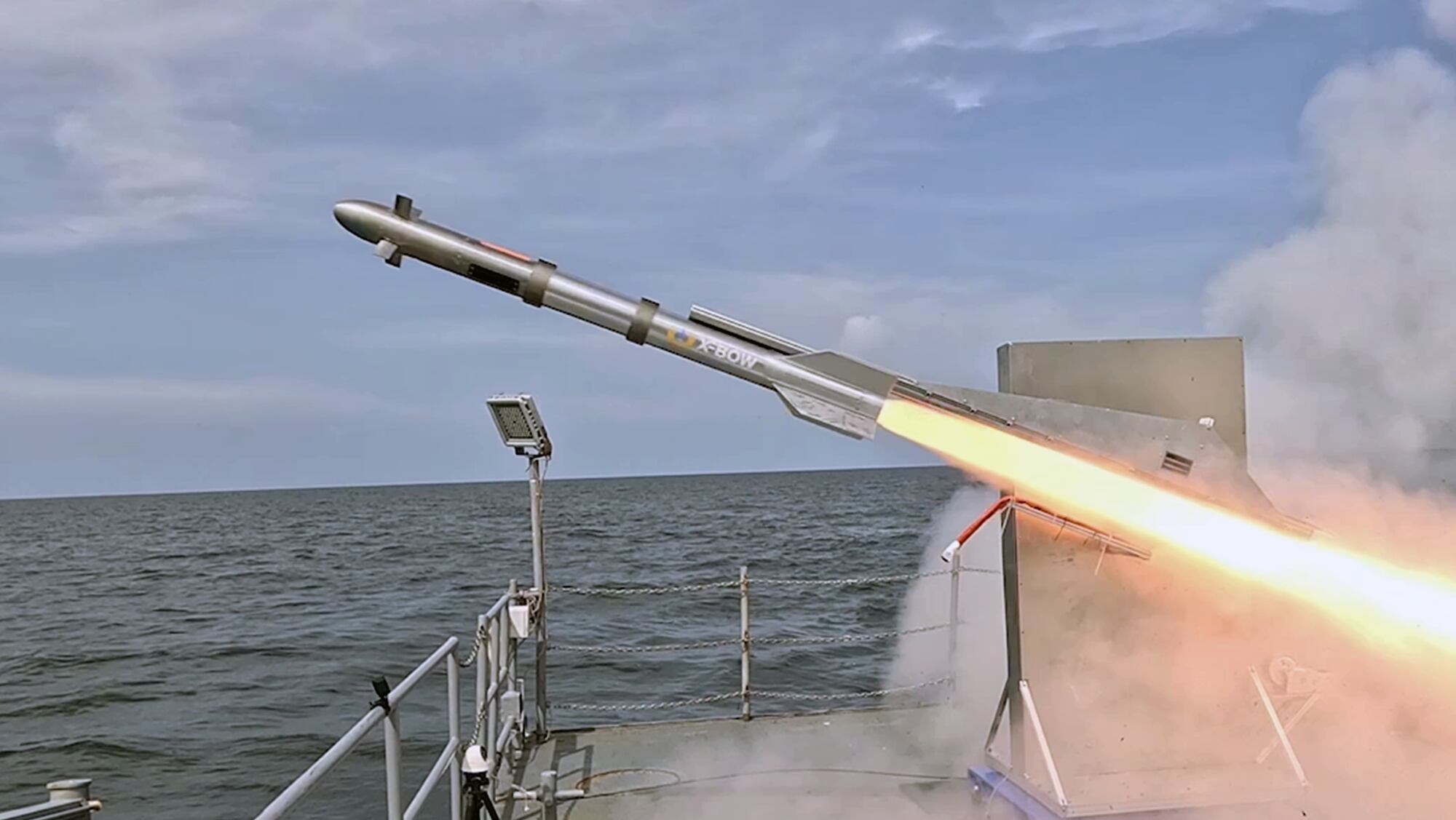
LONDON — X-Bow Systems has unveiled Buckler, a drone interceptor the solid rocket motor manufacturer says is designed to engage Group 3 unmanned aircraft for less than $100,000 per unit. The New Mexico company introduced the system at the 2026 Farnborough Airshow, presenting it as an answer to the high cost of using major air-defense missiles against comparatively inexpensive drones.
Buckler is intended to destroy Group 3 UAS, a category covering aircraft weighing up to 1,320 pounds that fly below 18,000 feet and at speeds under 250 knots. X-Bow says the interceptor can engage unmanned aircraft at supersonic speeds. The company recently tested the munition, saying that event demonstrated its propulsion and flight performance.
An in-house production approach
A central element of X-Bow’s pitch is its manufacturing model. The company says Buckler’s airframe and propulsion system are made entirely at X-Bow factories, rather than being dependent on components supplied by multiple companies. X-Bow argues that arrangement avoids a production bottleneck affecting more expensive systems whose manufacture relies on a broader supplier chain.
The company is positioning that production control alongside the interceptor’s stated price as it seeks to address demand for counter-drone weapons that can be built in quantity. Buckler’s name references a medieval shield, as previously noted by The War Zone.
You can’t win a war of attrition trading million-dollar interceptors against thousand-dollar threats. Buckler has flown, it comes in under $100,000, and we build its airframe and propulsion ourselves — the part of the industrial base that is so stressed by today’s munitions demands. This is our answer to the call from the U.S. and its allies: affordable capability, at scale.
Jason Hundley, X-Bow founder and chief executive officer
A cost-per-kill problem
X-Bow’s announcement arrives amid continued concern over the mismatch between the cost of attack drones and the interceptors used to defeat them. U.S. troops in the military’s Central Command area of operations have faced Iranian Shahed attack drones that are described as cheaper and mass-produced, while air defenders have relied on far more costly missiles.
The source cited a comparison between a PAC-3 interceptor and a Shahed-136: a single PAC-3 used against one Shahed carries a $4 million-to-$35,000 tradeoff, or a 114-to-1 cost-per-kill ratio. X-Bow’s stated sub-$100,000 unit price would still leave Buckler above the cost of the cited drone, but the company is explicitly targeting a substantially lower-cost option than multimillion-dollar interceptors.
Buckler was not the only counter-UAS offering unveiled at Farnborough. Lockheed Martin introduced Morfius X-Rotor, a ground-launched airborne high-power microwave system described by the company as a “one-to-many” counter-UAS option. Lockheed says Morfius can neutralize more than 50 enemy drones in a single flight and is designed for recovery and reuse. The company also introduced a lower-cost Patriot interceptor, underscoring the industry focus on reducing the expense of defending against evolving unmanned threats.