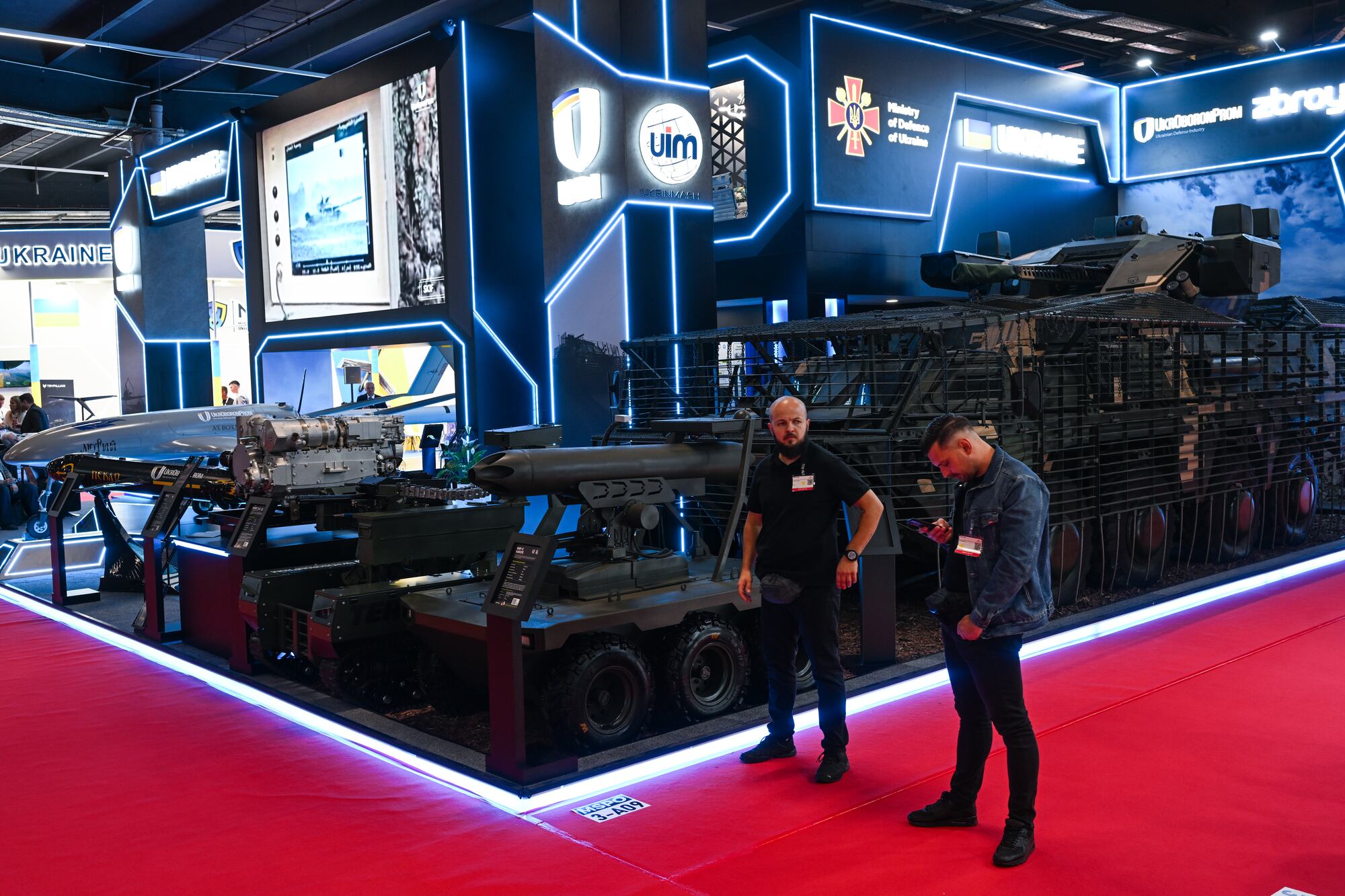
KIELCE, Poland — Ukrainian defense companies are accelerating work on drone interceptors designed to counter jet-powered Russian unmanned aircraft, with manufacturers focusing on the speed, materials and production economics needed to meet the emerging threat. Several firms presented or discussed their efforts during the MSPO defense industry exhibition in Kielce, Poland, which runs from Sept. 8 to 11.
The projects reflect a broader effort to field interceptors that can keep pace with faster targets while costing less than the drones they destroy. Ukrainian companies have been showcasing counter-drone systems to military and industry representatives from Poland and other countries at the show.
Higher speeds, revised materials
UAV producer General Cherry is developing a new kinetic-booster version of its Bullet interceptor. The company expects the aircraft to have a maximum speed of about 450 kilometers per hour, or 280 mph.
We have to make changes to the frame and the materials the drone is made of, using more heat-resistant materials.
Andrii Oliinyk, senior international affairs manager at General Cherry
Oliinyk told Defense News that General Cherry planned to release the interceptor in the fall, after completing its testing phase. The planned redesign points to the demands placed on an interceptor intended to operate at substantially higher speed than earlier systems.
Grim Tech, another Ukrainian vendor, is pursuing a separate interceptor for jet-powered drones. The company is targeting a maximum speed of between 500 and 700 kilometers per hour for the new system.
Russia uses almost only jet-powered Shaheds to attack Kyiv because the interceptors that we were using in the past against older generations of drones had an interception rate of around 90 percent.
A Grim Tech manager
The manager said Grim Tech wanted to present its jet-powered interceptor by the end of October. The comments describe a shift driven by the changing type of drones used in attacks, after interceptors deployed against older generations of unmanned aircraft had achieved an interception rate of around 90%, according to the company representative.
Cost and production are central requirements
BlueBird Tech, which supplies FPV drones, drone detectors, electronic warfare systems and unmanned ground vehicles to Ukraine’s military, has also announced the development of an air-defense interceptor. Vadym Stepanchuk, the company’s head of business development, said the project remains at an early stage.
We’ve had to build a very effective R&D system. Our R&D cycles are usually measured in weeks, whereas elsewhere you might expect them to take years.
Vadym Stepanchuk, head of business development at BlueBird Tech
For BlueBird Tech, affordability is a fundamental design condition rather than a secondary consideration. Stepanchuk said the company is pursuing a jet-powered interceptor that can be affordable and mass-producible, with the goal of ensuring the interceptor costs less than the target it destroys. He said this requires getting the engineering right from a cost-efficiency perspective.
Industry looks beyond domestic demand
The interceptor programs are being developed as Ukrainian manufacturers prepare for a potential lifting of an arms-export embargo that had limited their ability to sell products abroad. Earlier this year, Ukraine’s government decided to create a regulated framework allowing local defense companies to export surplus military equipment to partner nations, provided Ukrainian military needs are met first.
A growing number of Ukrainian defense companies are also working with U.S. and European partners to manufacture products outside Ukraine. MSPO provided a venue for additional international ties: among the agreements signed at the exhibition was a cooperation deal between Estonian counter-drone and surveillance specialist DefSecIntel Solutions and Ukrainian-Estonian company DoD Solution, which focuses on onboard computers and autonomy systems for unmanned platforms.