Ukraine’s Navy says one of its Sargan 3000 unmanned surface vessels destroyed an unidentified Russian drone boat in the Black Sea, an engagement it described as the first naval battle between unmanned boats. The claim has not been independently verified, and the Navy did not disclose when or where in the Black Sea the incident occurred.
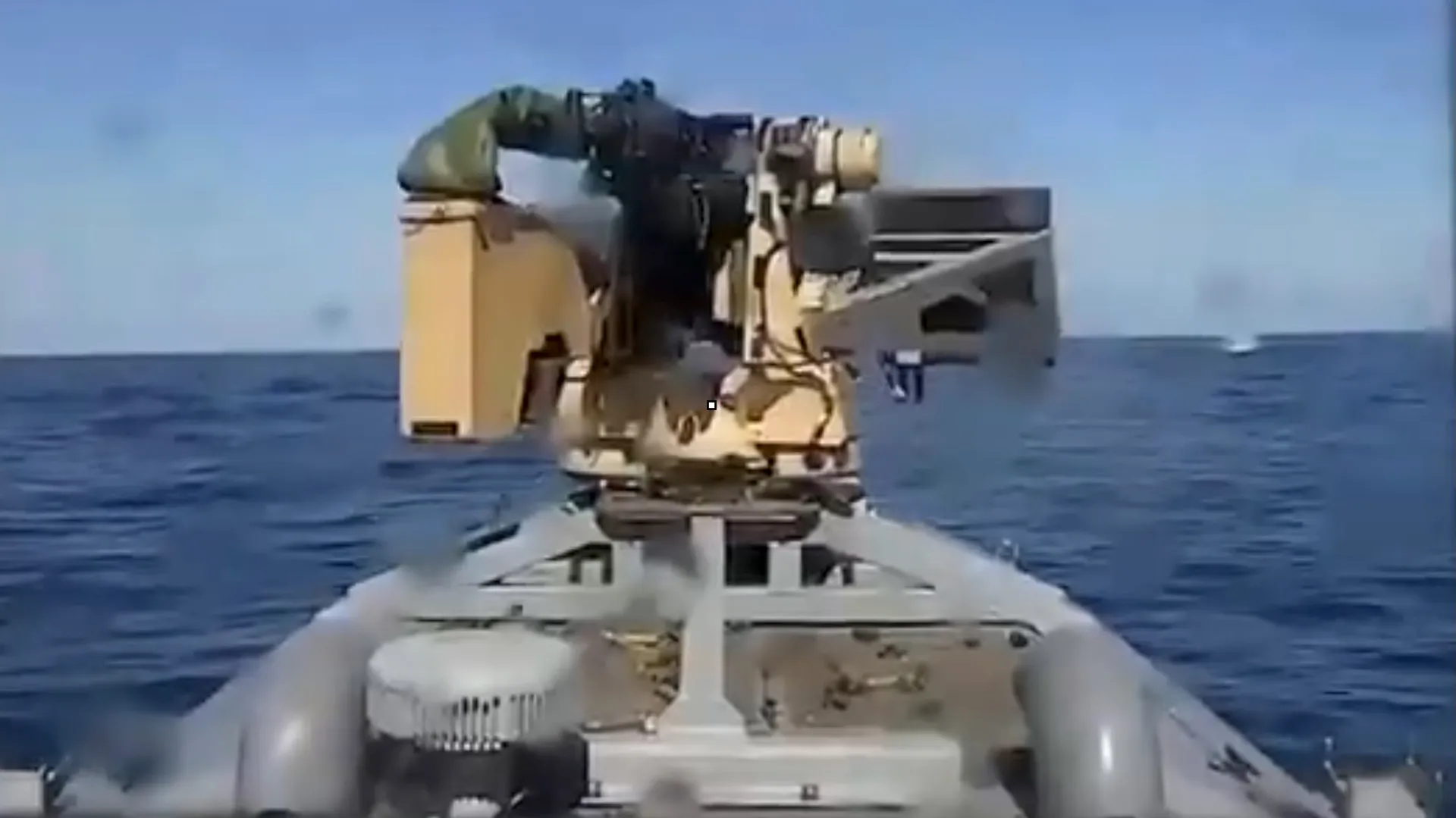
According to the Ukrainian Navy, units of the Main Intelligence Directorate, or GUR, detected the Russian vessel before the Navy’s Sargan 3000 engaged it. The Ukrainian boat was fitted with a Protector 12.7 mm remotely operated weapon station, made by Kongsberg. “This is the first naval battle in history between unmanned boats,” the Navy said in a Telegram post.
An 81-second video released by the service shows the Sargan 3000 acquiring and firing on the Russian USV with its machine gun. The footage begins with an onboard view from the Ukrainian vessel, then shifts to a closer perspective of the Protector weapon station firing. At roughly the 30-second point, the video switches to imagery from an aerial platform whose type is unclear. The Russian craft is repeatedly struck; debris appears to fly from it before it sinks stern first.
The Russian drone boat was not identified, and it did not appear to be armed in the released footage. While the Ukrainian account cannot be independently confirmed, no prior example of one drone boat destroying another was identified in the source reporting.
A multipurpose Ukrainian platform
Ukrainian President Volodymyr Zelensky first introduced the Sargan 3000 in April, describing it as a multipurpose platform that had completed testing and entered service with the Ukrainian Navy. He said the vessels were highly maneuverable and able to conduct strike missions. The name Sargan means needlefish in Ukrainian.
Russian outlet AmalNews reported that the system was initially designed as a kamikaze weapon before evolving into a platform for remotely controlled weapons. It described a low-profile hull with hydrodynamic lines and materials intended to reduce radar signature, along with a waterjet propulsion system. AmalNews said the propulsion system was presumably powered by a diesel or hybrid engine to provide long range.
AmalNews listed the Sargan 3000 at 6.9 meters long and 2.2 meters wide, with an operational radius of up to 1,600 kilometers, a 450-kilogram payload, and an estimated speed of 40 to 55 knots. Those specifications have not been independently confirmed.
The outlet also said the vessel connects with Ukraine’s Delta situational-awareness system to transmit target information, video and telemetry to operators in real time. Its reported control arrangements include redundant satellite communications terminals, while inertial and optical navigation are intended to allow operation under GPS jamming. AmalNews further reported electronic-countermeasures modules and multiple variants, including versions carrying machine guns, rockets, FPV drones, electronic-warfare equipment, or mines.
Potential role against drone-boat threats
The reported engagement adds another role to Ukraine’s expanding use of unmanned surface vessels. Ukraine has employed drone boats against Russian Black Sea Fleet vessels and facilities, and the Sargan 3000’s first publicly known combat engagement was reported in July. The Ukrainian Navy said then that a Sargan 3000 destroyed the Russian FSB border guard ship Izumrud near Novorossiysk, with dead and wounded among its crew. It was unclear whether that operation used the vessel as a one-way attack craft or as a weapons platform, though the former was considered more likely.
A drone boat capable of finding and engaging another USV could provide a means of countering weapons that are difficult to locate and destroy over open water. Such vessels can operate at sea across long distances and for extended periods, potentially allowing them to hunt other drone boats or form a protective screen around harbors, ships and other targets vulnerable to USV attacks.
The encounter was not a duel between similarly armed systems: the Russian craft appeared unable to return fire. Still, it underscores the continuing adaptation of combat drone boats from one-way attack weapons into platforms that can carry guns, rockets, missiles, FPV drones and other payloads. With both Russia and Ukraine developing unmanned maritime systems, the Ukrainian claim points toward the prospect of more direct USV-versus-USV engagements.