Unmanned systems are changing maritime warfare for a simple reason: the sea has always rewarded persistence, reach and numbers, but crewed warships are expensive places to put all three.
An uncrewed vessel changes the risk equation. It can remain on station for long periods, approach areas commanders would hesitate to send sailors into, act as a distributed sensor, carry a modular payload or simply force an opponent to spend attention and weapons on something far cheaper than a frigate or destroyer.
Ukraine made the strategic effect impossible to ignore in the Black Sea. At the same time, the U.S. Navy, NATO members and commercial suppliers are moving USVs from experimentation toward operational fleets. What is emerging is not a replacement for conventional navies. It is a new layer around them.
The sea-drone story is bigger than explosive boats
Public discussion of naval drones is dominated by strike USVs because the imagery is dramatic and their battlefield effects are visible.
But a modern unmanned maritime force includes a much wider set of roles: reconnaissance, persistent surveillance, communications relay, electronic support, mine countermeasures, anti-submarine sensing, logistics, deception and potentially strike.
The platform matters less than the mission architecture. A small craft carrying cameras and communications equipment can extend a force's maritime picture. A larger high-endurance vessel can patrol for weeks. A fast attritable craft can create a threat that must be detected and defeated before it reaches a ship or harbour.
The strategic effect comes from mixing those roles rather than expecting one universal sea drone.
Ukraine demonstrated what asymmetry at sea can look like
Ukraine entered the full-scale war without a conventional surface fleet capable of matching Russia ship for ship in the Black Sea.
That made unmanned maritime systems attractive because they offered a way to create sea-denial effects without reproducing the cost structure of a traditional navy.
The Ukrainian government now publicly presents several distinct naval-drone families. In April 2026, President Volodymyr Zelenskyy highlighted the Security Service's Sea Baby, the Defence Intelligence-developed Magura V5 and the Sargan-3000 system adopted by the Ukrainian Navy.
These systems differ in origin and mission, but collectively they show how quickly a wartime force can move from improvised unmanned craft toward a portfolio of specialized maritime platforms.
RUSI has argued that uncrewed platforms were critical to Ukraine's success in constraining Russian naval freedom in the Black Sea. That interpretation does not mean sea drones alone explain changes in Russian operations; shore-based missiles, intelligence, air attack and wider campaign effects also matter. The important point is that unmanned vessels became one part of a larger sea-denial system.
The economic advantage is not simply that a USV is cheap
A small unmanned vessel can cost far less than the ship it threatens, but sticker-price comparisons are incomplete.
The defender also has sensors, patrols, barriers, guns, helicopters, electronic warfare, harbour security and command systems. The attacker needs communications, launch infrastructure, navigation, intelligence and repeated sorties.
The economic shift is that unmanned systems can force expensive behaviour even when they do not hit anything.
A warship may alter its route, remain farther from shore, increase watchstanding, devote weapons to close defence or require escorts because a small surface contact could be hostile. Ports may add barriers and patrol craft. Maritime traffic may slow while threats are investigated.
That is cost imposition: a relatively inexpensive object changes the operating pattern of a much more valuable fleet.
| Role | What the USV contributes | Why it matters |
|---|---|---|
| Persistent sensing | Long-duration presence with cameras, radar, acoustic or other sensors | Extends the maritime picture without tying up a crewed ship. |
| Forward presence | Operation in areas judged too risky or too costly for routine crewed patrols | Moves risk from sailors to hardware. |
| Distributed communications | Relay or networking node | Extends links across dispersed formations or coastal geography. |
| Strike / sea denial | Forces ships and ports to detect and defeat small hostile contacts | Creates asymmetric cost and attention demands. |
| Mine / seabed missions | Remote inspection or payload delivery | Reduces personnel exposure in hazardous waters. |
| Deception | Additional contacts and signatures in the battlespace | Complicates identification and defensive prioritization. |
Persistence changes maritime sensing
The ocean is large, and the most expensive naval sensor is useless if it is not present where the contact appears.
USVs are attractive as distributed sensor platforms because endurance can be designed around a mission rather than around crew habitability.
The U.S. Navy's Medium Unmanned Surface Vessel fact file describes Sea Hunter and Seahawk as autonomous vessels used to extend battlespace awareness and maritime-domain sensing for crewed ships. The Overlord programme similarly emphasizes high endurance and reconfigurable payloads.
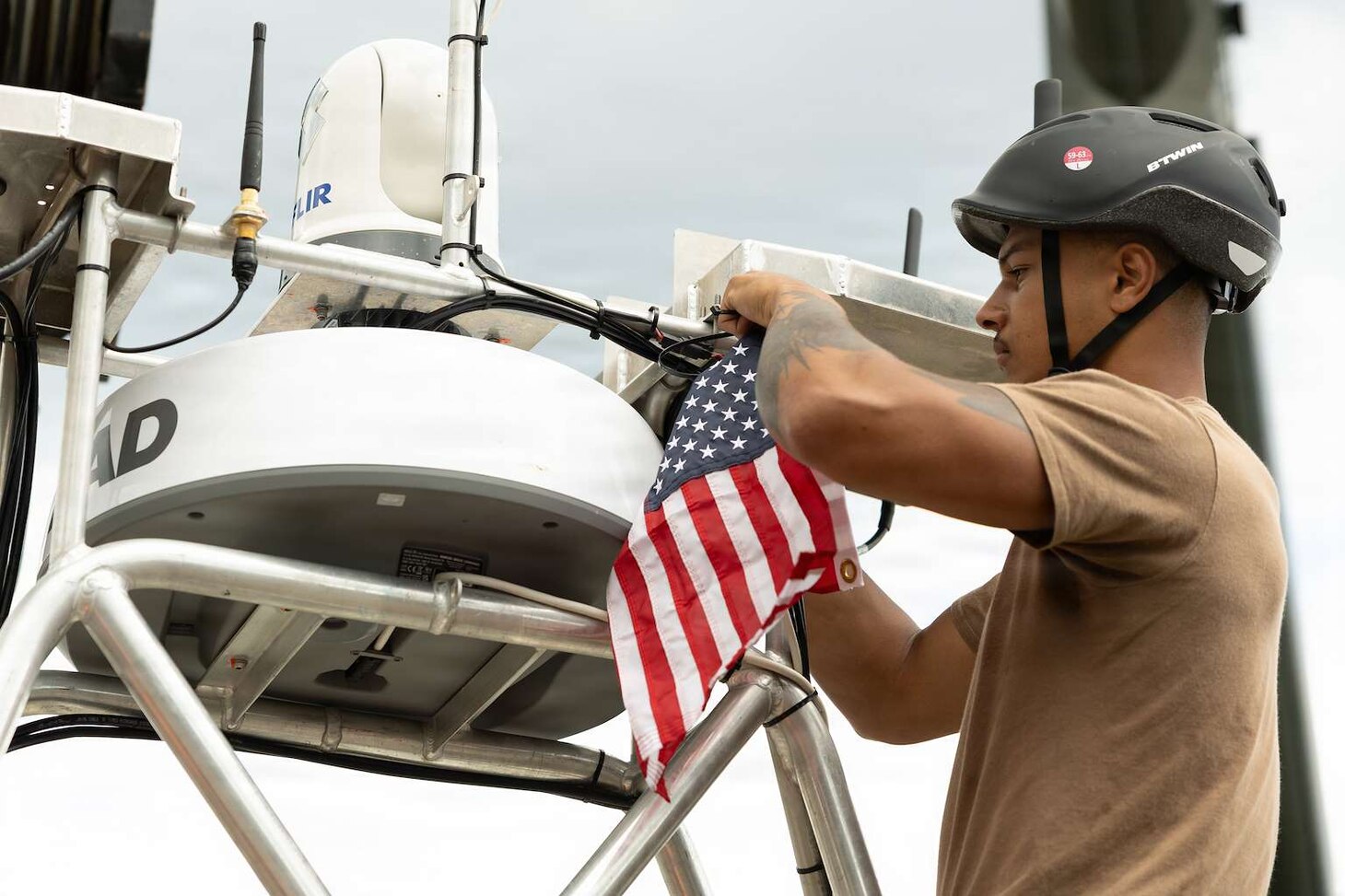
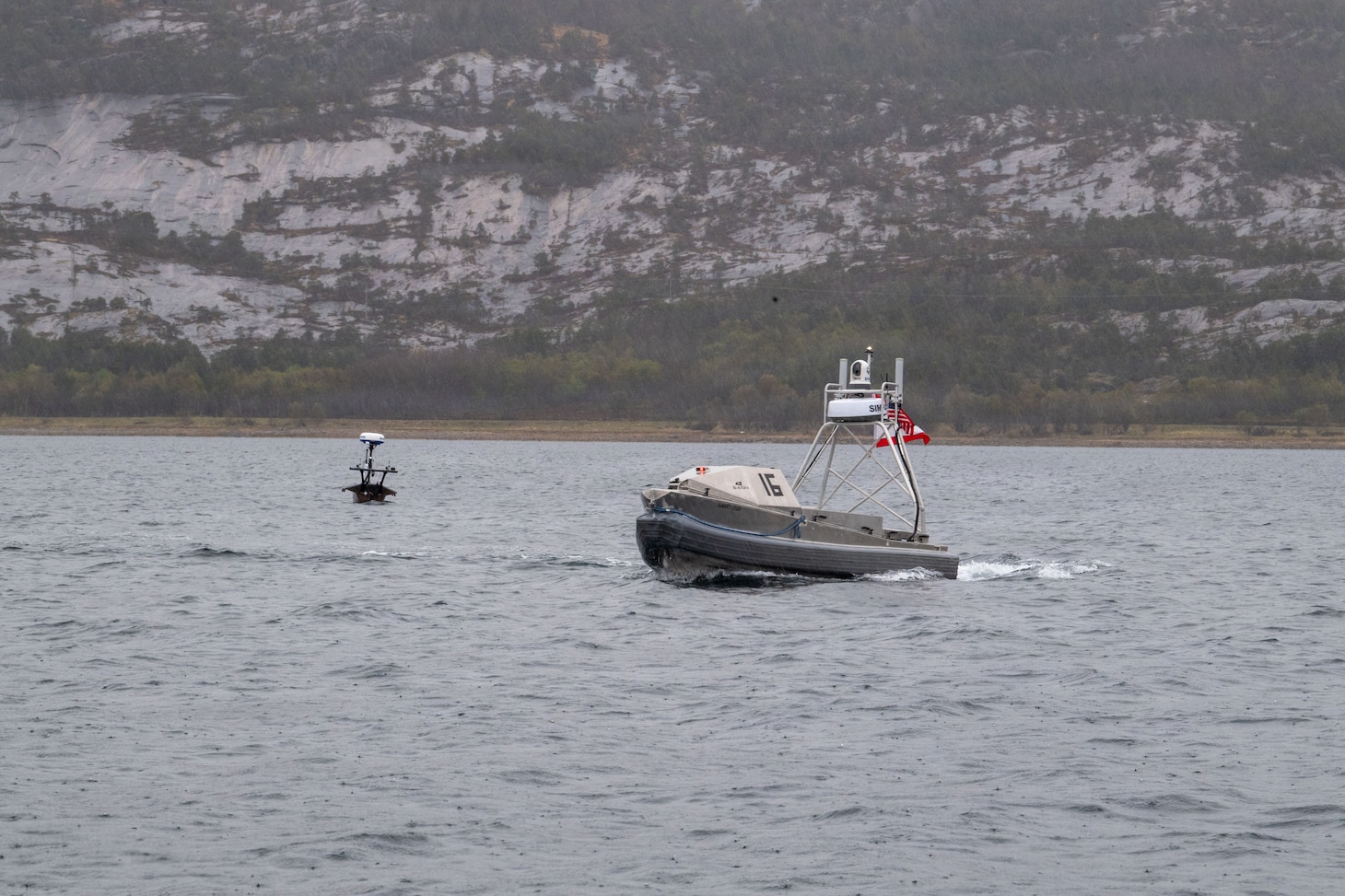
In 2026, U.S. Sixth Fleet exercises in Norway used Global Autonomous Reconnaissance Craft and Lightfish USVs for maritime-domain-awareness work in Arctic and fjord environments. The significance is not that these systems replace a surveillance ship. It is that many smaller nodes can keep watch in places where sending a large crewed platform continuously would be inefficient.
The U.S. Navy is moving from prototypes toward organizations
A technology becomes militarily important when the force builds units, training and logistics around it.
That transition is visible in the U.S. Navy. Unmanned Surface Vessel Squadrons and divisions are now permanent organizational structures rather than one-off experiment teams.
During BALTOPS 2026, USVDIV-32 deployed Global Autonomous Reconnaissance Craft as an opposing force for NATO allies, giving ships experience detecting and responding to unmanned surface threats.
The Navy has also created the Robotics Warfare Specialist rating to develop personnel focused on operating and maintaining robotic systems.
This matters because the hard part of unmanned adoption is rarely launching the first prototype. It is building a force that can sustain dozens or hundreds of vehicles, repair them, manage software, control data links and integrate their information into fleet operations.
Scale is arriving faster at the small end
The U.S. Surface Navy's SNA 2026 material stated that the service had grown from roughly four small USVs a year earlier to hundreds, with further expansion planned.
That does not mean hundreds of autonomous warships have suddenly entered service. Small USVs cover a broad range of relatively modest craft. But the number illustrates a procurement reality: autonomy scales fastest where the individual platform is comparatively inexpensive and commercial technology can be reused.
The Navy said it intended to operate Navy-owned small USVs in multiple theatres and integrate medium USVs into carrier-strike-group operations.
The industrial model is therefore bifurcating. Small systems can be fielded in large numbers and updated rapidly. Larger vessels remain closer to conventional shipbuilding in cost, integration burden and testing requirements.
Medium USVs are becoming modular ships rather than oversized drones
The U.S. Navy's 2026 Medium Unmanned Surface Vessel marketplace shows a different approach to scale.
Seven companies were selected for at-sea demonstrations, with successful participants eligible for follow-on production. The Navy said each system that successfully completed testing would receive a $15 million award.
The acquisition model is notable because it begins with existing industrial offerings rather than a single government-defined design competition that takes many years to produce a prototype.
Medium vessels are also being framed around modular payloads. A hull becomes a carrier for sensors, communications equipment or other mission packages that may change faster than the ship itself.
That separation between platform and payload mirrors what is happening in aerial autonomy: stable hardware can support more rapidly evolving software and mission systems.
Autonomy at sea solves a different problem from autonomy in the air
A small quadcopter flight may last minutes. A maritime drone may be expected to operate for days or weeks.
That difference changes the autonomy requirement. A long-endurance vessel needs to manage routine navigation, weather, maritime traffic, energy use and communications interruptions without continuous joystick control.
The record-setting transatlantic USV crossing reported by NIWC Atlantic in January 2026 is a useful illustration. The vessel crossed from South Carolina to Portugal in 62 days during 2025, demonstrating that unmanned persistence at ocean scale is now an engineering reality rather than a laboratory concept.
Military operations add more complexity, but endurance makes human micromanagement even less practical than it is for short-range aerial drones.
Communications are the hidden constraint
A vessel can be physically unmanned and still be operationally dependent on a large remote-control infrastructure.
Over-the-horizon maritime operations require connectivity for supervision, tasking and data return. Bandwidth is limited, satellite links may be contested, and fleets cannot assume that every vehicle will maintain a perfect connection.
This pushes maritime autonomy toward local navigation and mission execution. The vehicle has to remain safe, obey constraints and continue useful behaviour through intermittent communications.
USVRON 7's mission language explicitly refers to resilient distributed systems operating in bandwidth-limited or denied environments. That is a clue about the operational problem the Navy is trying to solve.
DOCUMENTThe 2026 MUSV marketplace shows the Navy moving toward competitive at-sea evaluation and faster follow-on production.OPEN ↗The ideal unmanned fleet does not require one full-time remote driver per boat.
The Black Sea showed why identification becomes a defensive problem
A sea drone approaching a ship creates a harder classification problem than a missile warning.
Small craft, floating debris and civilian traffic all exist close to the surface. The defender must decide which contacts are benign and which demand immediate action.
BALTOPS 2026 deliberately used USVs as an opposing force to train NATO ships on this problem. U.S. Navy participants emphasized that simply spotting the craft and understanding its behaviour was a meaningful challenge.
This means counter-USV defence is partly an ISR problem. Sensors need to detect small contacts early enough, maintain tracks and provide enough context that the ship does not waste weapons on every ambiguous object.
Counter-USV defence is becoming its own mission set
Once unmanned surface threats become common, navies need dedicated ways to defend against them.
The response can include electro-optical surveillance, radar tuned for small contacts, patrol craft, barriers, helicopters, guns and other effectors. No single layer is sufficient in every environment.
Ports are especially challenging because defenders operate around civilian infrastructure and dense maritime traffic. Open-water warships have more manoeuvre space but may have much less time to classify a fast inbound contact.
The result resembles counter-UAS defence in the air: many relatively cheap threats drive demand for layered sensing and lower-cost engagement options.
Maritime drones expand the meaning of sea denial
Traditional sea control is associated with the ability to use an area while preventing the opponent from doing the same.
Unmanned systems offer a more distributed version of denial.
A force may not control the sea continuously, but it can make certain routes, anchorages or operating patterns dangerous enough that the opponent changes behaviour.
Ukraine's experience is important because it demonstrates strategic effect without symmetrical fleet ownership. RUSI's analysis argues that uncrewed platforms, combined with other Ukrainian capabilities, helped compel the Russian Black Sea Fleet to disperse and operate more cautiously.
That is a different form of naval power from maintaining a large surface fleet on station, but it can still shape where and how ships operate.
Strike USVs are only one end of a wider spectrum
Ukraine's Sea Baby and Magura systems are known publicly for strike missions, but the same basic hull-and-autonomy technologies can support other payloads.
A high-speed platform can carry reconnaissance sensors. A long-endurance platform can act as a relay. A modular craft can change mission systems between sorties.
DOCUMENTUkraine publicly identified Sea Baby, Magura V5 and Sargan-3000 among naval unmanned systems developed or fielded during the war.OPEN ↗This is why the U.S. Navy repeatedly emphasizes reconfigurable and containerized payloads in its larger USV programmes.
The industrial advantage is that a common vessel can become several different fleet nodes without designing a new hull for every mission.
The risk is integration complexity: the more payloads a platform must support, the harder it becomes to keep interfaces, power, cooling, communications and software standardized.
Underwater systems complete the unmanned maritime picture
Surface vessels are only the visible portion of maritime autonomy.
Unmanned underwater vehicles are already central to mine countermeasures, seabed survey and other missions where persistence matters and sending divers or crewed platforms can be risky.
Arctic Sentry 2026 combined surface and underwater systems in maritime-security scenarios, including protection of critical undersea infrastructure.
The significance is organizational: navies increasingly need command systems that treat surface, subsurface and aerial unmanned vehicles as parts of the same information network rather than isolated robotic specialties.
The hybrid fleet is a command-and-control problem
Adding unmanned vessels to a navy sounds like a platform-acquisition problem. At scale, it becomes a command problem.
Someone has to assign missions, manage maritime safety, control permissions, fuse sensor outputs and decide when a vehicle can act locally versus when it needs human confirmation.
If every USV creates a separate ground-control interface and a separate data stream, adding more vehicles can increase operator workload instead of reducing it.
This is why the U.S. Navy's public discussion of unmanned integration increasingly focuses on common control, training and command-and-control rather than only hull performance.
The objective is a fleet in which unmanned systems extend the crewed force, not a collection of robotics projects competing for attention.
The human layer does not disappear
Unmanned vessels remove sailors from the vehicle. They do not remove sailors from the system.
Maintenance, launch and recovery, mission planning, software management, communications, legal authorities and command decisions still require people.
The creation of dedicated U.S. Navy robotics units and the Robotics Warfare Specialist rating is evidence that autonomy creates new specialist work rather than eliminating labour entirely.
The personnel advantage comes when one team can support many vehicles and when dangerous or repetitive watchstanding moves from people to machines.
Production matters because attritable maritime systems will be lost
An unmanned vessel designed for high-risk operations cannot be treated like a capital ship.
Some systems will be destroyed. Others will fail mechanically, lose communications or be recovered by an adversary. The force therefore needs an industrial model that assumes replacement.
This is one reason commercial technologies are attractive. Small autonomous craft can draw from civilian marine engines, composites, batteries, communications equipment and navigation systems.
But military reliability and secure integration still matter. Cheap hardware that cannot survive weather, operate for the required endurance or fit the command network does not create useful mass.
The challenge is to keep unit cost low enough that losses are tolerable without allowing the system to become operationally disposable in the peacetime logistics sense.
Procurement is being pulled toward marketplaces and rapid trials
The 2026 MUSV marketplace is significant because it treats sea-drone acquisition more like competitive technology evaluation than classic shipbuilding.
At-sea demonstrations are intended to identify commercial offerings that already satisfy much of the requirement and can move toward production quickly.
Ukraine's wartime model pushes this even further at smaller scale, where multiple naval-drone families have evolved through operational feedback rather than one centrally designed multi-decade programme.
Both approaches reflect the same pressure: unmanned technology changes faster than traditional naval acquisition timelines.
Maritime autonomy creates new escalation and attribution questions
Unmanned vessels can operate with fewer people at risk, but that does not make maritime operations politically or legally simple.
A surface drone can cross long distances, approach commercial routes and operate near civilian infrastructure. Misidentification or loss of control can have consequences beyond the intended mission.
For navies operating in peacetime or crisis, autonomy therefore increases the importance of predictable behaviour, navigation safety, logging and human authority over sensitive decisions.
The system needs to be governable even when communications are intermittent.
The next maritime competition is about networks, not individual boats
The first generation of sea-drone warfare encouraged comparisons between individual craft: speed, range, payload and price.
The more mature competition is shifting toward networks.
Which force can maintain the best maritime picture? Which can control many distributed vehicles with the least operator burden? Which can keep them connected in a contested environment? Which can replace losses faster? Which can combine surface, subsurface and aerial sensors into one decision cycle?
Those questions are much closer to naval warfare than to hobby robotics.
Unmanned systems will not make conventional navies obsolete
Large crewed warships still provide power generation, sensors, long-range weapons, aviation facilities, command spaces and endurance that small unmanned craft cannot reproduce.
The more plausible transformation is a change in fleet composition.
Crewed ships become command, sensing and combat hubs surrounded by larger numbers of unmanned nodes. Some nodes are expendable, some persistent, some specialized. The crewed platform carries fewer tasks alone.
That can increase reach and complicate an adversary's targeting problem without requiring every mission to be performed by another billion-dollar ship.
What Ukraine changed
Ukraine's contribution to naval innovation is not that it invented unmanned boats.
It demonstrated at wartime scale that relatively small maritime systems can have operational and strategic effects when they are embedded in a larger intelligence, strike and adaptation network.
That experience is now influencing navies that were already experimenting with autonomy but had not faced the same urgency.
The U.S. Navy's growth from a handful of small USVs toward hundreds, the creation of dedicated unmanned units and the MUSV marketplace all point toward an institution trying to move autonomy from the edge of the fleet into its normal structure.
The unmanned sea is becoming a permanent layer of naval power
The strongest evidence for maritime autonomy is no longer a spectacular prototype.
It is institutionalization.
Ukraine fields multiple naval-drone families. The U.S. Navy has unmanned squadrons and specialist personnel. NATO exercises train ships against USVs. Medium-vessel procurement is moving toward competitive at-sea demonstrations. Small USVs are appearing in larger numbers across theatres.
The unresolved questions are about scale, command, reliability and doctrine rather than whether unmanned systems belong at sea.
The future fleet is unlikely to be unmanned. It is likely to be hybrid — with far more of the ocean watched, mapped, contested and influenced by machines that carry no crew at all.