Electronic warfare against drones is often described as a contest between a jammer and a radio link. On the battlefield, it has become something much larger: a continuous competition over spectrum, navigation, software, antennas, data links and the speed at which each side can change them.
The central problem is that an electronic countermeasure is rarely permanent. A frequency that can be denied today can be changed tomorrow. A navigation method that depends on satellite signals can be supplemented by inertial or visual navigation. A radio-controlled FPV can be replaced by a fibre-optic aircraft that removes the vulnerable RF command link entirely. Then the defender changes again.
Ukraine has made this cycle unusually visible because drones and electronic warfare are both being consumed at industrial scale. The Ministry of Defence reported that more than 60 EW and signals-intelligence systems were among the first 1,000 new weapons and equipment models codified in 2026, while hundreds of new UAV types were entering service at the same time. By September, the ministry said 231 fibre-optic-controlled UAV models had been authorized during the year.
The result is not a stable technological hierarchy. It is an arms race measured in adaptation time.
The side that finds a new frequency, a new link architecture or a new navigation method does not permanently defeat electronic warfare. It creates a temporary advantage that the opponent then tries to measure, characterize and suppress.
The electromagnetic spectrum became part of the drone airframe
A conventional description of a drone separates the aircraft from its communications system. In practice, the two are inseparable.
A remotely piloted drone needs a way to receive commands. Many systems also need to transmit video or telemetry. Navigation may depend partly or heavily on satellite positioning. Each of those dependencies creates an electromagnetic signature and potentially a vulnerability.
That is why electronic warfare can affect unmanned systems without physically damaging them. A defender may interfere with the command link, disrupt video transmission, deny satellite navigation or detect the radio emissions associated with the aircraft and its operator.
But the same logic works in reverse. If the aircraft designer removes or reduces one dependency, the defender loses one avenue of attack. The drone's communications architecture therefore becomes as consequential as its motors, battery or payload.
The war in Ukraine has turned this relationship into a mass engineering problem. Radio systems, antennas and navigation components are not fixed specifications. They are variables that are repeatedly changed in response to what the other side is doing.
| Dependency | What EW can exploit | How unmanned systems adapt |
|---|---|---|
| Command link | Disrupt or deny the connection between operator and aircraft | Change bands or waveforms, increase resilience, use relays, reduce dependence on continuous control or replace RF with a physical link. |
| Video / telemetry | Interfere with the return path or exploit detectable emissions | Change communications architecture, onboard more processing, transmit less or use alternate links. |
| GNSS / satellite PNT | Jam or spoof satellite navigation signals | Use protected receivers, inertial navigation, visual navigation, terrain/reference methods or other alternate PNT sources. |
| Known RF signature | Detect or classify the aircraft or controller through its emissions | Reduce emissions, change signal characteristics or shift more processing onboard. |
| Fixed jammer configuration | Exploit bands or techniques the jammer does not cover | Change configuration faster than the defensive system can be updated. |
Jamming is a system effect, not a magic field
The popular image of electronic warfare is a bubble in which drones simply stop working. Real systems are more conditional.
A jammer has to affect something the target actually depends on. It has to place enough interference into the relevant part of the spectrum, in the relevant geometry and at the relevant time. The target's receiver, antenna, waveform and software all influence the result.
That is why a system can be effective against one drone configuration and much less effective against another. Even aircraft that look identical can behave differently if their radios, antennas, navigation software or control architecture have changed.
The U.S. Army's 2026 counter-UAS training reflects this layered approach. At Fort Bragg, Army leaders described a defensive framework combining sensors, drone-on-drone interceptors, close-range kinetic systems and electronic attack systems that break control links. The significance is that electronic attack is one effector among several, not a universal answer.
This distinction becomes crucial when procurement decisions are made. Buying an EW system is not buying permanent protection against a category called 'drones.' It is buying a set of electronic effects against a changing population of links and navigation methods.
The first adaptation cycle: frequency versus jammer
At the tactical level, one of the clearest adaptation loops is the move away from predictable radio configurations.
The U.S. Army's Military Review, examining Russian adaptation from lessons in Ukraine, describes a cycle in which counter-UAS EW systems were configured against known drone frequencies, Ukrainian systems shifted toward less commonly used bands and other counter-countermeasures, and Russian spectrum monitoring and jammers were then updated in response.
The exact tactical details change continuously, which is the important point. An EW device that is physically intact may still become operationally obsolete if the threat migrates outside its useful configuration.
This turns software, firmware, spectrum intelligence and field reconfiguration into logistics. A jammer may require updates almost like a digital product rather than a traditional weapon that retains the same behavior for years.
It also means the defensive organization needs a feedback loop. Frontline units have to report what they are seeing; spectrum monitoring has to characterize changes; engineers have to modify systems; and updated configurations have to return to the field.
The time between those steps can matter as much as the nominal power of the jammer.
Electronic support is as important as electronic attack
Jamming receives most of the attention, but an EW arms race cannot function without measurement.
Before a defender can decide what to suppress, it has to understand the electromagnetic environment. Signals can reveal that an unmanned system is present, what part of the spectrum it is using and how the local environment has changed.
This is the electronic-support side of the contest: search, detection, classification and analysis rather than direct interference.
The distinction matters because adaptive jamming depends on adaptive sensing. If the threat changes faster than spectrum monitoring can characterize it, the defensive system is always reacting to yesterday's configuration.
Modern counter-UAS architectures therefore increasingly combine RF sensing with radar, electro-optical systems and other sensors. Electronic intelligence helps explain the radio environment; non-RF sensors remain necessary when the drone is silent, unfamiliar or deliberately designed to minimize emissions.
GNSS jamming created a second adaptation race
Satellite navigation provides another obvious electronic dependency.
GNSS signals arrive at receivers at very low power, which makes them vulnerable to disruption. For unmanned systems, losing satellite navigation can degrade position estimates, route following or other functions depending on the aircraft's architecture.
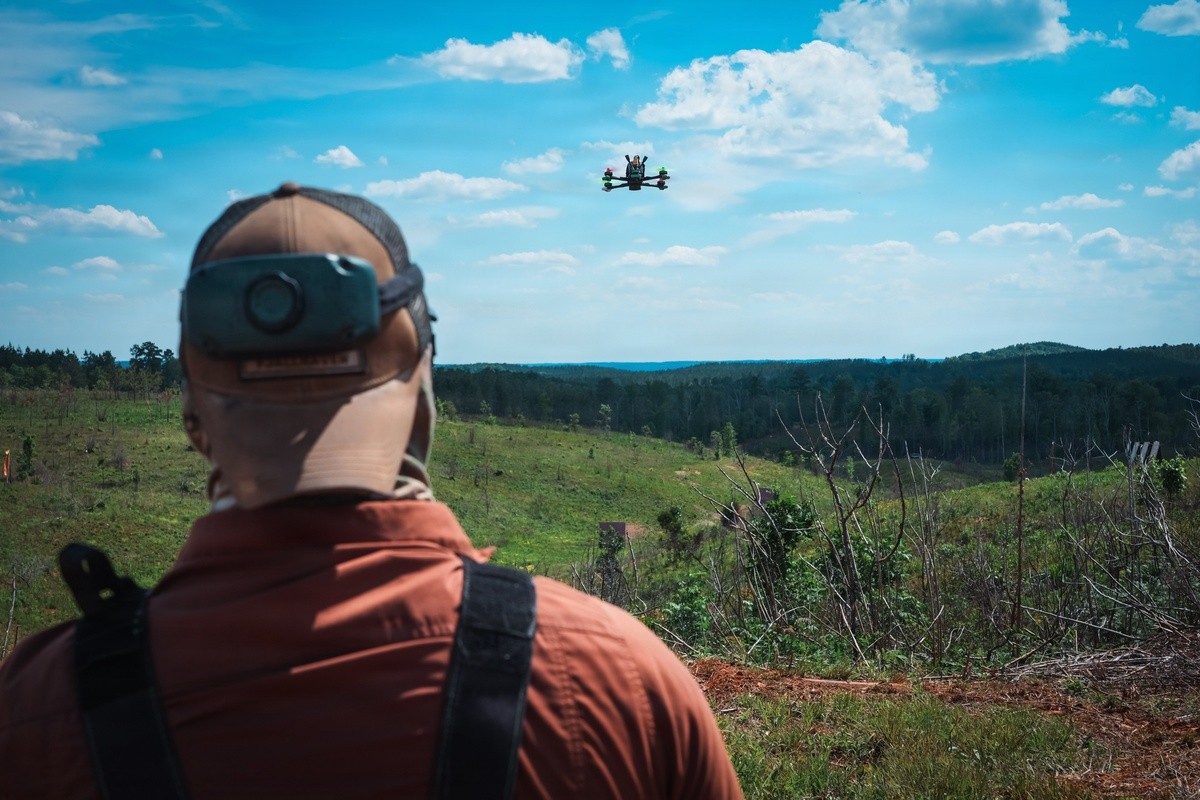
But denying GNSS does not produce one universal outcome. Some systems may fail badly. Others may continue with inertial estimates, protected receivers, alternate sensors or onboard autonomy.
The Russian Shahed adaptation cycle illustrates this. U.S. Army analysis describes Ukrainian use of electronic warfare against the drones' satellite navigation and subsequent Russian efforts to improve resilience with more protected reception and other changes.
The broader lesson is more important than any single component: once GNSS denial becomes expected rather than exceptional, aircraft design begins to assume that satellite navigation may be unavailable.
That moves the competition from 'Can the defender jam GPS?' to 'How long and how accurately can the system continue when GPS is degraded?'
Fibre-optic FPV changed the problem by removing the radio link
Fibre-optic FPV drones are one of the clearest examples of a countermeasure changing the architecture of the weapon itself.
Instead of sending command and video over a radio link, the aircraft trails a physical fibre. Conventional RF jamming against the control link therefore has nothing to disrupt.
Ukraine's Ministry of Defence said 231 fibre-optic-controlled UAV models had been authorized for use by September 2026. That figure demonstrates how quickly a niche adaptation can become an industrial category.
The consequence is not that electronic warfare becomes irrelevant. It is that the defender has to shift layers.
Detection can still rely on radar, optical, thermal or acoustic signatures. The aircraft can still be physically intercepted. Other onboard systems may retain electronic dependencies. But the specific RF command-link vulnerability that conventional anti-FPV jamming exploited is largely removed.
NATO's innovation work on fibre-optic drones reflects exactly this shift: the problem statement moved toward detection, tracking and physical defeat rather than assuming the radio link would remain the decisive vulnerability.
Autonomy reduces another source of electronic dependence
The next step is not necessarily a cable. It is more onboard decision-making.
A drone that requires continuous human steering requires continuous connectivity. A drone that can maintain flight, navigate or execute part of a mission locally can tolerate interruptions that would otherwise end the mission.
This does not mean autonomous systems are immune to electronic warfare. They still rely on sensors, processors and often some communications. Their perception systems can fail, their navigation can drift and their software can make mistakes.
But autonomy changes which link is critical. The operator may become a supervisor rather than a continuous pilot. Communications can become intermittent rather than constant. Navigation can fuse multiple sources instead of trusting one satellite solution.
Ukraine's Avengers Labs programme shows where this is heading. The Ministry of Defence says its battlefield dataset is being used to train models for scenarios in which a drone can receive a task, enter an area, detect a target and act according to mission logic with less continuous manual control.
The strategic effect is to make link denial less decisive. Electronic warfare then has to target a more distributed set of dependencies rather than one obvious remote-control channel.
The arms race is becoming software-defined
DOCUMENTA detailed review of how drone and counter-UAS EW adaptations have been institutionalized and repeatedly modified during the war in Ukraine.OPEN ↗The most consequential change may be organizational rather than electromagnetic.
When a drone or jammer can be materially improved through software, configuration and replaceable electronics, adaptation can happen on a much shorter cycle than traditional weapons procurement.
Ukraine's procurement reforms increasingly recognize this. The Brave1 Market and e-Points systems allow units to obtain not only complete drones and EW systems but also components including communications equipment, receivers, repeaters, navigation systems, controllers and software. The Ministry of Defence explicitly links that flexibility to rapid adaptation for changing frontline requirements.
That is an unusual military supply model. A traditional programme attempts to freeze requirements, qualify a system and then field a stable configuration. Drone warfare rewards the ability to modify the configuration after fielding because the threat itself is changing.
The logical unit of military value therefore shifts from a specific hardware model to an update ecosystem: the manufacturer, software, component supply chain, data from the front and the mechanism that pushes a change back to users.
| Layer | Slow model | Fast-adaptation model |
|---|---|---|
| Threat sensing | Periodic reporting | Continuous spectrum and battlefield feedback. |
| Engineering | Major redesign cycles | Software, firmware and modular component changes. |
| Procurement | Fixed configuration bought in large batches | Demand shifts toward configurations that are working now. |
| Field support | Scheduled maintenance and upgrades | Frequent reconfiguration, replacement and operator feedback. |
| Doctrine | Static procedures | Procedures updated as links, sensors and countermeasures change. |
Mass production makes obsolescence more expensive
The faster the drone economy grows, the more costly technical obsolescence becomes.
Ukraine reported hundreds of thousands of drones and related systems moving through digital procurement channels in 2026. At that scale, a configuration error is not a problem affecting a few prototypes. It can strand large inventories.
The same applies to electronic warfare. A jammer designed around a fixed set of assumptions can become a sunk cost if the threat population changes faster than the system can be updated.
This creates a tension between scale and flexibility. Mass production lowers unit cost and increases availability, but highly standardized output can lock a force into yesterday's solution.
The answer is not endless customization. That destroys economies of scale. The more sustainable model is modularity: stable interfaces and manufacturing processes combined with components and software that can change without redesigning the entire system.
DOCUMENTNATO innovation work illustrates how removing an RF control link shifts counter-UAS requirements toward other detection and defeat layers.OPEN ↗EW now affects the economics of every drone mission
Electronic warfare does not have to achieve a perfect kill to create economic value.
If jamming forces an attacker to use more expensive radios, protected navigation, fibre spools, additional sensors or more onboard computing, the defender has imposed cost even when the drone still reaches the battlefield.
The reverse is also true. If cheap adaptations allow drones to bypass an expensive jammer, the attacker can impose costs on the defensive architecture.
This is one reason the electronic contest should be understood as cost imposition rather than a binary measure of whether drones are 'jammed.'
A countermeasure may lower success rates, shorten useful range, increase operator workload or force redesign. Those effects can matter operationally even when they are less visible than a drone dropping out of the sky.
Large EW systems and small EW systems solve different problems
Another adaptation has been the distribution of electronic warfare down to smaller units.
Large vehicle-mounted EW systems can cover broader areas and provide substantial power and sensing, but they are scarce, logistically demanding and themselves valuable targets. The saturation of the front with small drones created demand for lighter systems that can protect vehicles, positions and small formations locally.
U.S. Army analysis of Russian adaptation describes this transition from a limited number of larger counter-UAS EW systems toward portable and vehicle-mounted devices distributed at lower echelons.
Ukraine has followed its own path toward distributed acquisition. EW equipment appears alongside drones and robotic systems in Brave1 Market and e-Points procurement, allowing units to select equipment closer to their immediate needs.
The architecture is therefore becoming layered in space as well as technology: larger systems provide one level of coverage while smaller systems attempt to protect the tactical edge.
Friendly interference becomes a scaling constraint
More electronic warfare is not automatically better.
A force operating large numbers of friendly drones, radios and jammers has to manage its own electromagnetic congestion. Defensive interference can disrupt friendly links as easily as hostile ones if spectrum use is poorly coordinated.
This creates a command-and-control problem. Units need to understand not only the enemy spectrum but their own. Frequency plans, identification, deconfliction and rapid updates become increasingly difficult when both friendly drones and friendly EW systems are changing quickly.
The problem becomes more severe as unmanned systems spread to lower echelons. A spectrum that was once managed around a smaller number of military radios now has to support huge numbers of airborne links, video streams, sensors, repeaters and electronic countermeasures.
Electronic warfare can therefore impose friction on the force using it. The side that coordinates adaptation better may gain as much advantage from avoiding self-interference as from increasing jamming power.
The defensive answer is becoming multi-layered
The proliferation of fibre optics, alternate navigation and autonomy is pushing counter-drone defence away from dependence on any one electronic mechanism.
Electronic warfare remains valuable because enormous numbers of drones still depend on radio and satellite signals. It can also be repeatable and economically attractive compared with expending a physical interceptor on every target.
But the systems that survive in contested environments increasingly require defenders to combine EW with radar, electro-optical sensing, acoustic detection, guns and interceptor drones.
That is why current NATO and U.S. counter-UAS work emphasizes integrated sensor and effector networks. The goal is not to find the perfect jammer. It is to ensure that when one layer loses effectiveness, another layer still has a way to detect or defeat the aircraft.
The more diverse the drone threat becomes, the more valuable that redundancy becomes.
The industrial contest is about update rate
The electronic arms race ultimately rewards organizations that can shorten the distance between observation and production.
A frontline unit discovers that a threat has changed. Someone has to collect that evidence. Engineers need access to it. Manufacturers need components. Software or hardware must be modified. The new version has to be tested, procured and delivered.
If that chain takes a year, the battlefield may have moved several generations ahead.
Ukraine's increasingly data-driven procurement model is an attempt to compress the chain. The Ministry of Defence says e-Points and DELTA create verified battlefield datasets that can influence which technologies are scaled and can also support AI model training.
This feedback architecture may be more important than any single jammer. It determines whether the force can convert a local adaptation into mass capability before the adversary develops the next response.
There is no final winner in an EW arms race
The phrase 'electronic warfare arms race' is useful precisely because it rejects the idea of a permanent technical solution.
Jamming changes drone communications. Changed communications alter jamming requirements. GNSS denial drives alternate navigation. Fibre removes RF links. Autonomy reduces dependence on continuous connectivity. New sensors then search for other signatures.
Each layer makes the previous one less decisive without necessarily making it obsolete.
This is why battlefield reports that a particular technology has 'defeated EW' should be treated cautiously. A system can defeat one type of electronic attack in one architecture and still remain vulnerable elsewhere.
The more durable advantage lies in adaptation capacity: spectrum awareness, modular hardware, software-defined systems, rapid procurement and a production base capable of changing configuration without collapsing output.
Electronic warfare is no longer only a specialist capability used around a handful of strategic systems. In drone warfare, it has become part of the design cycle of the aircraft itself.
The contest is therefore not jammer versus drone. It is adaptation system versus adaptation system.