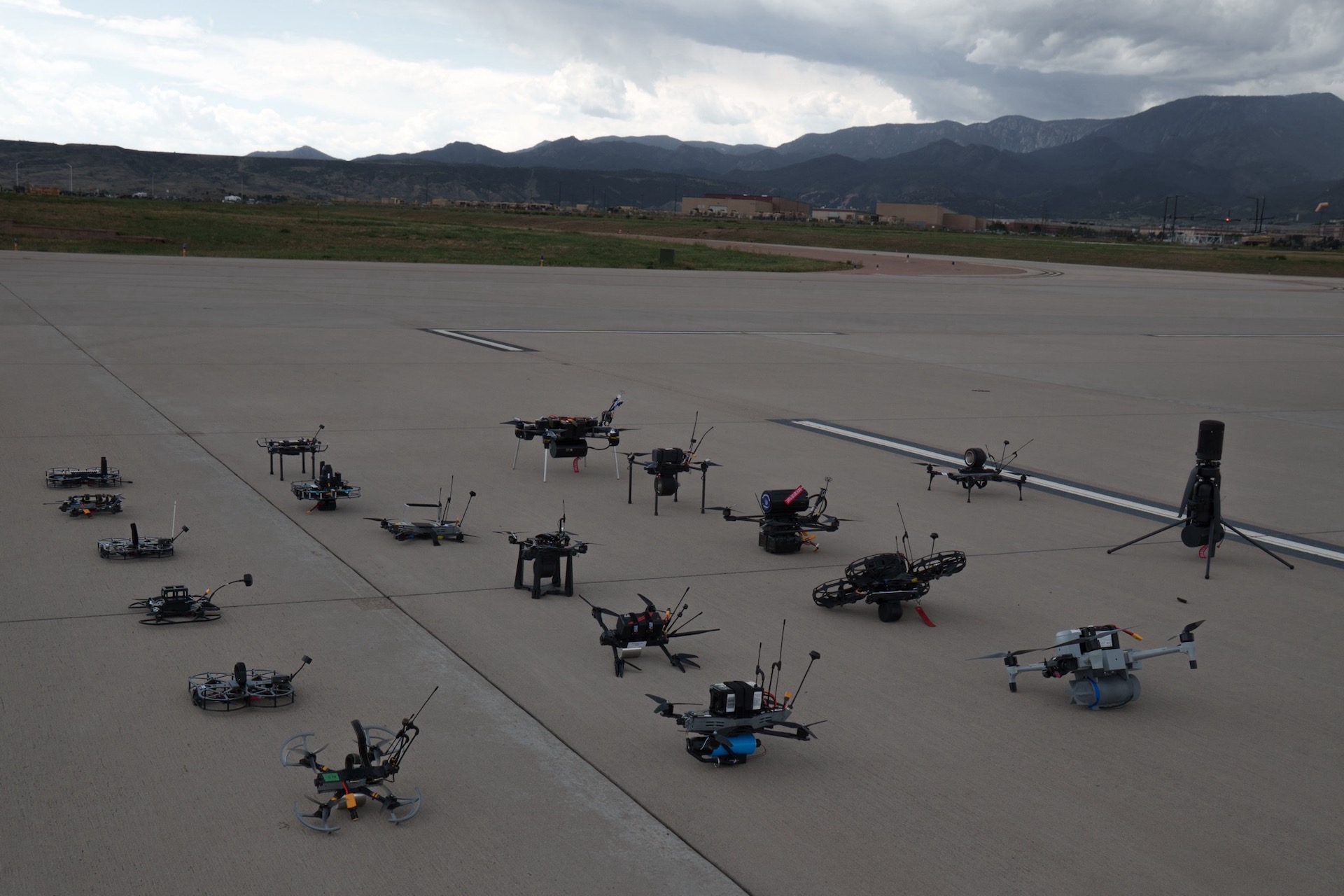
The Pentagon has announced results from the second Gauntlet competition in its Drone Dominance Program, identifying vendors from which it plans to buy about 60,000 small unmanned aerial systems. The evaluation, held in recent weeks at Fort Carson, Colorado, tested 23 platforms from 19 companies through 1,858 sorties, according to the Defense Department.
Gauntlet 2 was organized around two mission areas: deep strike and close-quarters battle. Perennial Autonomy led the deep-strike leaderboard, followed by Hyperscale, Neros, Skycutter and Swarm Defense Technologies. Neros placed first in the close-quarters category, with ORQA US, XTEND Reality, Vector and ModalAI following.
Range results and vendor pool
Defense Innovation Unit officials described Gauntlet 2 as the program’s most demanding test so far. All 11 platforms assessed at long distance reached 15 kilometers, the officials said in a social-media post. By comparison, they said, 24% of drones in the first Gauntlet reached 10 kilometers.
The Pentagon said the planned procurement will draw from the Gauntlet 2 vendor pool. Officials also said the drones tested in the second event were less expensive, more capable and supported by a supply chain more closely tied to the U.S. industrial base than those assessed during the first competition.
Companies participating in the deep-strike assessment that were not listed on that leaderboard were Ascent Aerosystems, Auterion Government Solutions, Griffon Aerospace, ORQA US, Stellarion and UDD Tech Corp. Other close-quarters participants not included on its leaderboard were Griffon Aerospace, Grim Tech, a Mountain Horse and AG3 Labs team, Renegade UxS, Skycutter, Teal Drones and Wilcox Cherry Defense.
Program expands toward bomber drones
The competition is part of the Pentagon’s Drone Dominance Program, an effort launched last year to evaluate and procure large quantities of low-cost, one-way attack drones for military use. The department’s stated objective is to acquire more than 200,000 UAS through several phases of the initiative by 2027. The Defense Innovation Unit is shepherding the effort under director Owen West.
The first Gauntlet took place earlier this year at Fort Benning, Georgia, using military operator evaluations of vendor systems. That event resulted in an order for approximately 30,000 UAS from contractors, according to the department.
Officials plan to begin Gauntlet 2.5 next month, focusing on bomber drones. The Pentagon first disclosed plans for that effort in July. A third Gauntlet is scheduled to begin about six months after Gauntlet 2, while Gauntlet 4—described as the final competition under the Drone Dominance Program—is expected roughly six months after Gauntlet 3 concludes.