The Marine Corps has completed a two-week field user evaluation of an unmanned surface vessel intended to support explosive-ordnance disposal operations in littoral waters, testing the system at Camp Pendleton, California, as part of the service’s Littoral Explosive Ordnance Neutralization, or LEON, program.
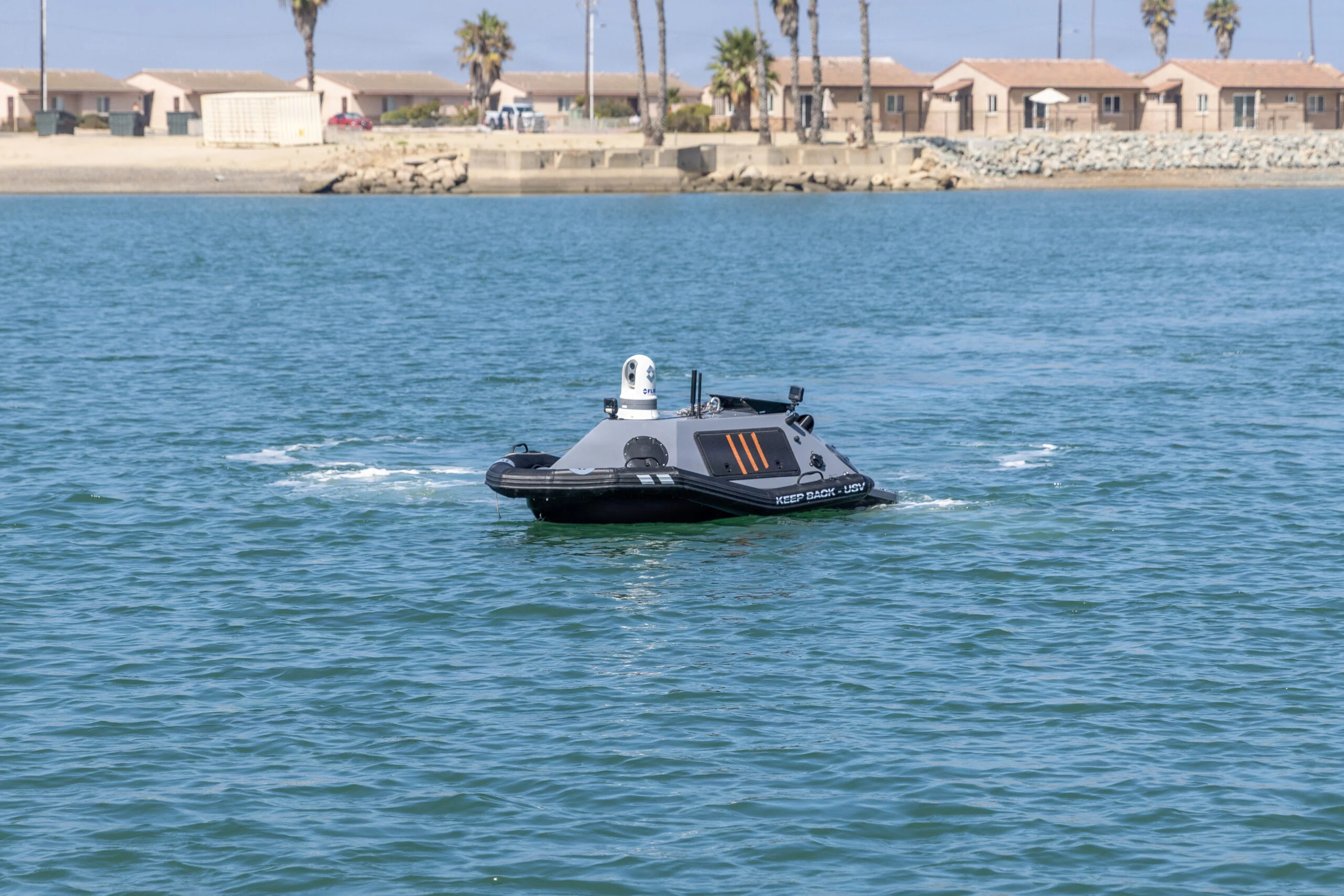
Program Manager Combat Support Systems, within Portfolio Acquisition Executive Marine Corps, conducted the trial with its Explosive Hazard Defeat Team and Marines from 7th Engineer Support Battalion. The evaluation followed a stated gap in littoral capability, with the program pursuing a commercial vessel equipped with autonomous driving, sonar, forward-looking infrared cameras, line-of-sight communications and acoustic communications.
The surface vessel is the fourth of five LEON capability increments. The family also includes a remotely operated vehicle, diver equipment, an unmanned underwater vehicle and an amphibious unmanned ground vehicle. LEON is intended to help EOD teams confirm and mark hazards and obstacles from very shallow water through the beach zone.
A surface link for subsurface systems
While the USV can search for potential hazards, its principal role is to support the other LEON systems operating below the surface, according to Capt. Timothy Guinan, the Explosive Hazard Defeat Team’s project officer. The vessel is designed to provide a communications capability as a Mobile Gateway Buoy, relaying information from subsurface systems to the surface for real-time updates.
“The LEON SOS will enable maneuvers by identifying safe routes for transit within the littorals.”
Capt. Timothy Guinan, project officer, Explosive Hazard Defeat Team
Guinan said unmanned systems can remain on mission without the fatigue associated with human operators. The systems can be launched and left to conduct missions for more than 14 hours while covering broad littoral areas with minimal personnel required for monitoring, he said.
Marines test navigation, targets and endurance
During the Camp Pendleton evaluation, fleet users received hands-on instruction and tested waypoint navigation, target deployment and location verification. The event also gave Marines an opportunity to provide feedback to the program office during development, focusing on system relevance and the human-system interface in a near-operational setting.
Engineers and EOD technicians began in calm water, familiarizing themselves with the controls and creating mock mine targets. They then put the USV through a wide-area search in differing sea states off the Pacific Coast. Chief Warrant Officer 2 Alfredo Andrade, officer in charge of Explosive Ordnance Disposal Company, 7th Engineer Support Battalion, said the events were successful and that the vessel demonstrated long endurance and produced results useful for refining the capability.
“Unmanned systems have always been a part of the EOD family of systems. But now, we’re expanding that into maritime systems that allow more endurance and less risk for operators.”
Chief Warrant Officer 2 Alfredo Andrade, officer in charge, Explosive Ordnance Disposal Company, 7th Engineer Support Battalion
Andrade said the program is intended to preserve force safety and health while maintaining readily available combat power, particularly when introducing additional forces would create a logistical burden.
Path toward fielding
According to the Marine Corps release, validation of the USV is expected to establish a path toward fielding systems to EOD companies in fiscal year 2027. It would also support integration of the broader LEON family of systems for fielding over the following two years.
The release did not identify the vessel tested. Pentagon imagery and video reviewed by USNI News showed what appeared to be AEVEX Corporation’s Mako Lite, a 2.7-meter scaled-down version of the company’s 3.4-meter Mako USV. AEVEX says the Mako Lite has endurance of 12.5 hours, a range of up to 250 nautical miles and a configurable payload capacity of 100 pounds.
The USV evaluation follows earlier work on other LEON elements. The Marine Corps introduced the program’s remotely operated vehicle in 2021, while public information on its unmanned underwater vehicle remains limited. Greensea IQ announced in February 2025 that it had received a $5.36 million contract for a customized Bayonet 250 amphibious unmanned ground vehicle for LEON. The company says the vehicle is designed for shallow-water and surf-zone operations involving mine and explosive-threat neutralization.
Marines from 7th Engineer Support Battalion also fielded the Bayonet 250 during Arctic Edge 2026 in Alaska. At Coast Guard Base Kodiak, they used the vehicle to survey subsurface areas and identify environmental hazards before divers entered the water. The Camp Pendleton USV assessment adds the surface component to that developing littoral EOD system, with the service now using user feedback to refine the capability ahead of a planned validation and fielding path.