A U.S. Marine Corps officer who recently led the 31st Marine Expeditionary Unit’s deployment to the Middle East has called for future MEUs to deploy with their own uncrewed surface vessels, arguing that drone boats should be used to examine dangerous coastal approaches before Marines are committed to an amphibious landing.
Col. Chris P. Niedziocha, now director of the Marine Corps Expeditionary Warfare School, told The War Zone that USVs were present in the theatre during the 31st MEU’s deployment but were not part of his unit’s deployed equipment. Asked whether MEUs need sea drones in the future, he said they do, describing the technology as part of a wider growth in robotics and autonomy in combat.
Niedziocha said Marines should not send personnel into an area before first sending a robot where possible. He characterized the service as a “fast follower” rather than a leader in adopting the technology.
Reconnaissance before landing operations
The colonel identified reconnaissance of highly contested beach landing areas as a principal potential USV mission. Before an amphibious operation, he said, commanders need to understand conditions below the water’s surface, including underwater terrain and possible hazards. A drone boat fitted with side-looking or forward-looking sonar could help establish whether approaches are clear and provide hydrographic and bathymetric information needed for a landing.
Such surveying is relevant to detecting mines and identifying natural or man-made obstacles that could impede forces moving from the sea to the shore. The Navy has largely carried out these missions, including through the use of USVs, but the Marine Corps is pursuing an organic capability that could support its own littoral explosive-ordnance and amphibious operations.
Counter-mine system testing
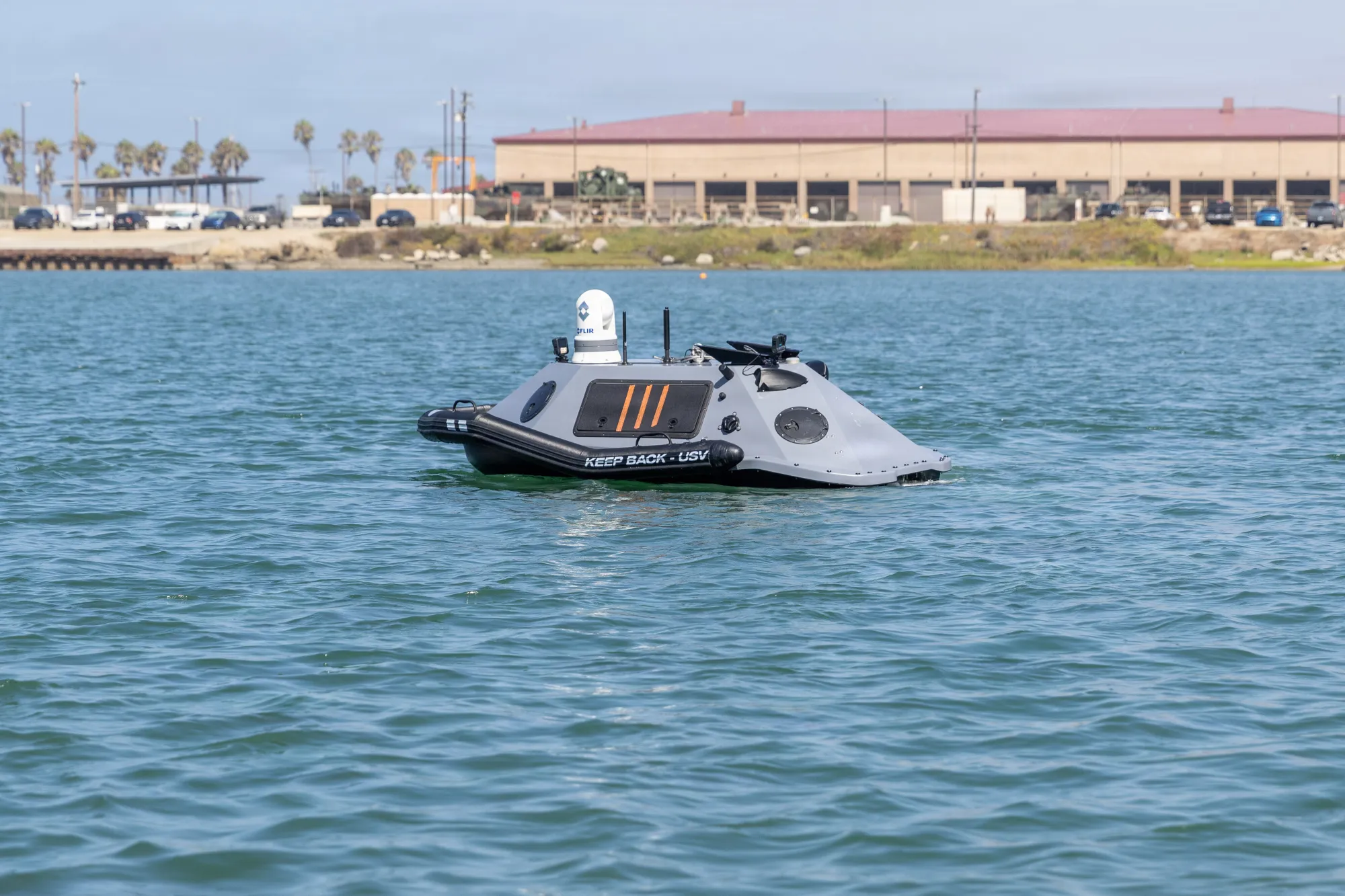
The Marine Corps recently tested a counter-mine USV at Camp Pendleton, California. The evaluation, conducted late last month by the Program Manager Combat Support Systems Explosive Hazard Defeat Team, was intended to address what a Marine release described as a littoral capability gap.
According to that release, the service was seeking a commercial USV with integrated autonomous driving and a payload suite including sonar, forward-looking infrared cameras, line-of-sight communications and acoustic communications. The stated objective is to give Marines greater stand-off distance while detecting, investigating and neutralising threats.
The work forms part of the Marine Corps’ Littoral Explosive Ordnance Neutralization, or LEON, effort. LEON combines a remotely operated vehicle, diver equipment, an unmanned underwater vehicle, a USV and an amphibious unmanned ground vehicle. The system is intended to allow explosive ordnance disposal personnel to confirm and mark hazards and obstacles from very shallow water through the beach zone.
Chief Warrant Officer 2 Alfredo Andrade, officer in charge of Explosive Ordnance Disposal Company, 7th Engineer Support Battalion, said the Corps is extending established unmanned EOD practices into maritime systems to provide more endurance and reduce risks to operators. He said the USV and LEON programme were intended to preserve readily available combat power while reducing exposure to explosive threats.
Amphibious ships tested as USV platforms
The Marine Corps has also evaluated USVs for roles beyond mine and obstacle reconnaissance, including logistics and offensive applications, according to The War Zone. At the Rim of the Pacific exercise this summer, a Splash Industries Typhoon USV was launched and recovered aboard the amphibious assault ship USS Essex.
Amphibious assault ships can carry Marines and equipment and have well decks that can support the deployment and recovery of vessels from the water. The RIMPAC trial demonstrated one pathway for operating drone boats from the ships that routinely transport Marine expeditionary forces.
Niedziocha’s comments point to a Marine requirement focused first on making amphibious approaches safer and better understood, rather than on a specific armed USV role. The ongoing counter-mine evaluation and the USS Essex trial show that the service is testing both the payloads and ship-based operating methods that would be required to make USVs available to deployed Marine units.