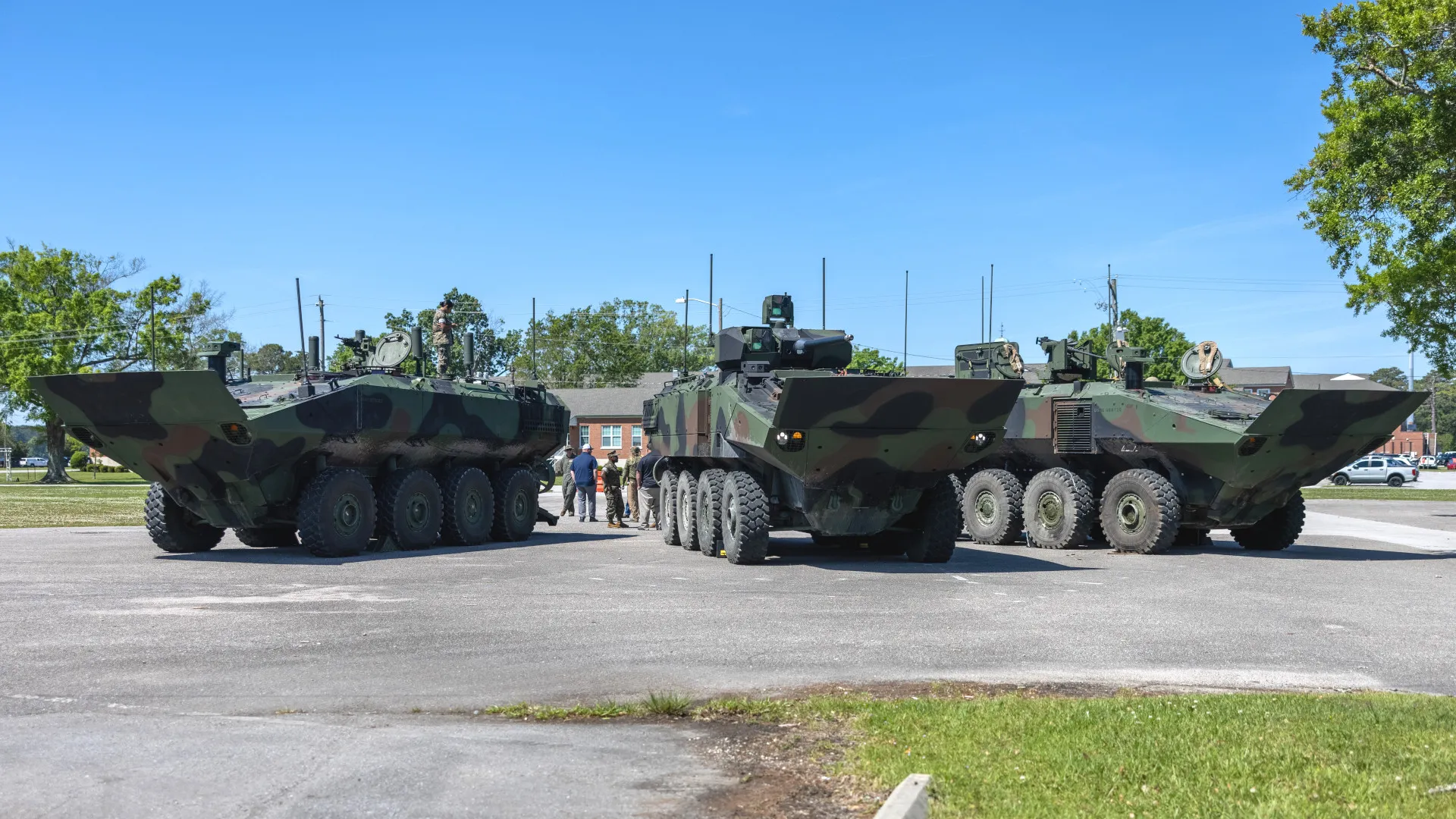
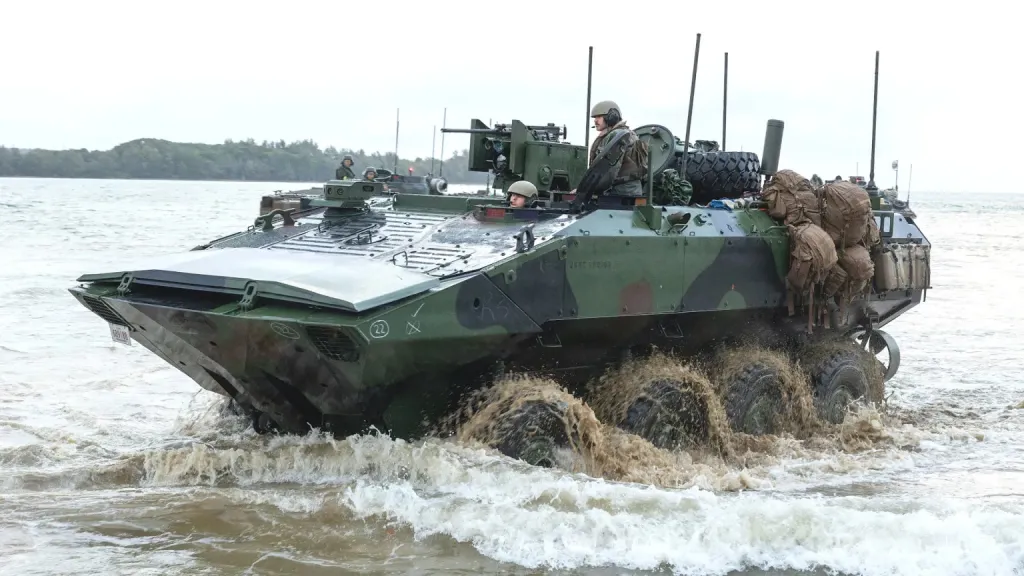
The U.S. Marine Corps has awarded Anduril a $15,711,445.50 sole-source contract for an unspecified number of Pulsar-L electronic-warfare systems, seeking to rapidly improve the ability of its Amphibious Combat Vehicles to defend themselves from small unmanned aircraft. Marine Corps Systems Command said the platform-integrated systems will provide a soft-kill counter-uncrewed aircraft capability for the 8×8 wheeled vehicles, which have replaced the service’s older tracked Assault Amphibious Vehicle fleet.
The contract is framed by the Marine Corps as an urgent operational requirement. In its justification for awarding the work directly to Anduril, Marine Corps Systems Command said forward-deployed Marines currently lack an ability to conduct self-defense against emerging UAS threats. The command said failure to field the capability quickly could expose personnel to avoidable risk, affect mission success and reduce the government’s ability to protect Marines on deployment.
The purchase is one element of broader Marine Corps work to improve the ACV’s protection against uncrewed aerial attacks, as well as anti-tank guided missiles and other threats. The service’s justification presents the vehicle-mounted jammer as a way to provide an organic defensive capability on the platform itself, rather than relying solely on external counter-drone assets.
Pulsar-L is a lightweight member of Anduril’s wider Pulsar electronic-warfare product family. Anduril unveiled the system in April 2025. The Marine Corps contract follows a statement of intent issued by Marine Corps Systems Command the previous month, and the command said the urgent requirement underlying the purchase was formalized on April 7.
Integrated soft-kill capability for the ACV
According to the Marine Corps justification, Pulsar-L combines sensing and jamming functions in an omnidirectional, vehicle-integrated package. The system is intended to detect, track, identify and defeat radio-frequency-dependent Group 1 and Group 2 unmanned aircraft. It also provides counter-positioning, navigation and timing capabilities, the command said.
Under U.S. military classifications cited in the source material, Group 1 systems weigh up to 20 pounds, can operate to 1,200 feet and may reach 100 knots. Group 2 aircraft weigh from 21 to 55 pounds, may fly as high as 3,500 feet and can reach 250 knots. The categories can include small weaponized and one-way attack drones capable of threatening armored vehicles, unarmored vehicles and personnel.
Marine Corps Systems Command said Pulsar-L was the only solution it had identified that could be mounted on the ACV while staying within the vehicle’s available space, weight and power allocation for a soft-kill counter-UAS installation. The command said the system could provide a mobile, organic capability to carry out the counter-drone engagement sequence in deployed land and maritime or littoral environments, without reducing the vehicle’s mobility or operational tempo.
The service described that engagement sequence as the complete counter-UAS kill chain, from finding a hostile aircraft through tracking and identification to defeat. Its assertion that Pulsar-L can perform all of those functions simultaneously is a central basis for the sole-source decision and should be understood as a Marine Corps assessment in the justification document, rather than an independently disclosed test result.
The contract does not specify how many jammers will be delivered or identify which ACV units will receive them. As of April 2026, the Marine Corps had 150 baseline personnel-carrier ACVs, designated ACV-P, and 21 command-and-control ACV-Cs in inventory. The service’s planned ACV family includes 389 ACV-Ps, 33 ACV-Cs, 152 ACV-30 vehicles fitted with 30 mm cannon turrets, and 34 armored recovery variants, designated ACV-R.
The baseline ACV-P’s standard armament is a single .50-caliber M2 machine gun in a remotely operated weapon station mounted on the hull. The addition of an electronic-warfare counter-drone system would address a separate defensive need: detecting and disrupting small aerial threats rather than relying on the vehicle’s existing armament.
Adaptation claims and an evolving electromagnetic threat
Marine Corps Systems Command said Pulsar-L is already used by U.S. Special Operations Command, citing its low weight, its claimed ability to engage multiple UAS at once, and its ability to execute the counter-drone sequence while a platform is stationary or moving. The command also described it as the only commercially available system known to meet the requirement to recognize and respond rapidly to emerging UAS technologies and tactics without repeated updates to predefined threat-data libraries.
In its justification, the command said Pulsar-L uses machine-based learning to adapt continuously as threats change, rather than depending on vendor-issued updates. It did not provide technical detail on how the system applies machine learning or artificial intelligence, nor did it specify the speed at which it can adapt to new signals, emission patterns or operating methods.
The ability to recognize, classify and respond to different radio-frequency waveforms is central to the performance of electronic-warfare systems. New waveforms, changes to the way existing signals are transmitted, and revised tactics or procedures can all degrade a system designed around established threat information. Updating embedded threat libraries has historically been a lengthy and complicated process. The source material notes that the conflict in Ukraine has demonstrated a far faster cycle, in which changes in the electromagnetic environment and associated countermeasures can emerge over periods measured in weeks.
The U.S. military has invested in cognitive electronic-warfare capabilities intended to automate and accelerate parts of that process. A system able to adjust autonomously in real time, including during an operation, has been a key objective of that approach. The Marine Corps justification presents Pulsar-L’s claimed adaptive capability as a factor in its decision to use a sole-source award, but does not establish performance details beyond the command’s stated assessment.
Electronic attack is not a universal answer to the small-drone problem. The source material identifies developments from the war in Ukraine that can complicate such defenses, including physical fiber-optic control links that cannot be jammed. It also notes the use of mesh-like, often improvised networks intended to make drone command links more resilient. The current Marine Corps purchase is specifically focused on radio-frequency-dependent Group 1 and Group 2 systems.
Part of a wider ACV protection effort
The Marine Corps has identified the Pulsar-L order as an interim step rather than its final approach to vehicle-mounted soft-kill counter-UAS equipment. Its justification says a formal program of record for soft-kill counter-UAS is planned to begin in fiscal year 2027. Components of that future effort are expected to be acquired through full and open competition, based on the expectation that more advanced non-kinetic and soft-kill defeat technologies will have matured by then.
Marine Corps officials have also discussed a broader survivability effort for the ACV fleet. At the Modern Day Marine exposition in April, Chris Melkonian, the service’s program manager for Advanced Amphibious Assault, said the Marine Corps was examining how a next-generation active protection system could be installed on the ACV in a lightweight configuration. Such systems could potentially be combined with counter-UAS functions and other protective features.
Melkonian also identified improved situational awareness as a foundation for counter-drone capability. He described the need to sense the surrounding environment, collect onboard video and provide that information to a counter-UAS system. He further said that overhead protection was a critical area of work for the ACV platform.
Overhead armor screens intended to reduce vulnerability to top-down drone attacks first appeared on armored vehicles in Russia before the full-scale invasion of Ukraine in 2022. The practice of fitting such structures, sometimes called cope cages, has since spread internationally, including within the U.S. military. The threat from small attack drones has also been demonstrated in Ukraine, where persistent drone attacks have affected the employment of armored vehicles, including heavily protected main battle tanks.
Small armed drones are not confined to one region or one type of conflict. The source material notes their daily use in Ukraine against armored vehicles, unarmored vehicles and personnel, and describes the threat as spreading more broadly among state forces and non-state actors. It also says that the scale and scope of the threat are expanding, including through increasingly automated targeting capabilities enabled in significant part by the wider availability of AI-driven technologies.
The timing of the Marine Corps requirement, formalized roughly a week after the United States and Israel began major combat operations against Iran, was noted in the source material. However, Marine Corps Systems Command did not identify the circumstances driving the urgent requirement or confirm a connection to those operations. The source notes that Iranian drones, missiles and other systems have presented risks to U.S. forces in the region, while emphasizing that the Group 1 and Group 2 drone threat is broader than the Middle East.