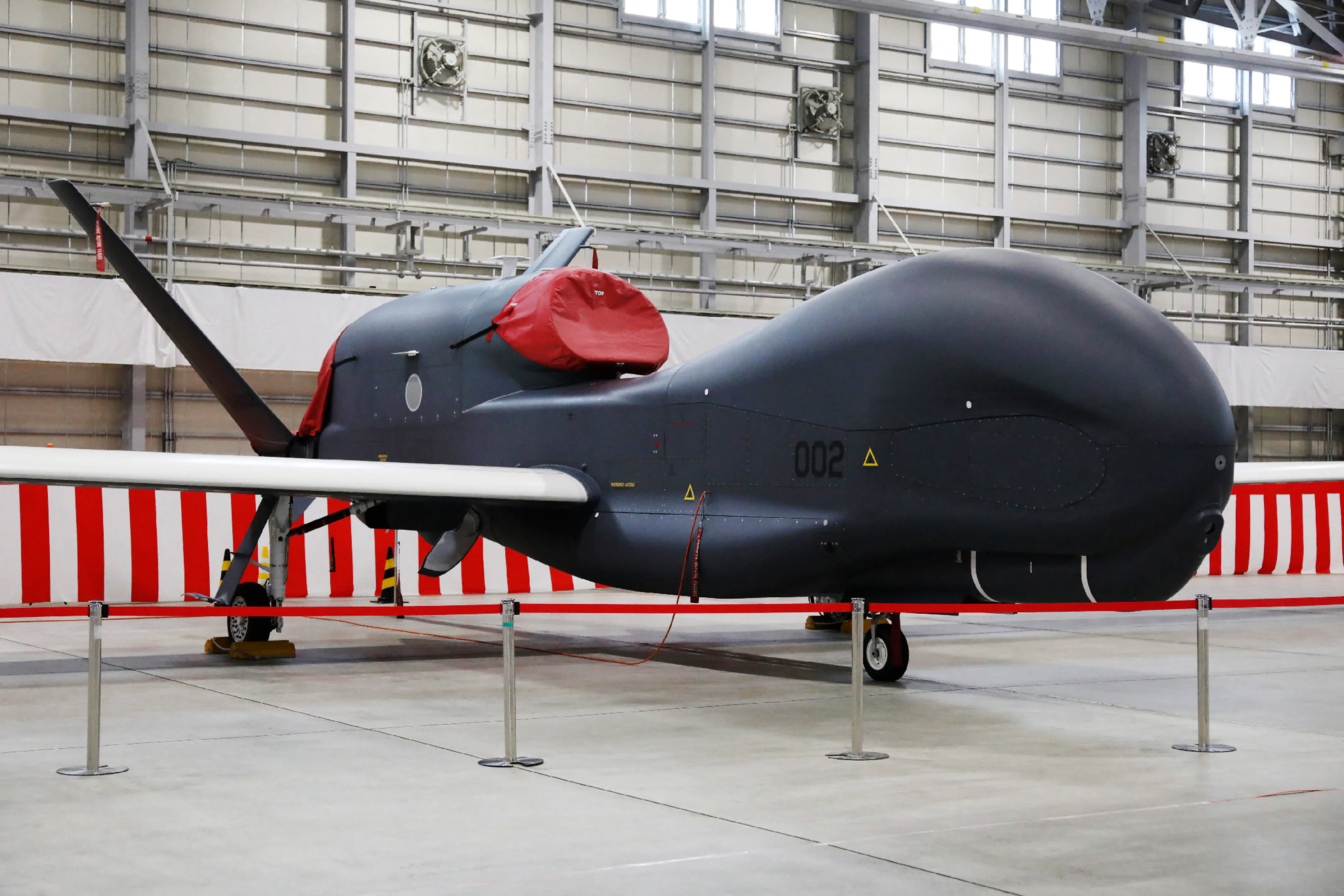
A Japan Air Self-Defense Force RQ-4B Global Hawk reconnaissance drone crashed into the Sea of Japan on Sept. 15 after controllers lost communications with the aircraft during an undisclosed operational mission, cutting Japan’s small fleet of the high-altitude unmanned aircraft from three to two.
The aircraft, operated by the JASDF’s 502nd Squadron from Misawa Air Base in northern Japan, departed at 10:20 a.m. local time. The service said communications failed at about 12:55 p.m. and the drone disappeared from radar three minutes later while over international waters. The crash location was approximately 50 kilometers north of Tottori Prefecture, on western Honshu, according to a JASDF loss report cited by USNI News.
JASDF Chief of Staff Gen. Takehiro Morita said the flight was not a training exercise, but did not disclose its mission. “This particular flight was not a training exercise. I apologize, but please allow me to coordinate regarding how much information I can disclose at this stage. I will provide an answer later,” Morita said, according to a transcript cited by USNI News.
Debris confirms loss
A Japan Coast Guard helicopter spotted floating debris at 2:19 p.m., about 50 minutes after the communications failure. An F-15J assigned to the search located debris six minutes later. The JASDF confirmed at 5:20 p.m. that the wreckage belonged to the missing Global Hawk after Japan Maritime Self-Defense Force fast attack craft JS Hayabusa reached the area at 6 p.m. and photographed the debris.
The JASDF said the aircraft was believed to have crashed based on the photographs taken by Hayabusa. The images were not released. The cause remains under investigation.
The response included two F-15J fighters, a U-125A maritime search-and-rescue aircraft, a UH-60J helicopter and a KC-46A tanker, as well as the frigate JS Agano and Hayabusa. The air force ended its search operations at 6:15 p.m. on Sept. 15, while maritime forces continued searching for debris, according to USNI News.
A reduced long-range surveillance fleet
Japan received its first Northrop Grumman RQ-4B Block 30i in March 2022, followed by the other two aircraft later that year. Japan had paid roughly $163 million for each of the three Global Hawks to be manufactured nearly a decade earlier, Defense News reported. All were assigned to the 502nd Squadron, and the fleet represented Japan’s only long-distance unmanned aircraft capability.
The Global Hawk’s endurance and altitude made it a distinctive element of Japan’s surveillance capacity. The aircraft can remain aloft for up to 32 hours and operate at altitudes of up to 60,000 feet. Its integrated payload includes an electro-optical/infrared sensor, synthetic-aperture radar and ground-moving-target indicator. Reported missions include monitoring preparations for North Korean missile launches and observing Chinese military activity.
The acquisition had drawn controversy in Japan because of the aircraft’s high cost and U.S. control over Global Hawk technology and the processing of collected data. With only three aircraft in service before the crash, the loss removes one-third of a fleet whose range and endurance exceed those of Japan’s other drone programs.
SeaGuardian program set to expand unmanned operations
Japan is separately preparing to introduce 23 MQ-9B SeaGuardian unmanned aircraft for maritime domain awareness beginning in fiscal year 2027. The country’s draft fiscal 2027 defense budget sought $1.88 billion to acquire the first 17 aircraft. Although the SeaGuardian has less endurance and range than the Global Hawk, Japan plans to use the type for missions currently carried out by P-1 and older P-3C Orion maritime patrol aircraft.
The Japan Maritime Self-Defense Force plans to initially deploy 10 MQ-9Bs at Kanoya Air Base on Kyushu and another 10 at Hachinohe Air Base on Honshu, according to remarks by JMSDF chief Adm. Akira Saito cited by USNI News. A Defense Ministry notice released by the Kanoya City council said deliveries to Kanoya would begin in increments of two aircraft per fiscal year from 2027 through 2029, with 10 aircraft planned there by fiscal 2031.
The crash also occurred while U.S. Global Hawks were operating from Japan. The U.S. Air Force has three RQ-4Bs assigned to the 4th Reconnaissance Squadron at Yokota Air Base after relocating them from Guam in May, a move the service said was intended to avoid typhoon-season weather and sustain regional reconnaissance. A U.S. Navy MQ-4C Triton, a Global Hawk derivative, is also operating around Japan; the JMSDF said one conducted an information-exchange exercise with Japanese EP-3 and UP-3 aircraft over the East China Sea on Sept. 15.