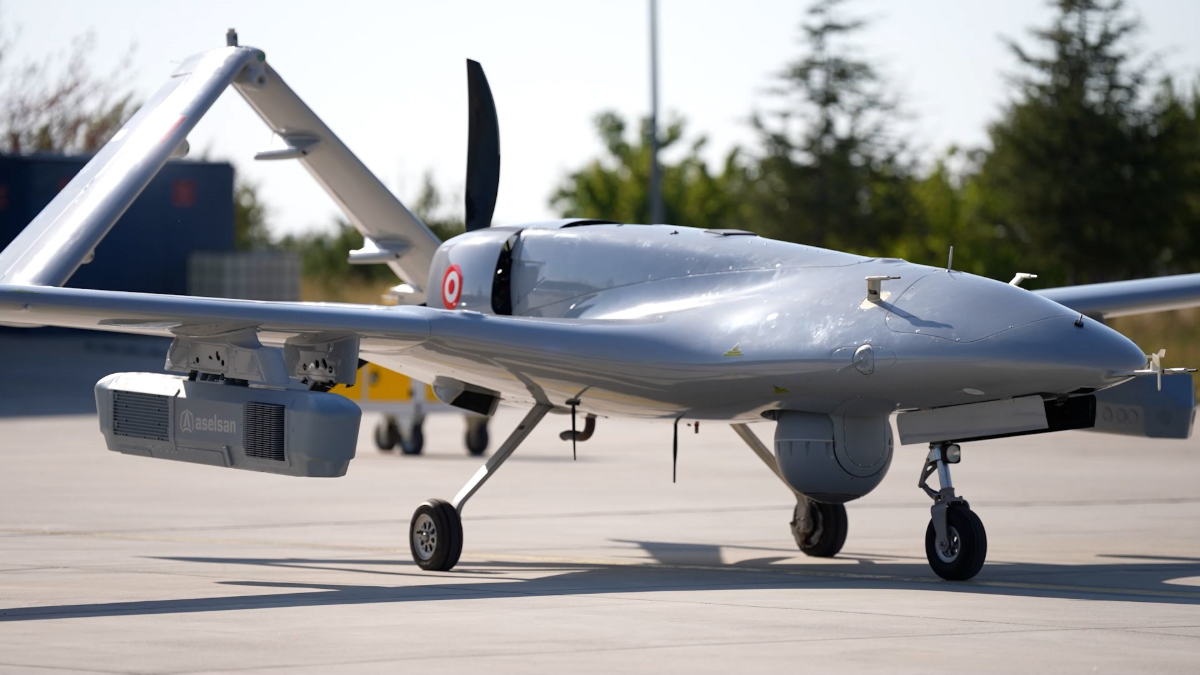
Baykar’s Bayraktar TB3 unmanned combat aircraft has completed a live sonobuoy deployment test from the Turkish amphibious assault ship TCG Anadolu, adding an unmanned acoustic-sensing function to the carrier-capable platform’s maritime role. The aircraft released two sonobuoys during the Turkish Navy’s Denizkurdu-I/2026 exercise in the Eastern Mediterranean, according to Baykar.
The test was conducted from Anadolu’s flight deck as part of anti-submarine warfare drills held from September 20 to 25 across the Black Sea, Sea of Marmara, Aegean and Eastern Mediterranean. Baykar described the event as the first deployment of sonobuoys by a Turkish-made unmanned aerial vehicle in an operational maritime environment.
Wing-mounted dispenser and acoustic processing
The TB3 carried Baykar’s domestically developed Sonobuoy Dispenser System, designated the SAS POD, under its wing. The system was used to release the two expendable acoustic sensors during the exercise. Baykar’s announcement did not identify the specific sonobuoy variant involved.
The aircraft also processed acoustic telemetry from multiple sources. Its onboard architecture handled data collected by the two sonobuoys it had deployed as well as sensors released by a manned maritime patrol aircraft operating in the area. The TB3 then relayed underwater acoustic tracking data to the command network, according to the company’s release.
That combination of deployment, processing and data relay makes the aircraft more than a platform for dropping sensors. In the tested configuration, it operated as an airborne acoustic node able to contribute information from its own sonobuoy field while sharing the wider sensor picture with the naval command network.
Part of Turkey’s unmanned maritime aviation effort
The test follows earlier Turkish efforts to equip unmanned aircraft for underwater warfare missions. TUSAS has displayed its twin-engine Aksungur medium-altitude, long-endurance unmanned aircraft with a sonobuoy pod at domestic IDEF exhibitions and later presented concepts for integrating lightweight torpedoes at NAVDEX 2023. The supplied report says public progress on that platform’s subsurface payload suite subsequently stalled, leaving the TB3 as the first Turkish unmanned aircraft reported to have completed a live sonobuoy deployment.
Turkey has also been developing indigenous acoustic sensors. During the World Defense Show 2026 in Riyadh, Aselsan chief executive Ahmet Akyol told Naval News that airborne release of the company’s Aselbuoy family from an unmanned platform was imminent. The TB3 exercise indicates that the country’s work on uncrewed carrier aviation and acoustic-sensor systems has progressed to joint field testing, although the release did not say whether Aselbuoys were used.
An unmanned addition to airborne ASW
Airborne anti-submarine warfare normally depends on maritime patrol aircraft and shipborne helicopters. Patrol aircraft can establish sonobuoy barriers over suspected submarine operating areas, while helicopters use dipping sonars to search more localized sectors. The report notes that crew fatigue, mechanical limitations and flight-cycle constraints restrict the time manned aircraft can remain on station before refuelling or crew rotation.
The TB3’s reported endurance of more than 30 hours could provide a longer-loitering unmanned option for surveillance and acoustic operations. Adding sonobuoy release and telemetry relay would allow a task group to establish an additional airborne ASW screen without relying exclusively on manned aircraft or sending surface combatants into areas where they could face torpedo threats, as described in the report.
Because the TB3 is designed for short-deck, short takeoff but arrested recovery operations from TCG Anadolu, the capability can accompany an expeditionary group at sea. The exercise therefore demonstrated not only a new payload function but also the integration of a carrier-operated unmanned aircraft with manned maritime aviation and the naval command network. The supplied report identifies the Bayraktar TB3 as only the second known unmanned platform, after General Atomics Aeronautical Systems’ MQ-9B SeaGuardian, to demonstrate live sonobuoy release together with integrated acoustic-telemetry processing.