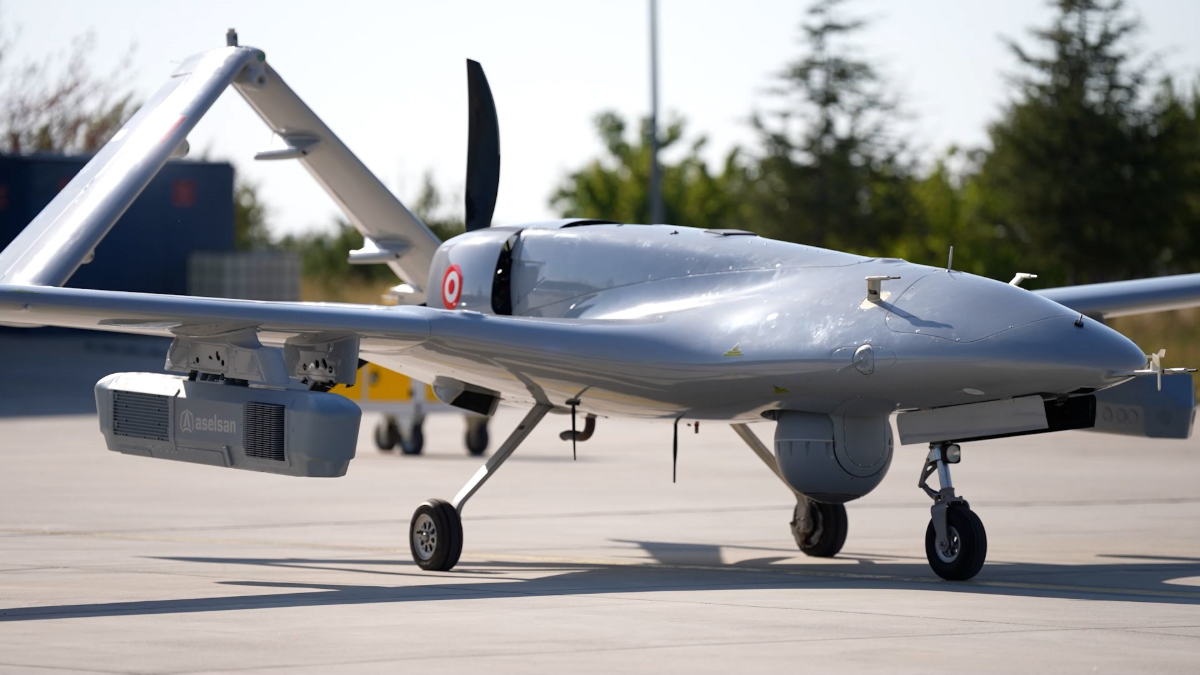
Turkish defence manufacturer ASELSAN has demonstrated a coordinated airborne sequence in which Bayraktar TB2 unmanned aircraft detected a radar emitter, jammed it and produced a radar image of the target area during live trials in Konya province.
According to the company, the event was attended by more than 15 international defence delegations. The demonstration brought together three ASELSAN systems: the ANTIDOT 2ES 100 electronic-support pod, the ANTIDOT 2EA 200 electronic-attack pod and the FULMAR 200 radar-imaging pod.
Three-pod sequence
The ANTIDOT 2ES 100 is intended to detect radar emissions and determine the location of the emitting system. In the first part of the trial, it identified and geolocated a search radar before passing targeting information to the ANTIDOT 2EA 200, which then conducted an electronic attack against the detected radar, ASELSAN said.
At one stage, jamming was stopped deliberately to allow the target radar to reacquire and lock on to the drone. ASELSAN said the jamming pod then used digital radio-frequency memory techniques to disrupt the tracking radar. Such techniques capture a radar signal and retransmit it with alterations intended to confuse tracking.
During the second phase, the detection pod again located the radar emitter while the FULMAR 200 generated a high-resolution radar image of the target area. ASELSAN said the pod provides ground-imaging and target-identification capability with accuracy within a few metres, and that the combined systems can support reconnaissance in darkness and adverse weather.
Configuration and mission scope
ASELSAN described the trial as showing the three systems operating on Bayraktar TB2 drones. However, other reporting on the Konya event said the ANTIDOT and FULMAR pods were carried by two separate TB2 aircraft. Those accounts also put the number of participating countries at 18, rather than ASELSAN’s figure of more than 15 delegations.
The company presented the detection, jamming and imaging sequence as an early form of suppression and destruction of enemy air-defence activity, a mission set focused on disabling radar and air-defence systems to enable other aircraft to operate nearby with greater safety. ASELSAN said a complete version of that concept would include marking a target with its ASELFLIR 500 sensor and engaging it with a laser-guided munition.
No laser-guided strike was included in the Konya demonstration. ASELSAN also did not disclose any customer orders for the specific three-pod package, its cost, or a schedule for operational fielding beyond the live trial.