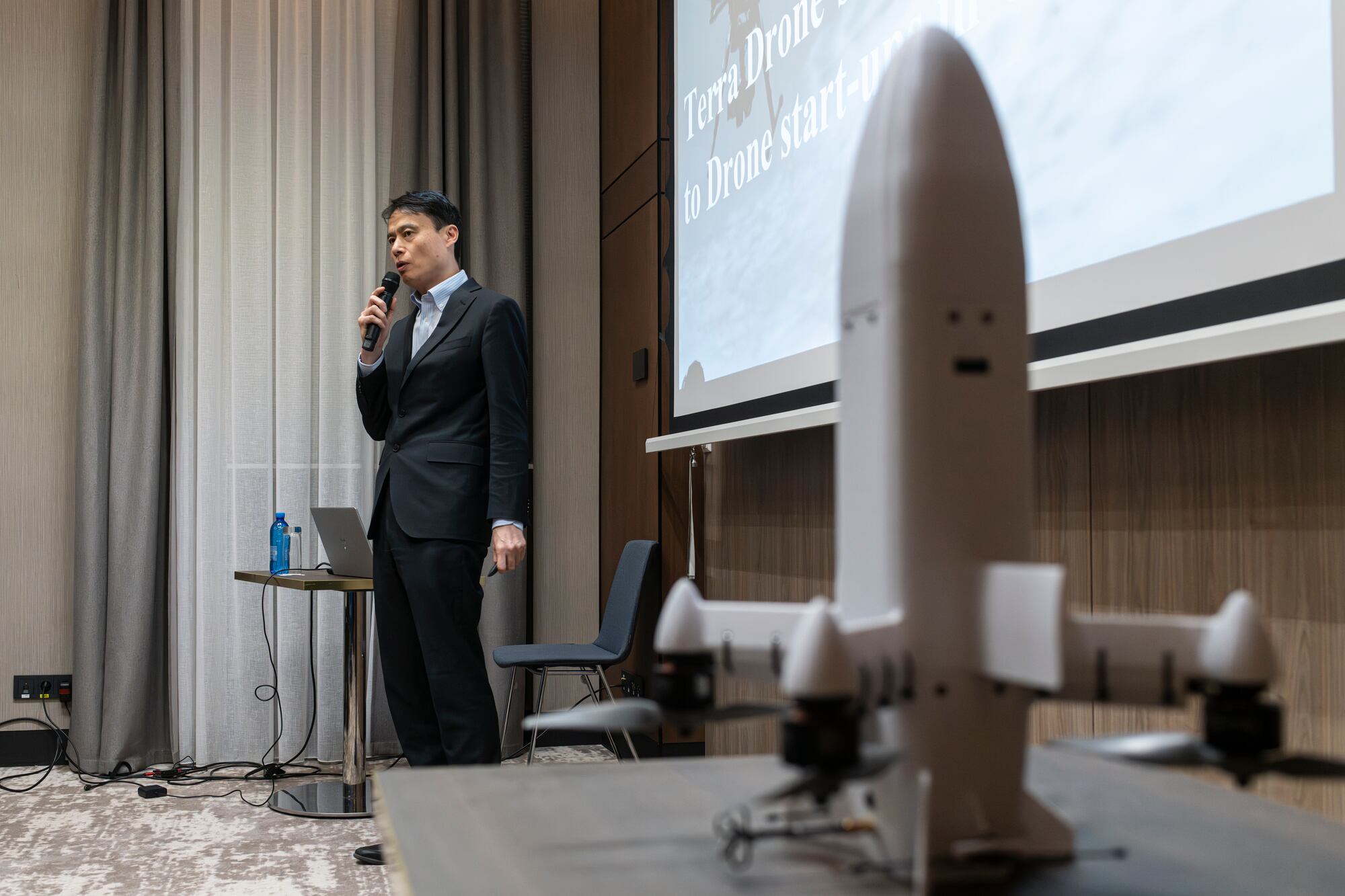
Japan’s Acquisition, Technology, and Logistics Agency has signed a mass-production procurement agreement for interceptor drones manufactured using 3D printing, advancing a government effort to rapidly deploy a large unmanned fleet by 2027. The agency selected Terra Drone’s Terra B1, a rocket-launched interceptor, after a demonstration with the Maritime Self-Defense Force last month.
ATLA did not disclose the number of drones ordered or the value of the contract. Terra B1 is developed by Terra Drone, a domestic industrial company, and is described as the Japan-made counterpart to the Terra A1, which had been fielded on Ukraine’s battlefields earlier this year.
A rapid procurement decision
The selection follows a Defense Ministry tender issued in late May to rapidly acquire and deploy drones able to intercept one-way attack drones, including Shahed-type systems, and anti-radar loitering munitions such as the IAI Harpy. Industry insiders described the decision as the fastest to date: the tender process took three months, compared with one to two years for previous bids.
The procurement also reflects the government’s expanding interest in 3D-printing capacity for defense needs. Terra Drone CEO Toru Tokushige said the manufacturing approach would simplify and shorten the design and prototyping stage, while helping the company move Terra B1 into mass production quickly enough to meet the contract’s requirements.
Production flexibility and resilience
According to Terra Drone, additive manufacturing is intended to reduce costs and speed production, but its value also lies in allowing changes to the interceptor as threats and drone technology evolve. The company says it can modify the systems without delaying their scheduled deployment, an important consideration for a program aimed at countering rapidly changing unmanned threats.
Terra Drone also plans to distribute production among multiple sites before eventually expanding to local printing farms. The company presents the arrangement as a safeguard against disruption if a manufacturing facility is attacked.
Even if one production site were attacked by a system such as a Shahed-type drone, this distributed model could significantly reduce the risk of the entire supply chain being disrupted.
Toru Tokushige, Terra Drone CEO
The approach builds on the growing defense use of 3D printing. The U.S. Army and Navy deployed printers in the field in 2012, while printing farms in Ukraine have become a frontline necessity, producing drone parts and tools for brigades in the ongoing war. In Japan, the ministry’s decision to adopt the technology signals what the source describes as a major shift for a defense industry that experts warn may struggle to keep pace with the administration’s export drive and growing global demand.
We believe 3D printing is not simply about reducing manufacturing costs. It has the potential to transform Japan’s defense manufacturing into a faster, more flexible and more resilient production model.
Toru Tokushige, Terra Drone CEO