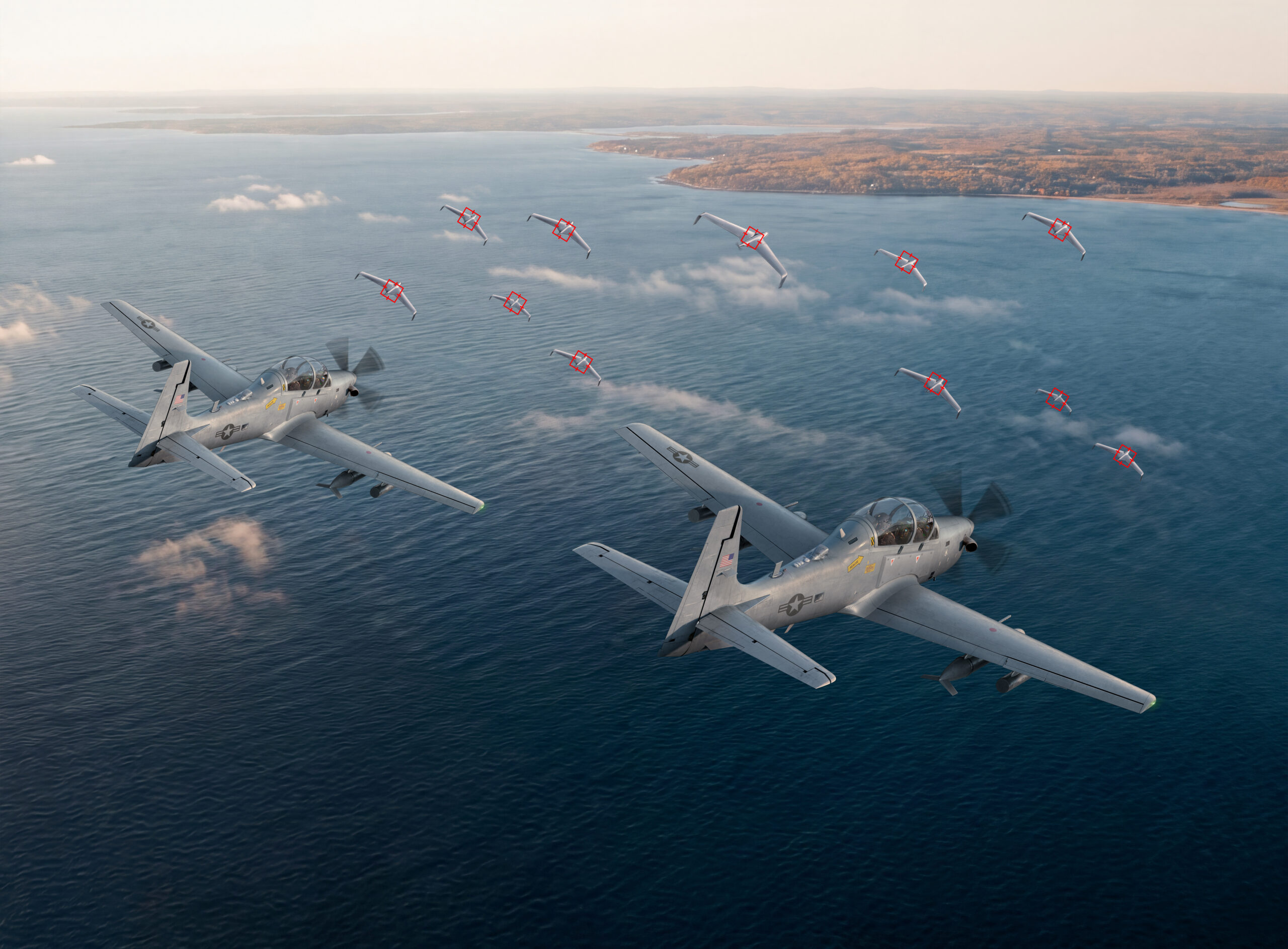
Embraer is developing a counter-unmanned aircraft system concept for its A-29 Super Tucano light-attack aircraft, seeking to position the turboprop as an airborne layer against incoming drone swarms. The company is conducting a proof-of-concept demonstration with an undisclosed country using A-29s and actual drones as targets, an effort intended to refine the operational concept and optimize the system’s human-machine interface.
The concept addresses a central challenge for air defenses: the cost and availability mismatch between inexpensive one-way attack drones and the fighters and air-to-air missiles often used to stop them. High-end aircraft including F-15s, F-16s and F-35s can engage drones, but repeatedly using those platforms and their missiles against lower-cost targets can be difficult to sustain. Ground-based kinetic and non-kinetic counter-UAS systems offer another defensive option, but their range can limit how far from a defended site they can begin engaging an incoming formation, and swarms can deplete their magazines or overwhelm them.
Embraer’s proposed solution would put the A-29 between fixed-site defenses and high-performance fighters. The aircraft would use air-to-air precision rockets, its internal wing-mounted .50-caliber machine guns and an electro-optical/infrared sensor system to acquire and attack drones before they reach the inner defensive layer. Its turboprop propulsion is also intended to give the aircraft an advantage against slower aerial targets that can present a difficult intercept problem for fast jets.
An outer layer for drone defense
“Many Air Forces are moving toward this idea of a layered defense,” Marc Ayala, Embraer’s vice president for defense sales in North America, said. “It’s not just fixed-point defenses. Fixed-point defenses are great and they’re sort of the goalie in the analogy here, but you have to have some defenders that are out beyond the goalie to thin the swarm to a manageable size by the time it gets into that engagement range.”
Ayala cited Guam as an example of how the aircraft could fit into such an architecture. In that model, A-29s would provide a first defensive line across a zone extending roughly 50 to 200 miles from the defended area, while fixed-point ground defenses would cover the inner zone from 50 miles inward. The objective would be to reduce the number of drones approaching the point-defense layer rather than rely on that layer alone to defeat the entire threat.
The A-29 would not be expected to independently search broad areas of airspace for small, low-flying drones. Instead, a ground-based air-defense radar or another external source would detect an incoming swarm and transmit its location to the aircraft over a datalink. That handoff is a core element of the concept, allowing the crew to be vectored into the engagement area before using the aircraft’s own sensors to identify individual targets.
“If you think about counter-UAS, you think about the weapon first, right?” Ayala said. “The weapon is definitely part of it, but the datalink on how the information is received is equally important, if not more important. We talk about the engagement as find, fix and finish.”
Sensors, rockets and guns
After being directed to the target area, the A-29 would use an L3Harris WESCAM MX-15D electro-optical/infrared system to fix and track drones. The sensor includes embedded moving-target-indicator and advanced video-tracker capabilities, which help generate a firing solution. According to Ayala, A-29s already equipped with the MX-15D would need a software upgrade rather than a hardware modification for the counter-UAS configuration. Aircraft without an EO/IR system would require one to be installed.
For the final engagement, Embraer’s concept centers on Advanced Precision Kill Weapon System-equipped rockets, or APKWS. The aircraft also retains its wing-integrated .50-caliber machine guns, unlike aircraft that carry guns in external pods. That arrangement allows the A-29 to load missile pods on its hardpoints while keeping several hundred gun rounds, depending on configuration. Ayala said the guns could be used when rockets miss or have been expended, increasing the number of targets an aircraft could potentially engage during a sortie.
Speed is another part of Embraer’s argument for the platform. A slow-moving drone can be difficult for a fighter to engage because of the difference between the target’s speed and that of a jet conducting an intercept. Ayala pointed to a Shahed drone flying at about 115 mph, while an F-16 approaches at speeds many times higher. If a pilot must visually acquire a small target, designate it, fire and then maneuver to avoid a collision, the available engagement window can be only seconds.
“It can slow down, roll in behind the swarm and take out multiple targets before it has to come in and do another pass,” Ayala said of the A-29. “You’ve got several seconds of engagement time versus one or two. And the odds of having a collision with one of these attack drones is much lower when you’re flying the right speed. You have to get there fast and then attack slow.”
Leveraging an existing fleet
For operators that already use the A-29 for light attack, close air support, reconnaissance, border security or advanced training, the counter-UAS mission could add another role without introducing a wholly new aircraft type. Ayala said the transition from ground attack to airborne drone engagements would be relatively straightforward for A-29 pilots. The aircraft’s ability to operate from unprepared runways and with less supporting infrastructure than high-performance fighters is also part of its appeal, according to the company.
Embraer said it is seeing increased interest in the A-29 from NATO allies seeking to expand their defense capabilities. In the United States, three A-29s remain in Air Force inventory and are flown by the Air Force Test Pilot School at Edwards Air Force Base; those aircraft could potentially be used to evaluate the airborne counter-UAS concept. Embraer also maintains an A-29 production line in Jacksonville, Florida, which Ayala said is not operating at full capacity. The aircraft includes significant U.S. content through American suppliers, a factor the company says aligns the proposed mission with the U.S. industrial base.