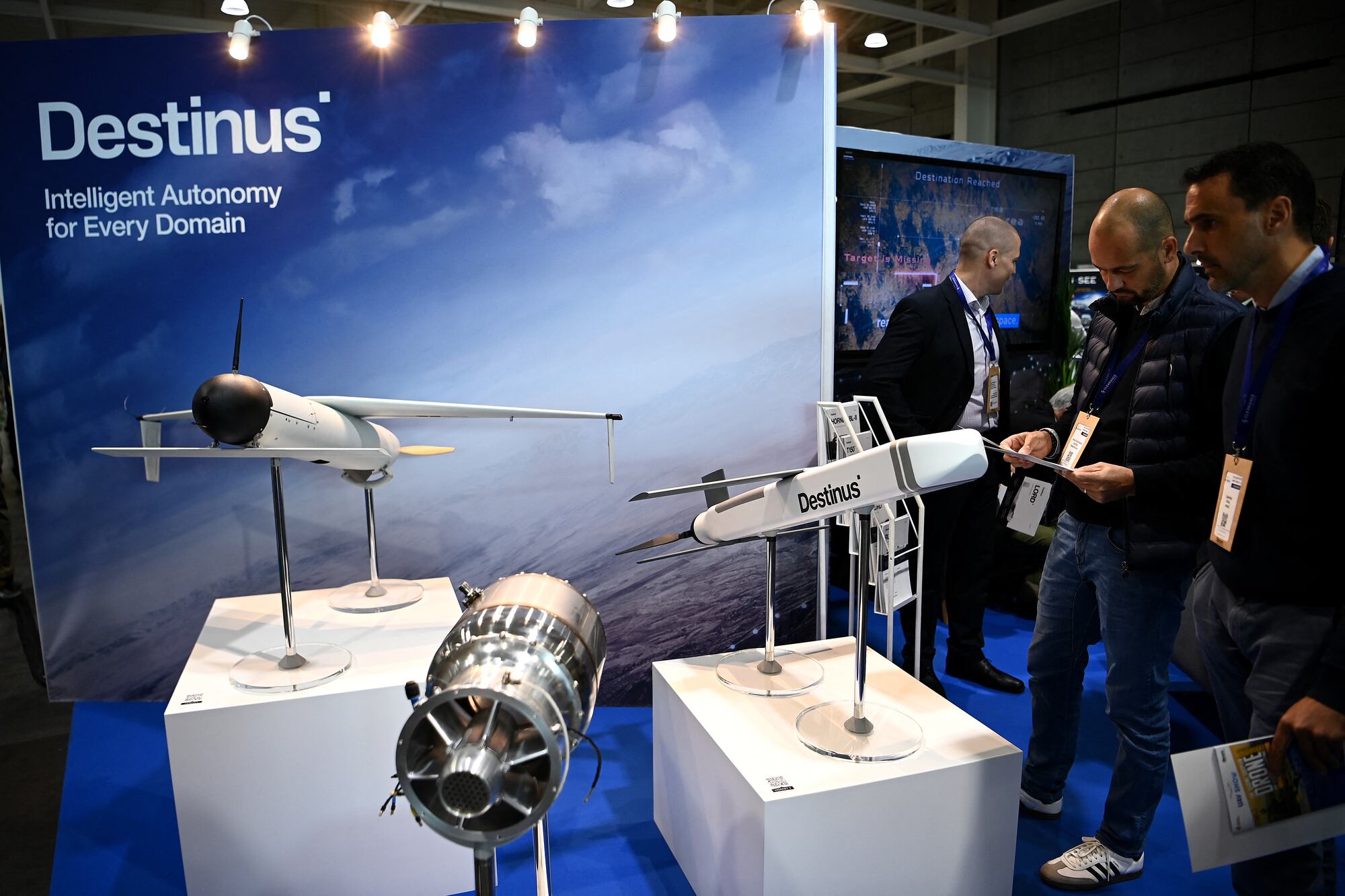
The Royal Netherlands Navy plans to add a kinetic counter-unmanned aircraft system capability based on Destinus’ Hornet B2 interceptor drone, a program intended to improve warship protection against drone attacks and scheduled for completion in the second quarter of 2027.
Destinus will develop the capability, deliver interceptors, integrate the system aboard several warships and provide support toward a possible initial operating capability, the company said. The Dutch Ministry of Defence said the new equipment will supplement, rather than replace, existing armaments.
A response to medium-range threats
“The threat of drones at medium range is increasing,” the Dutch Ministry of Defence said. “That’s clear from both operational analyses as well as the current threat picture during maritime operations. Sailing units therefore need additional means to effectively defend themselves in fleets.”
The planned system comprises a base station and a launch platform able to fire a drone interceptor. The ministry said the counter-UAS solution will continue to be developed through testing. Destinus said the Dutch Navy will provide direct operational expertise during development and evaluation, helping shape capability requirements and system specifications. According to the company, that involvement is intended to reduce the need for adaptation after development.
Hornet interceptor architecture
The Hornet B2 is designed as a kinetic interceptor for one-way attack systems. Destinus said its earlier Hornet B1 variant is already in serial production. The interceptor is launched from a sealed canister using a rocket booster, then deploys its wings and transitions to electric-powered cruise flight.
For the terminal phase of an engagement, the system is designed to use electro-optical and infrared sensing with AI-based processing, Destinus said. The company said the interceptor’s cost per engagement is “far below that of traditional interceptor missiles,” framing the program as a means of addressing low-cost threats that can arrive in large numbers.
“The program addresses the growing requirement for scalable naval protection against low-cost, high-volume aerial threats,” Destinus said. Chief Executive Mikhail Kokorich argued that low-cost aerial threats have changed the economics of naval air defense. “No navy can sustainably trade multimillion-euro missiles against low-cost threats arriving at volume,” he said. “Hornet B2 answers this with a different architecture.”
Naval interest in lower-cost interceptors
The Dutch effort follows growing interest in lower-cost drone interceptors for defending against one-way attack UAVs. Ukraine has used low-cost interceptor drones against such systems, while Western navies have faced the prospect of using expensive missiles against relatively inexpensive Houthi drones in the Red Sea. The U.S. Navy has already installed launchers for Raytheon’s Coyote interceptor on Arleigh Burke-class destroyers.
For the Netherlands, the Hornet B2 program is set to move from development and integration through testing toward a potential initial operating capability by the second quarter of 2027. The project will determine how the interceptor system can be incorporated into several Dutch warships as an added layer of fleet defense.