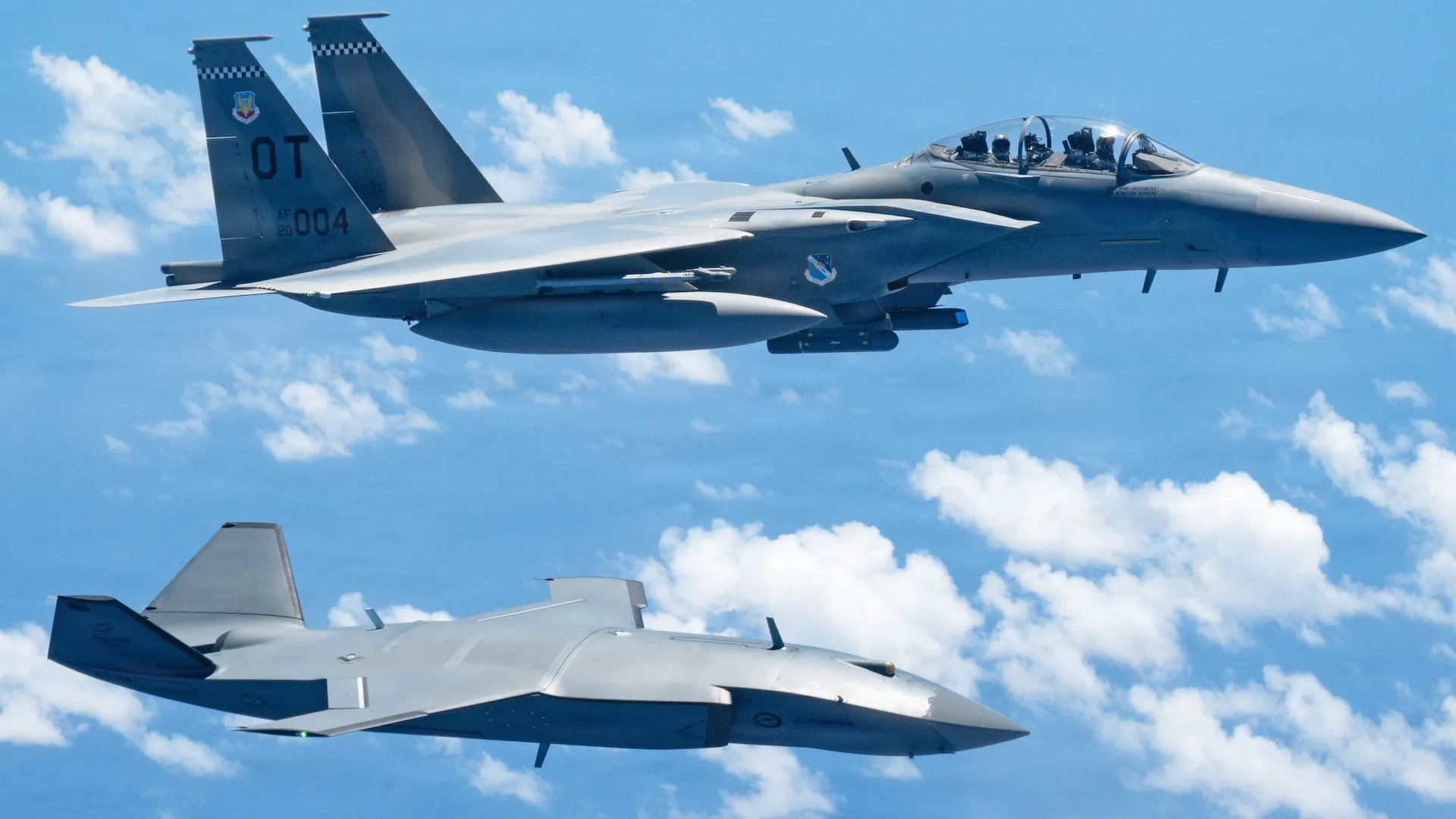
U.S. Air Forces in Europe is preparing for a future in which NATO members field collaborative combat aircraft alongside their crewed fighter fleets, with the command emphasizing that common standards, networking and shared operating concepts will be essential if those systems are to add usable alliance combat power.
Lt. Gen. Jason T. Hinds, commander of U.S. Air Forces in Europe, U.S. Air Forces Africa and NATO’s Allied Air Command, said European interest in autonomous combat aircraft is growing as the U.S. Air Force pursues a planned fleet of hundreds of CCAs. Speaking at the Air & Space Forces Air, Space and Cyber Symposium, Hinds pointed to the service’s stated aim of having at least 500 CCAs in service by 2032.
“I think you’re going to see a lot more interest from other nations inside Europe about what is America doing with CCAs and how they can join this party, if you will.”
Lt. Gen. Jason T. Hinds
That interest is particularly consequential in Europe, where USAFE operates a smaller fighter force than it did during the Cold War and many NATO allies also face shrinking inventories of crewed combat aircraft. In that setting, autonomous aircraft could augment crewed fighters and increase available combat mass without a matching expansion in permanently based aircraft and personnel.
Hinds identified Germany as heavily involved in the CCA discussion, while saying Scandinavian countries and the Netherlands are also interested. Germany is pursuing procurement of CCAs by 2029, Sweden has unveiled a concept for a high-end stealthy CCA-type drone, and the Netherlands is seeking closer alignment with U.S. Air Force CCA efforts. The United Kingdom has launched its Storm Fighter CCA program, while Germany is pursuing a separate loyal-wingman effort. The United Kingdom, Italy and Japan are also jointly pursuing the Global Combat Air Program, intended to produce the Tempest next-generation crewed fighter and associated uncrewed systems.
Defensive and offensive roles
USAFE is using two broad operational scenarios, or vignettes, to help allies consider how CCAs could fit into NATO force structures. The first is defensive: an autonomous aircraft operating within an integrated air and missile defense network could engage one-way attack drones or cruise missiles, reducing the need to use expensive crewed fighters for those missions.
Hinds said NATO air forces have been effective when called upon to counter one-way attack drones, but he wants that work done more efficiently from a cost perspective. He described a desired mix that would include lower-cost interceptors, preferably ground-based in some cases and air-based in others. CCAs could offer an additional option for that defensive mission set.
The second vignette concerns an offensive response to a hostile incursion into NATO territory. In that circumstance, CCAs could help reduce or destroy integrated air defense systems and potentially attack fielded opposing forces. Hinds said allies are interested in incorporating the aircraft into future force designs for both defensive missions and counter-integrated air and missile defense roles.
Work has already begun at the alliance level on the practical implications. The Joint Air Power Competence Center, NATO’s airpower think tank in Kalkar, Germany, has produced a study examining modular CCA employment by member nations, including training, sustainment and exercises. Hinds said the paper reflected demand from the countries involved, and he expects experimentation to begin soon, initially in the United States and potentially later in Europe, including in Sweden and other NATO nations.
Commonality and interoperability by design
The spread of national CCA and uncrewed-aircraft initiatives creates a central integration problem for NATO: ensuring that autonomous platforms developed or acquired by different countries do not become incompatible national fleets. Hinds said the preferred answer is commonality in equipment wherever possible.
“The first and foremost thing is we want to strive for commonality. Commonality means we don’t even have to worry about interoperability.”
Lt. Gen. Jason T. Hinds
Where common equipment is not feasible, USAFE wants interoperability incorporated at the beginning of a program rather than added after a platform enters service. Hinds called this “interoperability by design,” with NATO data standards and other requirements built into national systems from the outset. The alliance already has experience establishing shared standards for tactics, procedures, communications, datalinks, weapons employment and other technologies, providing a foundation for integrating differing systems.
Hinds cautioned that countries have previously acquired equipment that did not work with NATO systems. Such decisions can leave an operator facing the cost of modifying its equipment, or require the alliance to adapt its own systems around it. The stakes increase as autonomous aircraft become elements of more complex sensor, weapons and command-and-control networks.
A baseline command-and-control network for CCAs is especially important, Hinds said, because it would allow different platforms to manage autonomous aircraft seamlessly across a complex battlespace. He described a prospective kill chain in which an F-35 detects a target, sends information to another network node, and a ground-based system operated by another NATO nation ultimately launches the weapon. In such an architecture, the sensor, aircraft, command-and-control network and weapon need not belong to one country.
USAFE is also making what Hinds described as significant advances in cross-servicing, cross-loading and cross-flying allied aircraft. The same principle extends to weapons, as European nations expand production of missiles, drones and other systems alongside aircraft programs.
“We want to have all the fires, right? Whether it’s U.S. built or built inside European nations.”
Lt. Gen. Jason T. Hinds
Expanding the industrial base
Hinds rejected the view that indigenous European aircraft and autonomous-system programs necessarily represent a move away from U.S. equipment. Instead, he characterized the trend as an expansion of the transatlantic defense-industrial base. He cited Sweden, which continues to manufacture military equipment including Gripen fighters, as an example of a NATO member producing systems already operated within the alliance. Swedish Gripens are leased to Hungary, and other countries are considering the aircraft, he said.
He also welcomed discussions around co-manufacturing and co-production. For USAFE, the goal is not to require every ally to buy identical platforms. It is to ensure that aircraft NATO members develop or acquire can connect to a common architecture, exchange data and targeting information, draw on logistics networks and contribute weapons effects across national boundaries. If that architecture is ready when allied CCAs begin entering service, the aircraft could offer NATO a significant means of expanding combat capacity across Europe.