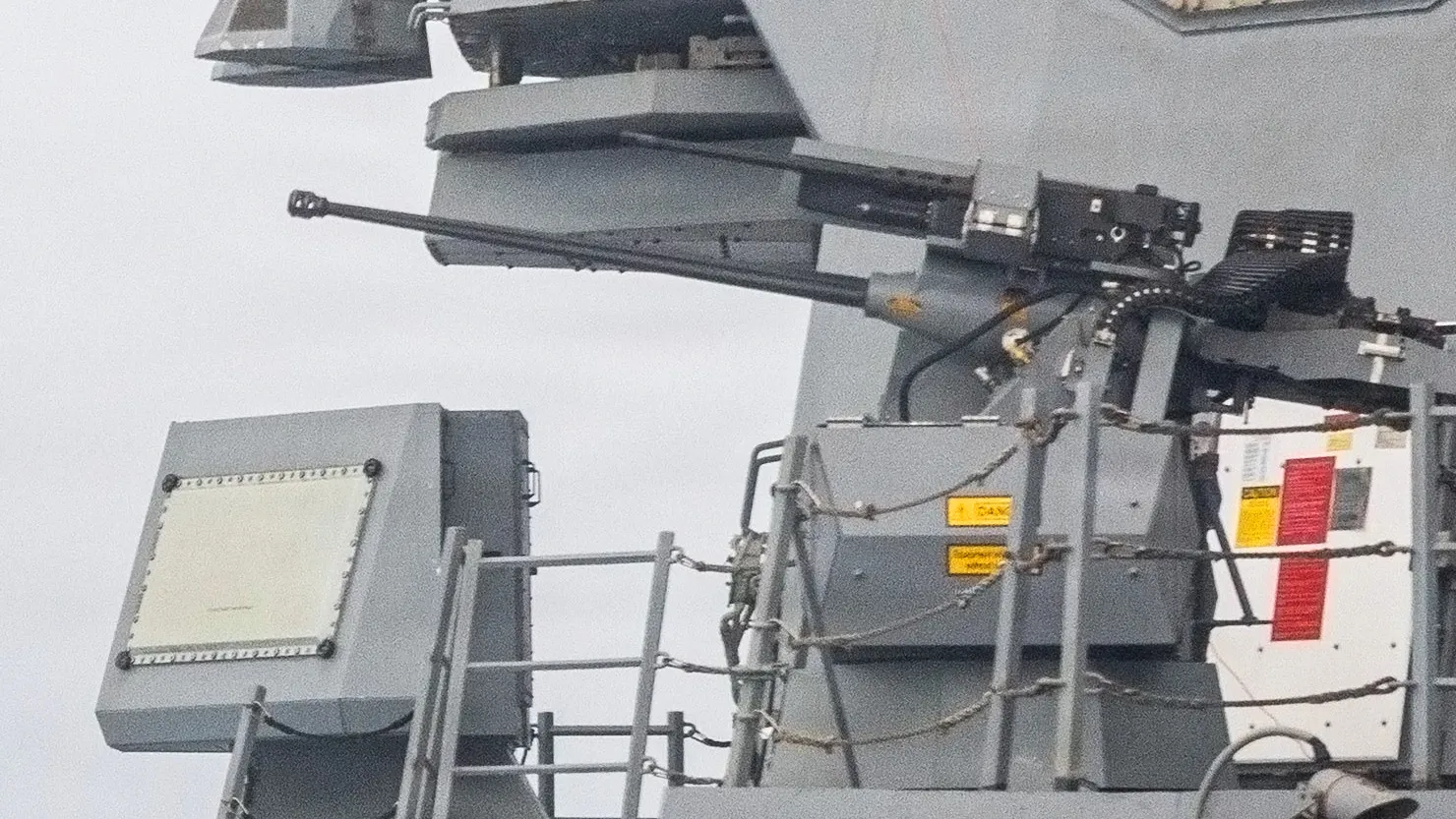
The Arleigh Burke-class guided-missile destroyer USS Mustin has become the first U.S. Navy warship fitted with the Mk 38 Mod 4 Gun Weapon System, a new remotely operated point-defense mount that pairs a 30mm chain gun with a .50-caliber machine gun. Recent Navy imagery from the Indian Ocean showed the installation aboard Mustin during a replenishment at sea, while photographs released late last month showed the system being fired in routine training.
The Mk 38 Mod 4 is intended to improve the Navy’s ability to counter uncrewed aerial systems while retaining defensive utility against surface targets and supporting anti-terrorism and force-protection missions. Although it carries the Mk 38 designation, the new variant differs substantially from the earlier Mk 38 systems installed across the fleet. Mustin received its installation in 2024 and still appears to be the Navy’s only ship equipped with the Mod 4, though the service is preparing the configuration for broader use.
A new dual-gun mount
The system is the Navy designation for a version of MSI Defense Systems’ Seahawk DS30 series, which the service began acquiring in the late 2010s. Its primary weapon is the 30mm Mk 44 Mod 3 Bushmaster II chain gun, mounted beneath an M2 .50-caliber machine gun in the distinctive stacked, or “piggy-backed,” arrangement visible aboard Mustin.
The Mk 44 can fire single shots and bursts, as well as fully automatic fire at low and high rates of 100 and 200 rounds per minute, respectively. The M2 has a rate of fire of about 500 rounds per minute. The ammunition capacity of the Mod 4’s magazines for either weapon is not immediately clear. The 30mm Mk 44 is also used in Mk 46 gun systems on Zumwalt-class destroyers and San Antonio-class amphibious ships, as well as in other ground and air applications.
In addition to the gun mount, the complete Mod 4 installation includes a separately mounted Mk 48 Mod 2 electro-optical sight system and a Mk 134 Mod 0 operator console for remote operation. It is designed for full integration with the Aegis Combat System on Arleigh Burke-class destroyers. That integration could provide a significant advance for engaging some target types, including drones, through radar-based targeting, though it is unclear how individual mounts are targeted simultaneously. Unlike earlier Mk 38 systems, the new turrets do not appear to carry their own prominent optical assemblies.
The Navy said a July 2022 test demonstrated that a Mk 38 Mod 4 could identify, track and engage both surface and aerial targets with live ammunition against fixed and moving targets. According to the service, the event also highlighted an enhanced fire-control chain, improved 30mm-gun performance and the system’s ability to address new challenges.
Replacing and expanding the Mk 38 family
The Mk 38 line has evolved from a manually operated 25mm deck gun into a family of stabilized, remotely controlled weapons. The original Mk 38 Mod 0, developed by the Navy in the late 1970s, used a manually operated 25mm M242 Bushmaster chain gun. The Mod 1 was the first version to enter serial production and began appearing on Navy ships in the late 1980s.
After the 2000 terrorist attack on USS Cole in Aden, Yemen, the Navy began acquiring the Mk 38 Mod 2, also known as the Typhoon Weapon System. The Mod 2 added remote control, stabilization, electro-optical and infrared sensors, and a laser rangefinder. The Navy has said testing showed the variant delivered two to three times the strike accuracy of its predecessor. It retained the 25mm M242, which could be fed by a 168-round magazine and fired in single-shot, three-round-burst, or automatic modes.
The Mk 38 Mod 3, acquired beginning in the 2010s, added a 7.62x51mm Mk 52 Mod 0 chain gun supplied by a 750-round magazine. The Mk 52 has a maximum rate of fire of 570 rounds per minute. The Mod 3 also incorporated an improved electro-optical/infrared sensor with 330-degree surveillance coverage and multiple fields of view. The sensor can scan independently from the gun, allowing operators to observe without moving the weapon toward a detected target.
Earlier Mk 38 variants have been fielded on cruisers, destroyers, aircraft carriers, amphibious ships and auxiliaries. The Navy is also upgrading its remaining Mk 38 Mod 2 systems to the Mod 3 standard, while the Mod 4 introduces a more powerful 30mm main weapon and the added .50-caliber gun for a new layer of capability.
Path to a wider fleet role
The Navy awarded MSI Defense a contract for an initial low-rate production batch of 15 Mk 38 Mod 4 systems in 2023. In a February news item, Naval Sea Systems Command said Naval Surface Warfare Center Dahlgren Division was finalizing the configuration so that it could be introduced to a wider range of platforms as fleet requirements evolve.
The Navy’s fiscal year 2027 budget request indicates the service plans to integrate the Mk 38 Mod 4 on at least all Flight IIA and Flight III Arleigh Burke-class destroyers. The system is also planned for future U.S. Coast Guard icebreakers, which are to receive combat systems derived from Aegis.
For the destroyer force, the new mount is part of a broader effort to strengthen short-range defenses against drones and other threats. The Navy is also fitting increasing numbers of destroyers with new anti-drone interceptors and is working to replace the 20mm Vulcan cannon-equipped Mk 15 Phalanx close-in weapon systems on Arleigh Burke variants with launchers for RIM-116 Rolling Airframe Missiles. Those changes are intended to improve protection against uncrewed aircraft, incoming missiles and other aerial threats, while small crewed boats operating in large groups remain a concern as well.
More broadly, the Navy has invested in shipboard counter-drone defenses that include directed-energy weapons, physical interceptors and electronic-warfare systems. The Mk 38 Mod 4 gives that effort a gun-based component designed for the close-in fight. With Mustin serving as the first installation and the Navy moving toward a fleet configuration, the dual-gun system is positioned to spread beyond its current single-ship deployment.