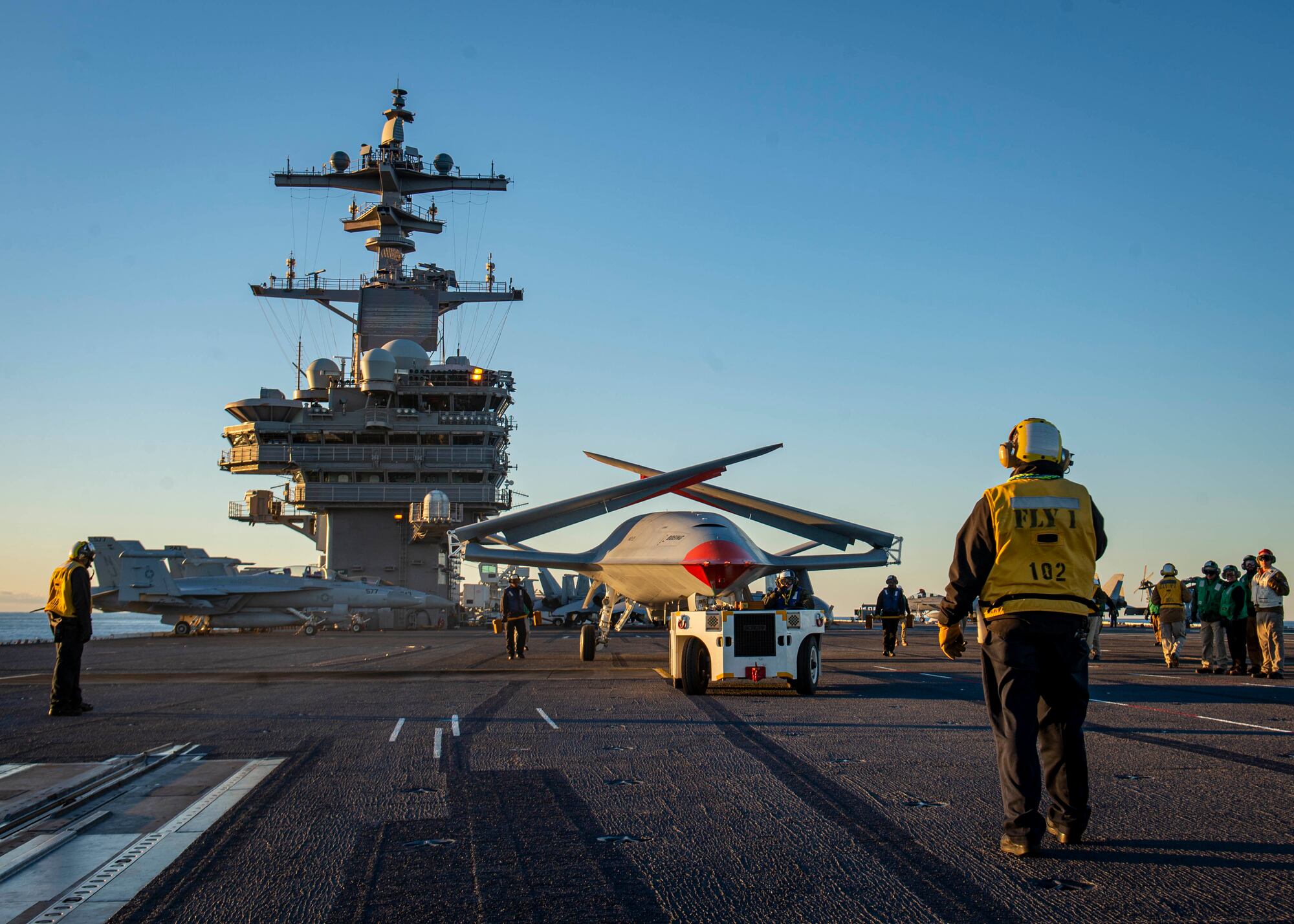
The U.S. Navy is seeking industry input on a prospective family of unmanned aircraft designed to operate from its nuclear-powered aircraft carriers and, in some cases, other sea-based platforms. A July 14 request for information describes the effort as part of the Air Wing of the Future Family of Systems and asks companies to identify affordable, scalable designs able to undertake missions ranging from strike and aerial refueling to anti-submarine warfare and resupply.
The service said it is exploring the industrial base’s ability to provide “highly capable, autonomous platforms optimized for operations from Ford-class and Nimitz-class Nuclear Aircraft Carriers.” Responses are due Aug. 13. The Navy said potential solutions could be single-mission aircraft, multirole platforms or a modular family of systems.
Eight mission areas
The RFI calls for unmanned systems that can address eight mission sets: surface strike, land strike, anti-submarine warfare, air-to-air combat against aircraft and missiles, electronic warfare, intelligence, surveillance and reconnaissance, aerial refueling, and naval task-force resupply. The Navy is soliciting expertise on a mix of platforms that can provide what it describes as affordable mass and risk-tolerant capability against current and emerging threats.
For strike missions, the service specifies a minimum range of 1,000 nautical miles. It also wants aircraft with mature flight autonomy for functions such as carrier-pattern operations and taxiing, as well as mission autonomy for dynamic tasking and retasking, threat evasion, and automated aerial refueling. Proposed systems must be compatible with existing Unmanned Carrier Aircraft control systems, according to the request.
Beyond the carrier deck
Although the RFI centers on carrier aviation, the Navy is also seeking vertical-takeoff-and-landing concepts that could operate from other air-capable vessels. It specifically cites destroyers and expeditionary sea bases as examples, saying it is interested in concepts able to operate from platforms beyond the CVN using VTOL.
The request sets a performance bar tied to the future composition of the carrier air wing. The Navy says the new drones must show increased combat effectiveness over current fourth-generation platforms at a given spot factor, a measure associated with the space aircraft occupy aboard a carrier. The stated direction is toward an air wing combining fifth- and sixth-generation manned and unmanned aircraft.
Production and sustainment focus
The Navy is asking respondents to address not only aircraft performance but also how quickly designs could be produced and sustained. Companies are requested to explain how their production approach would support rapid scaling and elasticity during a surge, while keeping recurring flyaway and sustainment costs within sustainable limits.
Potential manufacturers also are being asked to describe how their designs would reduce maintenance demands and fit existing naval supply chains. The RFI requests information on planned capital investments and internal research-and-development commitments needed to mature proposed solutions.
The Air Wing of the Future Family of Systems is part of the Trump administration’s Golden Fleet expansion plan for the Navy. Existing family-of-systems unmanned efforts include the MQ-25A Stingray tanker and the Collaborative Combat Aircraft program. The new RFI indicates the Navy is examining a broader set of carrier and shipborne unmanned roles, with autonomy, range, production capacity and affordability all central to the concepts it wants industry to develop.