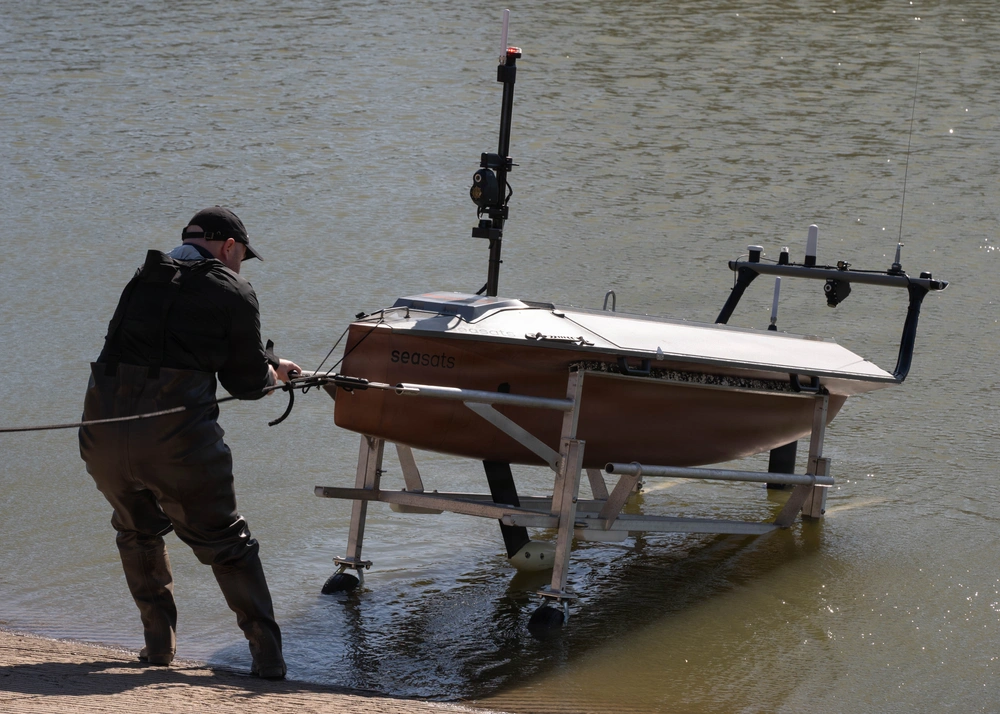
A U.S. Army MH-47G Chinook operated by the 160th Special Operations Aviation Regiment has landed on and conducted replenishment operations from an autonomous unmanned barge, according to Sea Machines Robotics. The demonstration is the first publicly disclosed instance of a U.S. helicopter landing and replenishing from a vessel operating autonomously, the company said.
The event links an aircraft used by the Army’s airborne special operations force with an unmanned surface platform intended to extend logistics options at sea. Sea Machines said its autonomous barges can support replenishment not only for rotorcraft, but also for surface vessels and shore installations.
SM300 conversion system
The barge is part of Sea Machines’ work on the SM300, an autonomous conversion kit designed to enable long-range autonomous operation for a range of existing vessels. Naval News previously reported that Sea Machines received notice in early 2021 to manufacture and trial the system, with $3.1 million allocated to development and deployment efforts.
The program has largely remained out of public view while Sea Machines worked with the U.S. Department of Defense, according to the report. The SM300 is intended for installation on manned vessels of different sizes, classes and performance levels. Its design uses common architecture, hardware and software to convert those vessels for long-range autonomous operation.
Sea Machines has demonstrated the technology on barges large enough to accommodate one of the United States’ largest helicopters, as well as on vessels approximately the size of a rigid-hull inflatable boat. Those smaller craft are described as roughly 20 to 30 feet long.
Logistics for dispersed helicopter operations
Autonomous replenishment at sea could give Army, Marine Corps and Navy helicopters additional operating flexibility where conventional landing sites or support vessels are unavailable. The source specifically identifies the potential benefit for attack and transport helicopters that might otherwise lack a place to operate from, or require a stopover or alternative landing location to extend their range.
The use of a Chinook from the 160th SOAR also demonstrates the integration of autonomous surface technology with a specialized Army aviation unit, according to the report. The event was presented as part of broader efforts to improve logistics and operational flexibility for complex missions, rather than as a live combat operation.
Wider push to extend and protect rotary-wing forces
The source places the autonomous-barge test alongside U.S. efforts to increase helicopter range, armament and survivability. One area of concern identified in the report is the resupply and rearming of helicopters as short-range weapons and interceptor drones become more widespread, making forward operations more challenging.
The Army, Marine Corps and Navy have been testing smaller cruise missiles weighing 500 pounds or less for helicopter employment. Naval News reported that L3Harris’ Red Wolf had been tested on Marine Corps AH-1Z Viper attack helicopters for land and maritime strike missions, providing a reported range of 200 nautical miles.
The services are also examining the use of helicopters to carry and launch large numbers of first-person-view or smaller utility drones, including potential drone-swarm operations. Separately, The Defense Post reported the test firing of an Anduril Altius 700M attack drone or loitering munition from an Army MH-60M Black Hawk. That system is described in the source as providing a medium-range, beyond-line-of-sight option positioned between a cruise missile and smaller FPV drones.
Helicopter counter-drone capabilities are also being expanded. Navy MH-60S aircraft, Marine Corps AH-1Z Vipers and UH-1Y Venoms, and Army MH-60 and AH-64D/E helicopters have received the ability to employ Advanced Precision Kill Weapons System II guided rockets as a lower-cost option for engaging Group 2 and Group 3 unmanned aircraft systems, according to the source.