A large, unusually enclosed vessel under construction in Shanghai may be intended to support China’s expanding fleet of large unmanned underwater vehicles, according to newly examined satellite imagery and an independent naval analyst’s assessment. The ship, which has been taking shape at Hudong-Zhonghua Shipyard since at least April, combines a well deck with what appears to be a substantial cradle-like platform and an internal arrangement that could accommodate multiple large submersible drones.
The vessel’s precise purpose remains unconfirmed. Its configuration could support other missions, and several features visible in imagery are subject to interpretation. However, recent views of the stern provide additional evidence for the assessment that the ship could serve, at least in part, as a dedicated mothership for large uncrewed underwater vehicles, or UUVs. Such a role could allow the vehicles to be launched, recovered and supported away from shore facilities.
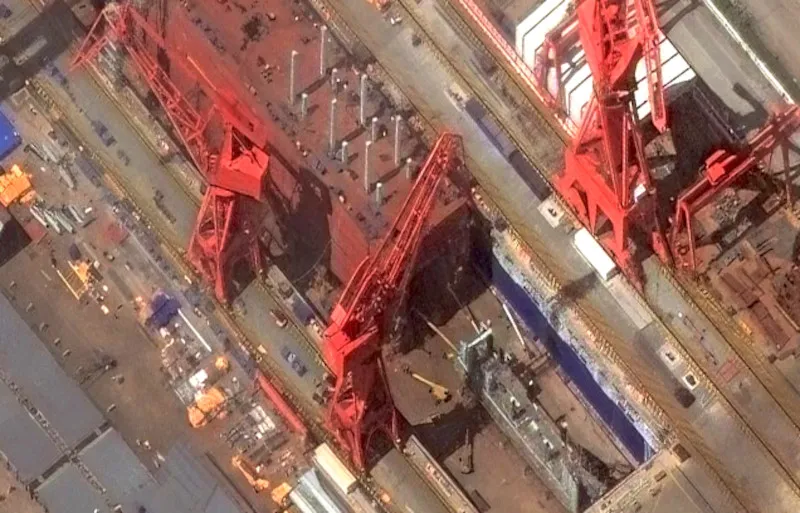
A satellite image taken on September 10, obtained by The War Zone from Vantor, showed the vessel from the stern as construction continued. Since that imagery was taken, the ship has received an overall grey paint coat. That development suggests possible future service with the People’s Liberation Army Navy, or PLAN, though the paint scheme alone does not establish the ship’s final operator or mission.
The ship is about 204 metres long and approximately 30 metres wide at its broadest point. Those basic dimensions are broadly comparable to China’s Type 071 amphibious warfare ship, although the new vessel appears considerably taller overall. The vessel’s high, box-like superstructure has been among its most conspicuous features during construction and may be significant to its potential role as an underwater-vehicle support platform.
Hudong-Zhonghua, on Changxing Island in Shanghai, produces commercial designs as well as naval vessels, including surface combatants and amphibious assault ships. The shipyard setting therefore does not by itself settle the vessel’s status. Still, its growing resemblance to a specialized naval auxiliary, together with the grey paint and apparent payload-handling features, has focused attention on a possible PLAN connection.
Well deck and stern platform
The September 10 satellite image confirms that the design includes a well deck and that the space is arranged around a large rectangular platform visible aft of the ship. The platform is roughly 50 metres long. It has an arch-shaped structure at one end, two teardrop-shaped structures at the other, and six pillars between them, with three pillars on each side.
The two teardrop-shaped elements, in particular, are consistent with a platform that is at least partly submersible. They could provide stability and guide water flow while the platform is being towed or otherwise moved through the water. The arrangement has led to the assessment that the structure could function as a cradle for handling large underwater vehicles, although imagery alone cannot confirm its exact operating sequence or the types of payload it will carry.
Six large struts are visible extending from the upper stern portion of the superstructure. Each large strut is paired with a shorter one, creating 12 visible supports in total. H.I. Sutton, an independent naval analyst who tracks undersea warfare developments, has assessed that these could be used to lower a platform or a similar device beneath the hull. He has also suggested that they may belong to a broader system for moving payloads internally between decks.
That interpretation would help account for the superstructure’s unusual height over much of the ship’s length. Sutton assessed that the interior may be largely made up of hangars and other open work areas, allowing the vessel to carry and support multiple large UUVs. Individual vehicles could be moved within the ship and launched or recovered one at a time through the cradle. The platform immediately behind the ship in the imagery aligns with that assessment, though it does not conclusively establish how the system would operate.
Sutton drew attention to a previously shown rendering of a proposed Chinese scientific research vessel that used a broadly similar stern-strut concept for deploying submersibles and other large payloads. On that proposed research ship, however, the system was exposed. On the vessel at Hudong-Zhonghua, the extended superstructure appears to contain the relevant machinery or handling spaces, potentially shielding them from weather and outside observation.
The well deck could provide an additional, more conventional launch-and-recovery route. The apparent design of the cradle-like platform suggests that well-deck operations may be part of the concept, whether or not the stern struts are also intended to lower equipment below the hull. The available imagery therefore points to more than one potential means of handling large submersible payloads, but it does not show the complete system or confirm the ship’s final configuration.
Using openings in the bottom of a ship’s hull, including moon pools, to deploy and retrieve underwater payloads is not new. Navies, including the United States Navy, are also exploring the use of well decks and cradle systems to operate large UUVs. The notable possibility in the Shanghai case is a large specialized ship designed to launch and recover very large underwater vehicles in an operational setting, rather than only from a shore-based facility or an improvised support arrangement.
The source assessment also noted that Russia operates highly specialized mothership submarines that can carry crewed midget submarines and large uncrewed submersibles beneath their hulls. Those submarines are also capable of launching ultra-long-range, nuclear-powered and nuclear-armed torpedoes. The ship under construction in Shanghai appears to represent a different approach: a large surface vessel whose enclosed internal spaces and well-deck arrangement may be intended to support sizeable underwater systems.
Enclosed spaces and other visible features
Other details are emerging as construction progresses. A large opening on the starboard side could be intended for launching and recovering lifeboats or other watercraft. It could alternatively be used to transfer payloads between the vessel and a pier while docked. The bridge is fitted with a multi-pronged mast, while a further section of superstructure behind the bridge appears to contain a hangar.
No attached helipad is currently visible. A flight deck could still be added later, potentially above the superstructure or on a raised frame attached to another part of it. The source reporting notes that many naval auxiliaries and commercial ships built for offshore-support or other specialist duties use open helipads mounted on elevated frames around their superstructures. At present, however, imagery does not establish whether aviation support is planned for the new ship.
The vessel’s enclosed and boxy design would inherently make activity on board harder to observe from outside. It could also shelter personnel and payloads from the elements. Such protection could be useful in severe operating conditions, including waters in and around the Arctic, an area where China is seeking greater engagement, according to the source. The design does not, however, confirm that Arctic operations are among the ship’s intended tasks.
Support for expanding UUV operations
China has publicly displayed or tested several unmanned submersible designs, including the HSU-100 and AJX-002. The PLAN is pursuing UUVs in various size tiers for missions that, according to the source assessment, include intelligence, surveillance and reconnaissance; mine laying; support to special operations; and direct attacks on enemy vessels. Larger UUV designs have continued to emerge in China, potentially increasing the need for specialized systems to launch, recover and maintain them at sea.
The ability to deploy and retrieve vehicles while away from fixed facilities could support long-duration missions farther from China’s shores. It could also reduce reliance on port infrastructure for certain activities. These are potential implications of the apparent mothership concept, rather than confirmed requirements for the vessel now being built. The ship’s ultimate mission, payload complement and service status remain unknown.
“With smaller UUVs, even up to 20 meters like the AJX-002 and HSU-100 paraded in Beijing last year, they are road mobile,” Sutton wrote in an earlier assessment. “Truck mounted cranes should be sufficient for getting them in and out of the water making operations much simpler. With these latest, much larger XXLUUVs [extra-extra large uncrewed underwater vehicles] however, China will start to need dedicated port facilities.”
H.I. Sutton, independent naval analyst
Sutton said China has used floating docks to house two extra-extra-large UUV prototypes undergoing testing on Hainan. In his account, one floating dock was built for the task, while the other may have been taken from general use. He identified a key limitation: each dock can carry a single extra-extra-large UUV, or more than one only if all are placed in the water at the same time, because the entire dock floods during the process.
“This arrangement also has a significant drawback: each floating dock can only carry a single XXLUUV,” Sutton added. “Or if more than one, then they both need to be placed in the water at the same time. Because the whole dock floods, there cannot be one undergoing maintenance while another is being launched or recovered.”
H.I. Sutton, independent naval analyst