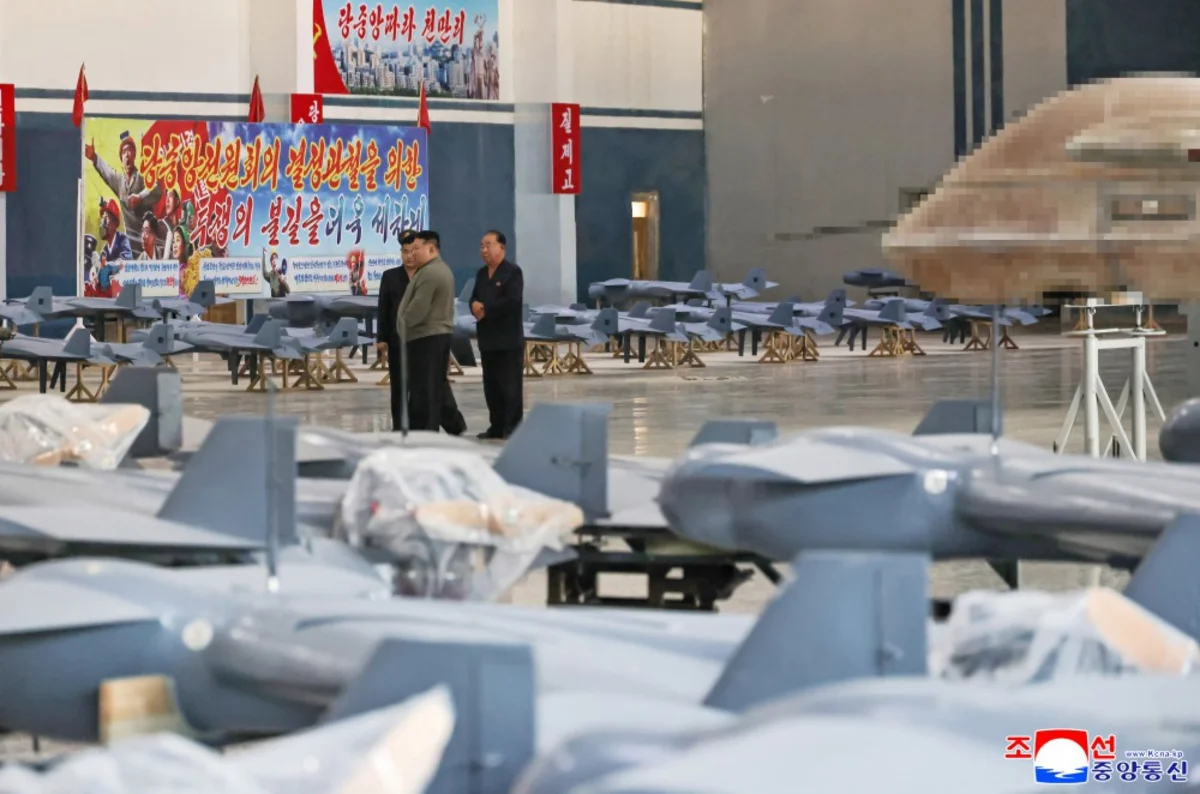
North Korean state media has shown leader Kim Jong Un inspecting production lines for at least three types of domestically built unmanned aircraft, offering a new look at the country’s attack and reconnaissance-strike drone programs. The images, published after Kim’s visits to what the ruling party described as important munitions-industry enterprises from Sept. 16 to 18, did not identify the facilities or disclose output levels.
Photographs released by the Workers’ Party newspaper Rodong Sinmun showed Kim walking through an assembly hall containing dozens of small flying-wing drones mounted on stands. Separate images showed him examining what appeared to be missile or drone airframe components alongside factory officials.
One-way attack drone line
One of the drones displayed was a one-way attack type whose visible configuration resembles Israel’s Harop family of loitering munitions. Such weapons are designed to fly toward a target and detonate on impact rather than return for recovery. The visual relationship is an assessment based on the imagery; North Korea has not published detailed technical information about the system.
A dedicated launcher for the drone first appeared publicly during a nighttime military parade on Oct. 10, 2025, marking the 80th anniversary of the Workers’ Party. The parade displayed four 6×6 trucks. Each vehicle carried two stacked rows of three launch containers, indicating an apparent load of six drones per truck.
The launcher display followed North Korea’s August 2024 unveiling of prototype airframes styled after the Harop and Switchblade-type Hero loitering munitions. No performance figures were released with those prototypes. In the newly published factory images, views of the attack drone during testing were partly obscured, preventing a clear assessment of some components. Analysts have suggested the design could be related to a separately tested rail-launched drone that uses a small rocket booster for launch, though the imagery does not confirm that relationship.
Larger reconnaissance-strike airframes
Other airframes visible on the factory floor were incomplete but matched the shapes of North Korea’s larger Saetbyol-4 and Saetbyol-9 reconnaissance-strike drones. Both aircraft first appeared publicly in July 2023 and have since undergone repeated flight tests.
The Saetbyol-4 visually resembles the U.S. RQ-4 Global Hawk surveillance drone. The Saetbyol-9, reported to have a wingspan of roughly 20 metres, resembles the U.S. MQ-9 Reaper and has hardpoints that suggest a role involving guided weapons as well as observation. These design comparisons are based on the aircrafts’ visible configurations rather than North Korean technical disclosures.
North Korean state media has separately called for broader production across the country’s drone programs after Kim publicly pushed earlier this year for faster output. The latest images provide visual evidence of assembly activity, but they do not establish production rates, the number of operational aircraft, or the status of the systems shown.
Limited disclosure on capacity
The drone factory tour took place in the same week that Kim also visited facilities producing a mobile rocket launcher which outside analysts have compared with the U.S. Army’s HIMARS system. North Korea also rejected an International Atomic Energy Agency resolution criticizing its nuclear weapons program that week.
North Korea has not disclosed where the drone factories are located, how many aircraft are being produced, or further specifications for the one-way attack drone. As a result, the state-media release identifies several programs moving through visible assembly stages but leaves their scale and technical maturity unresolved.