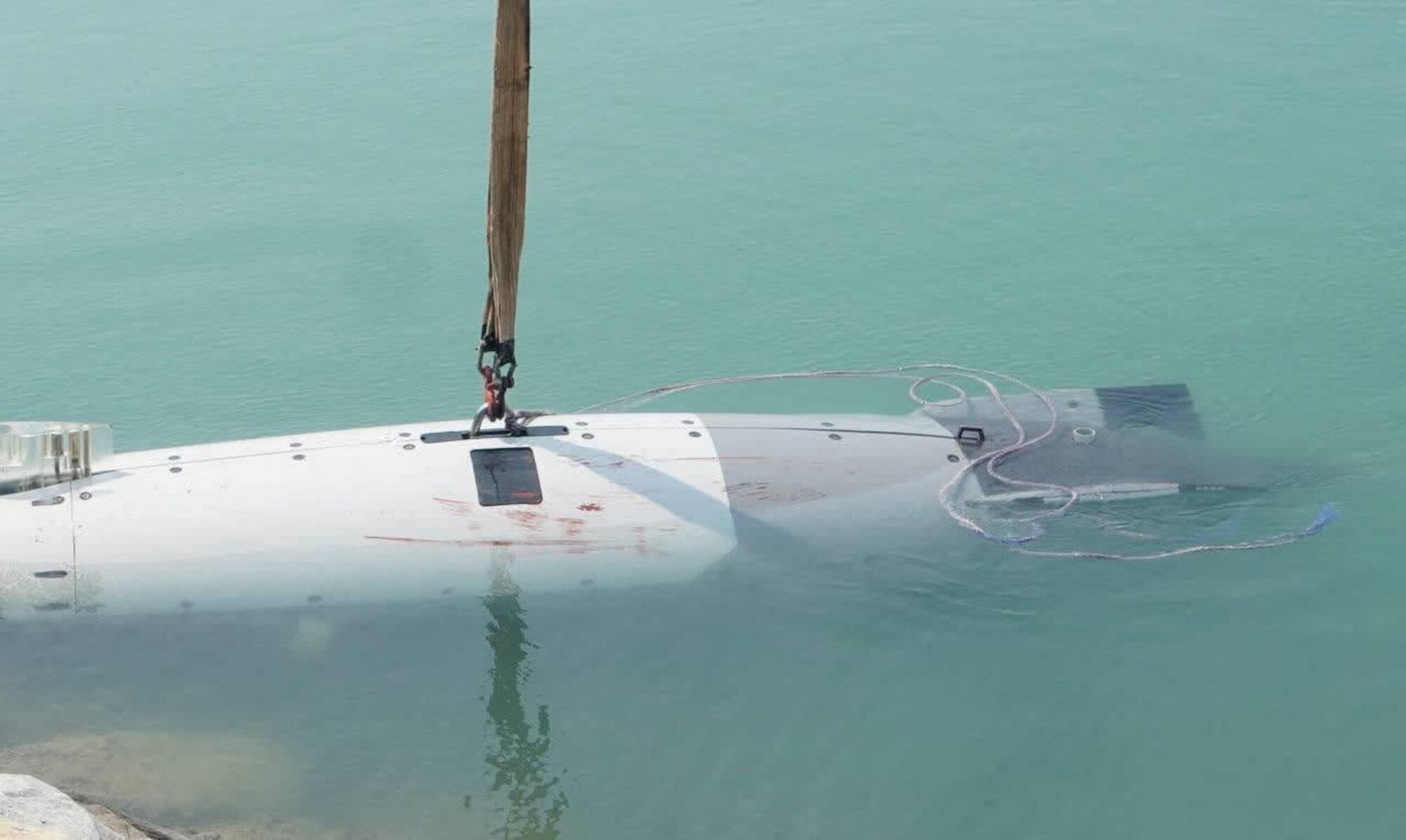
Iran’s Revolutionary Guards said it captured a U.S. uncrewed underwater vehicle at the entrance to the Strait of Hormuz, identifying the craft as Anduril’s Dive-LD large autonomous underwater vehicle. Iranian state media released images and video that it said showed the vehicle being recovered largely intact, but the precise circumstances of the reported seizure were not independently verified.
The Revolutionary Guards Navy described the recovery as a “complex intelligence and operational action” and said it had trapped “one of the most modern, intelligent and unmanned submarines” of the U.S. military. Tehran said the submersible was equipped with advanced technology and had been taken near the strategic waterway’s entrance.
A Pentagon spokesperson said an underwater drone operated by U.S. forces had malfunctioned more than a day earlier while surveying regional waters in support of ongoing operations. The spokesperson characterized the vehicle as an older model and said it had neither collected sensitive data nor carried classified sonar or radar equipment. The Pentagon statement did not confirm Iran’s account that the vehicle had been captured or identify its type.
Anduril initially referred questions to U.S. Central Command, but later confirmed to TWZ that it had lost a Dive-LD operating in the region. The company said the system is designed to be attritable—an autonomous platform intended to operate in dangerous environments where vehicle losses are an expected possibility. An Anduril spokesperson said the vehicle had already provided significant value during thousands of operating hours in months-long operations in the Central Command area of responsibility.
A new Navy underwater capability
Dive-LD is a large uncrewed underwater vehicle developed by Dive Technologies, a U.S. company founded in 2018 that Anduril acquired in 2022. The roughly 19-foot-long vehicle is about four feet in diameter and has a gross weight close to three tons, according to details reported by TWZ. Its exterior is 3D-printed, and the design is intended to support a high degree of autonomy during operations at sea.
Anduril says Dive-LD can remain deployed for about 10 days, depending on configuration, and can dive to depths of up to 6,000 meters, or roughly 19,700 feet. The company has described the system as modular, capable of being equipped for intelligence preparation of the operational environment, intelligence, surveillance and reconnaissance, mine warfare, and precision placement of objects underwater. Its publicly described missions also include seabed mapping and inspection of underwater infrastructure such as cables and pipelines.
The platform is a relatively recent addition to U.S. Navy operations. Anduril announced delivery of the first Dive-LD to the Navy’s Unmanned Undersea Vehicle Group One in April 2025, following an image released months earlier showing Navy personnel training with one of the vehicles. The number of Dive-LDs now in U.S. service has not been disclosed. DefenseScoop reported in 2024 that individual units cost about $2.5 million.
Surveying and mine-countermeasure missions
The reported loss comes as the U.S. military expands its use of uncrewed naval systems, including underwater and surface craft, to monitor broad ocean areas, gather intelligence and track vessels and submarines without placing sailors directly at risk. U.S. officials have previously confirmed that uncrewed underwater vehicles have supported efforts to keep the Strait of Hormuz clear of naval mines.
Underwater platforms can help locate and record mines using sonar, cameras and other sensors while keeping crews farther from the threat. Such work remains difficult and dangerous, particularly in contested waters. The Pentagon’s description of the malfunctioning vehicle as conducting a regional survey is consistent with the broad roles assigned to uncrewed systems, though officials did not provide details about its route, payload, launch point or the nature of the failure.
Iran’s claim, the Pentagon’s limited confirmation of a malfunction and Anduril’s acknowledgement that a Dive-LD was lost leave key questions unresolved, including when and where the vehicle was recovered and what condition it was in. The episode nevertheless offers a public example of the risks attached to deploying autonomous underwater systems in a sensitive maritime area, even when those systems are designed to be expendable.