Hanwha Defense USA and autonomous maritime company Magnet Defense plan to begin construction this fall on a 38-meter medium unmanned surface vessel, with testing of the new H38 vessel expected to start in January, according to Hanwha Defense USA Chief Executive Michael Coulter.
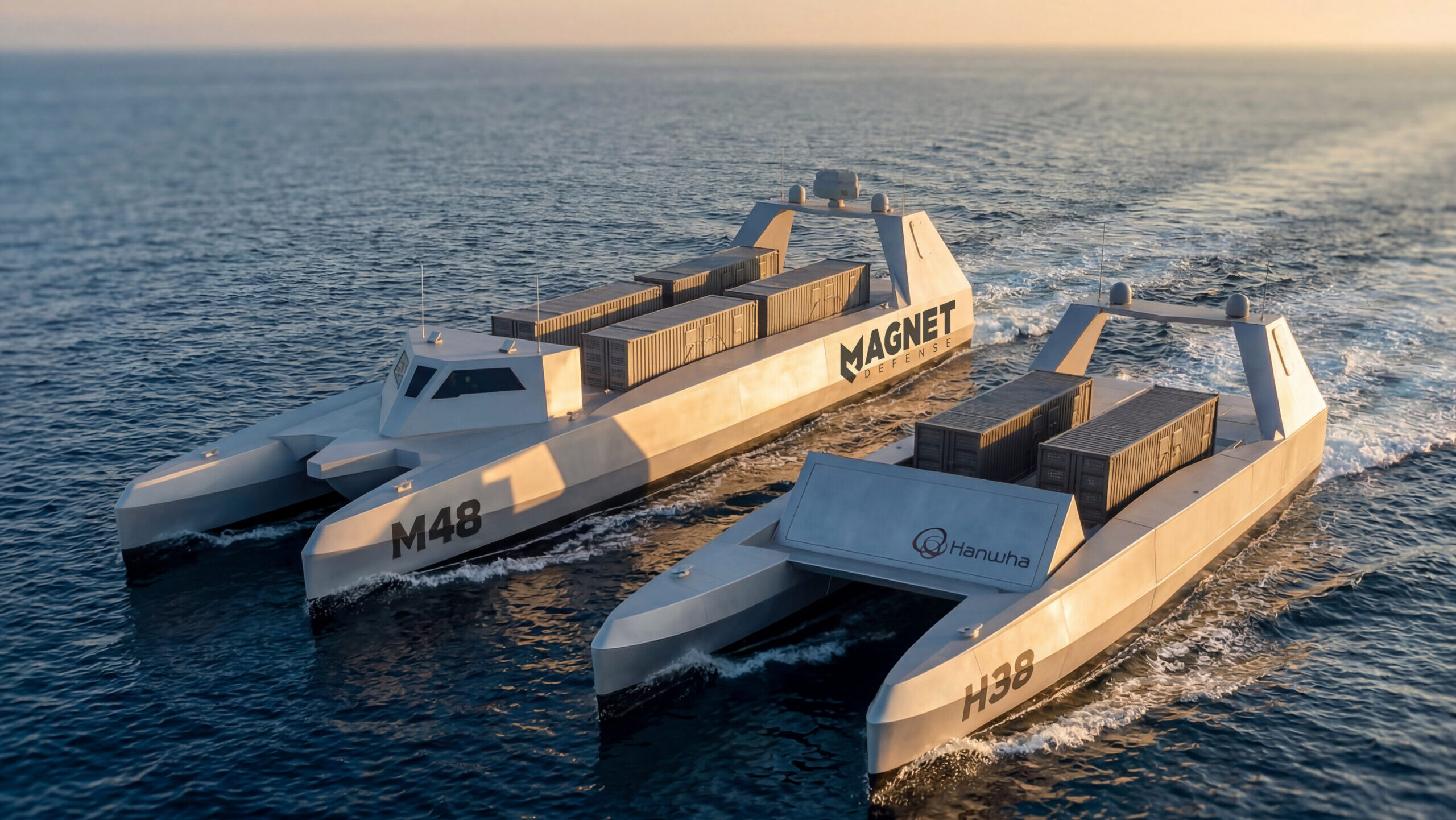
The companies signed a memorandum of understanding in April to develop the H38, which is based on Magnet Defense’s flagship M48 medium unmanned surface vessel. The planned program is centered on a modular approach intended to allow the vessel to take on different payloads and missions.
“As we talk with the Navy, they’re very interested in modular solutions,” Coulter told reporters. “One day it may be EW [electronic warfare]. One day it may be linking for communications. One day it may be lethal effects. So we’ve been focused on bringing those capabilities in partnership with Magnet, so we will be beginning construction of those next month, and we’ll be testing on other platforms our payloads this fall, and testing on the H38 in January to bring capability.”
Michael Coulter, CEO, Hanwha Defense USA
A smaller vessel based on the M48
Company officials discussed the effort during an event at the Wharf Marina in Washington, where reporters toured an M48 docked pier-side. The M48 is 48 meters long; the H38 is expected to have slightly smaller dimensions at 38 meters.
Magnet Defense has pointed to the M48’s long-distance operations as an indication of the platform’s performance. In 2024, the vessel completed a 32,000-nautical-mile voyage from Miami to American Samoa, transiting the Panama Canal and encountering Sea State 9 conditions. According to a March Magnet Defense press release, the M48 can support missions including integrated air and missile defense, anti-surface warfare, anti-submarine warfare and search and rescue.
Positioning for Navy demand
The H38 effort comes as the Navy pursues faster acquisition of unmanned surface vessels. In March, the service launched a new medium unmanned surface vessel marketplace aimed at identifying production-ready, mission-capable platforms already available for procurement.
Hanwha has not committed publicly to competing in future iterations of that marketplace, saying it is waiting for further information as the process develops. But Kevin Schoonover, Hanwha Defense USA’s senior vice president for missiles, said the company wants to participate if given an opportunity.
“We have meetings and discussions with the Navy related to where they want to go, etc.,” Schoonover told reporters. “Our main focus is that we’re leaning forward. We’re going to bring the capability not just as a vessel, but as a complete system that has all the hooks to be able to switch and swap, whether it’s directed energy or a missile system.”
Kevin Schoonover, senior vice president for missiles, Hanwha Defense USA