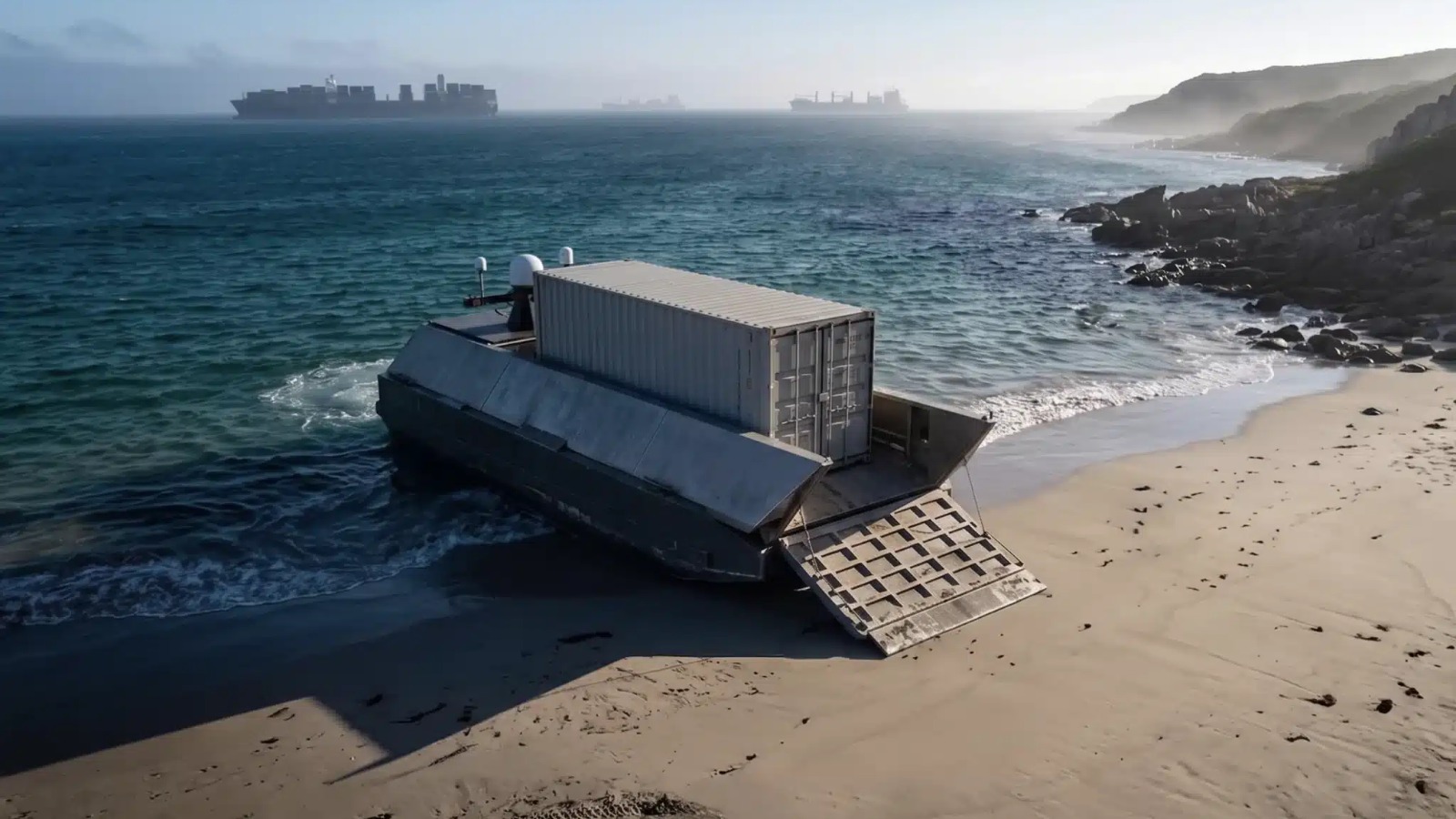
U.S. maritime defense startup Bulwark Dynamics has announced a strategic manufacturing partnership with Japan’s Onomichi Dockyard for its Caravel autonomous landing craft, linking the company’s uncrewed-systems development effort with an established commercial shipbuilding operation.
The partnership was announced alongside the completion of Bulwark’s seed funding round. According to the company, the arrangement is intended to support production of Caravel vessels for both U.S. and Japanese markets, with potential civilian and commercial applications also under consideration. Bulwark co-founder and chief operating officer Yuta provided the program details in comments to Naval News.
35-foot craft is the current priority
Bulwark is currently building its first 35-foot Caravel prototype. The company has not disclosed specific production figures at this stage, but said its initial objective is to reach output of several dozen units per year as the program develops. It also plans to evaluate recurring and longer-term demand before making a commitment to larger mass-production capacity.
The Caravel family is available in two sizes: a 15-foot version and a 35-foot version. Bulwark has identified the larger craft as its main focus, while describing the smaller vessel as a complementary option that could be produced in response to specific customer demand. The company has not ruled out developing a larger autonomous landing craft in the future, but said it is not currently pursuing the Medium Unmanned Surface Vessel, or MUSV, category.
Bulwark’s immediate design roadmap remains centered on the Caravel uncrewed series rather than an expansion into conventional crewed defense vessels. The craft is being developed primarily as an autonomous landing platform for distributed maritime operations and resupply missions in littoral environments, according to the source.
Manufacturing link between U.S. and Japanese markets
The agreement with Onomichi Dockyard gives Bulwark a manufacturing partner in Japan as it seeks to move from prototype development toward repeat production. The source characterizes the relationship as a connection between a U.S. defense technology startup and the manufacturing capacity of a commercial Japanese shipyard.
Bulwark is pursuing customers in both countries, rather than limiting Caravel to a U.S. defense program. Yuta said the company is considering possible civilian and commercial uses in addition to military applications. The dual-market approach places the platform within broader U.S.-Japanese defense-industrial cooperation, while preserving a potential route to non-military orders.
For U.S. military users, the company is positioning the autonomous landing craft toward missions associated with littoral maneuver and distributed logistics, including support for U.S. Navy and U.S. Marine Corps operations. The source specifically links the platform’s intended role to resupply in contested coastal environments and to the Marine Corps’ distributed operating concepts.
Scaling will depend on demand
The planned production rate remains an initial target rather than a firm delivery commitment. Bulwark’s decision to assess recurring and long-term demand before expanding capacity indicates that the company is treating the first 35-foot prototype as a step toward validating the platform and its market, rather than announcing a fixed mass-production schedule.
The source also identifies potential relevance for Japan’s Self-Defense Forces, which face manpower shortages and could have an interest in autonomous littoral craft for operations involving the country’s southwestern islands. That application remains part of the platform’s stated market alignment; no Japanese procurement or delivery decision was reported.
With the 35-foot prototype under construction and the 15-foot variant retained as a complementary option, Bulwark’s near-term effort is focused on establishing the Caravel platform and determining whether demand supports annual production at the planned level. Onomichi Dockyard is expected to provide the manufacturing basis for that next stage, while the company continues to target military and potential civilian users in the United States and Japan.