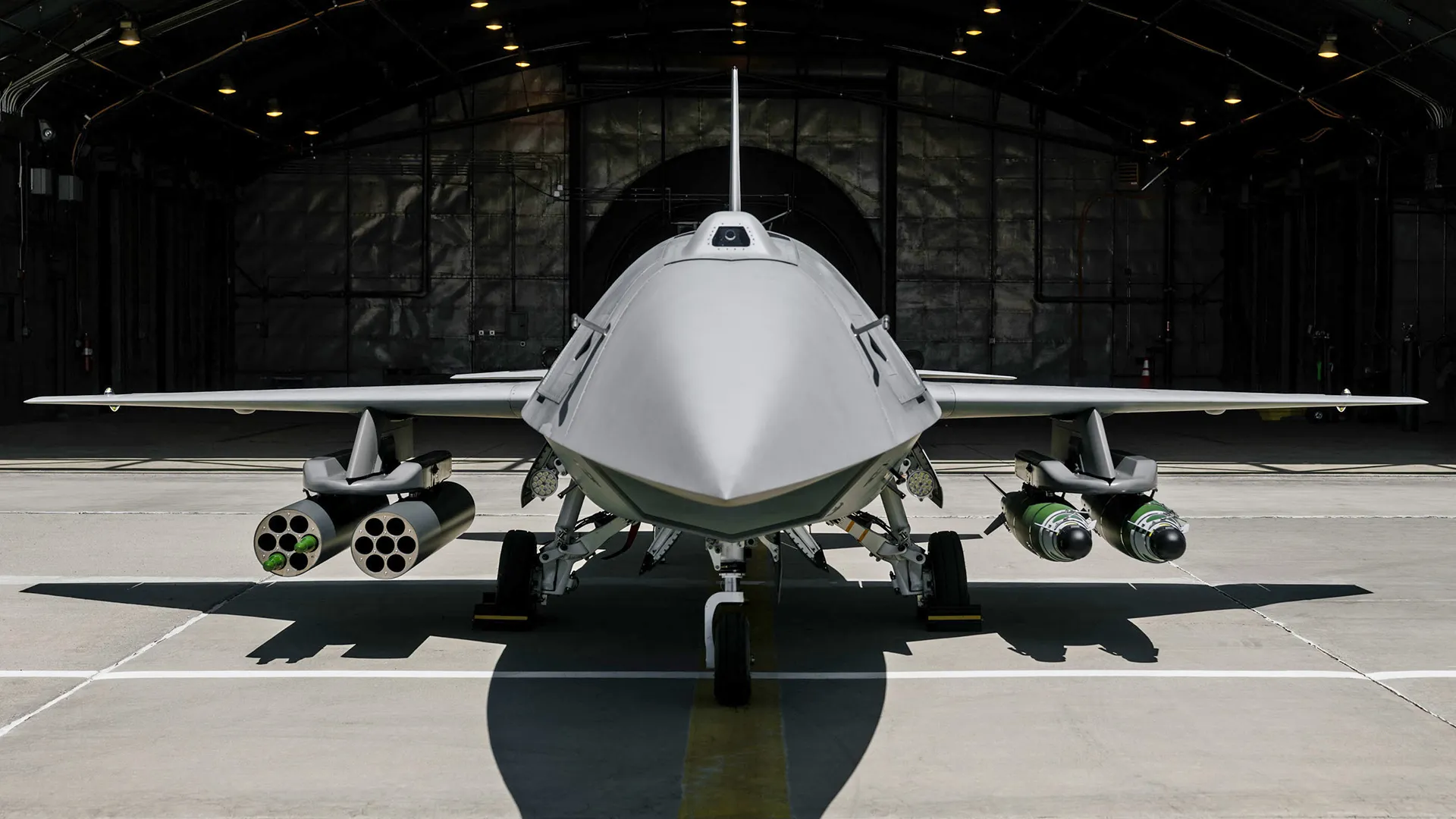
Anduril has begun ground-based weapons fit checks of its YFQ-44A Fury Collaborative Combat Aircraft with several air-to-ground stores, a step that points to potential missions beyond the Air Force’s current air-to-air emphasis for the program. Newly released company imagery shows the uncrewed aircraft carrying different air-to-ground weapons on its two external stations, but Anduril says none of those stores has yet been flight-tested on Fury.
The YFQ-44A is one of two aircraft selected for the Air Force’s Collaborative Combat Aircraft Increment 1 effort, alongside General Atomics’ YFQ-42A Vengeance. The service’s stated priority for the first increment is air dominance. Fury’s current test configuration has two underwing pylons, and the aircraft has already conducted a live AIM-120 air-to-air missile firing while testing with the Air Force’s Experimental Operations Unit.
The new fit checks indicate that Anduril is considering a broader weapons envelope even as the initial CCA requirement remains focused on air-to-air operations. The company displayed 500-pound Joint Direct Attack Munitions, 250-pound Small Diameter Bombs and pods for 2.75-inch guided or unguided rockets fitted to Fury. The stores shown were mounted using twin adaptor racks.
Integration work begins on a wider weapons set
At a roundtable during the Air & Space Forces Association’s Air, Space and Cyber Symposium, Anduril executives Jason Levin, senior vice president for Air Dominance and Strike, and Erin Simpson, vice president for Strategy for Air Dominance and Strike, said the company had started integration and fit-check work for JDAMs, Small Diameter Bombs and low-cost cruise missiles. Anduril has also begun engineering work to integrate its Barracuda 500 offering for the Air Force’s emerging low-cost cruise-missile effort.
“We’ve begun integration and fit checks of a lot of other munitions. We’ve done 500-pound guided bombs. We’ve done Small Diameter Bombs.”
Anduril executive
A ground fit check is an early but consequential part of a weapon-integration effort. It establishes that a store can be physically carried in the intended configuration before subsequent captive-carry testing and, if Anduril and the Air Force choose to proceed, live-release testing. The company’s work therefore should not be read as confirmation that Fury has an operational air-to-ground capability, but it does show that such configurations are being explored.
The available options could support missions including counter-uncrewed aircraft systems, counter-cruise-missile operations, and air-to-ground or air-to-surface strike, according to Anduril. Delivering a JDAM or Small Diameter Bomb against a predetermined fixed target would offer a comparatively austere strike role, without necessarily requiring the more demanding capabilities associated with dynamic targeting and more sophisticated air-to-ground missions. Such a capability could give Increment 1 aircraft a secondary strike function when their air-to-air support is not required.
Four hardpoints planned for production aircraft
Anduril says the production FQ-44 will have four external hardpoints, doubling the two currently fitted to the YFQ-44A test aircraft. The company has said those four stations will be able to carry four AIM-120 Advanced Medium-Range Air-to-Air Missiles for the Air Force’s air-dominance mission. Loading all four stations with AIM-120s would reduce the aircraft’s range, Anduril says, but would not demand a larger engine or move the aircraft outside its basic takeoff, landing, climb and flight-envelope requirements.
Those additional stations could also give the production aircraft more flexibility in mixed or changing mission sets. A Fury directed as part of a formation could carry air-to-air missiles for counter-air work while other aircraft carry strike stores or provide other effects. The same aircraft could instead be reconfigured before operating from a different location. With four pylons, Fury could have greater scope for swing-role missions involving both air and surface targets.
Anduril is pursuing that flexibility alongside work on the autonomy and operational concepts required for CCAs to operate with crewed fighters. During a July Experimental Operations Unit exercise at Creech Air Force Base, Fury flew in the same airspace as crewed fighters and other CCAs while Air Force personnel operated its Mission Autonomy system. Anduril has also said Fury has flown in formation with F-35s, though the fighters were not controlling the uncrewed aircraft at that stage.
The company is working toward what it calls “quarterback integration,” in which a crewed aircraft directs autonomous aircraft within a larger combat formation. Anduril says this work has advanced through hardware- and software-in-the-loop environments and onto the aircraft, with live testing expected in the near term.
Air-to-ground role remains an open question
The Air Force has not settled on the requirements for CCA Increment 2. Speaking at the same symposium, Air Force Chief of Staff Kenneth Wilsbach said the service was weighing whether a subsequent increment should include air-to-ground capabilities, more sensors, lower cost, greater attritability or expendability, different range characteristics, or alternative launch and recovery concepts.
“We’re going through some thought processes about what Increment 2 should be able to do. Increment 1 is air-to-air, so do we want air-to-ground? Maybe, maybe not.”
Air Force Chief of Staff Kenneth Wilsbach
Wilsbach said it was too early for definitive decisions before the service gains experience with the Increment 1 aircraft. For Anduril, however, the fit checks provide an avenue to position Fury as more than an uncrewed air-defense adjunct. They also preserve an air-to-ground option that could be relevant to export customers seeking a limited number of CCA types. The effort remains at the ground-integration stage, but it signals that Fury’s external hardpoints may eventually be used for a wider range of missions than the air-dominance role now driving the program.