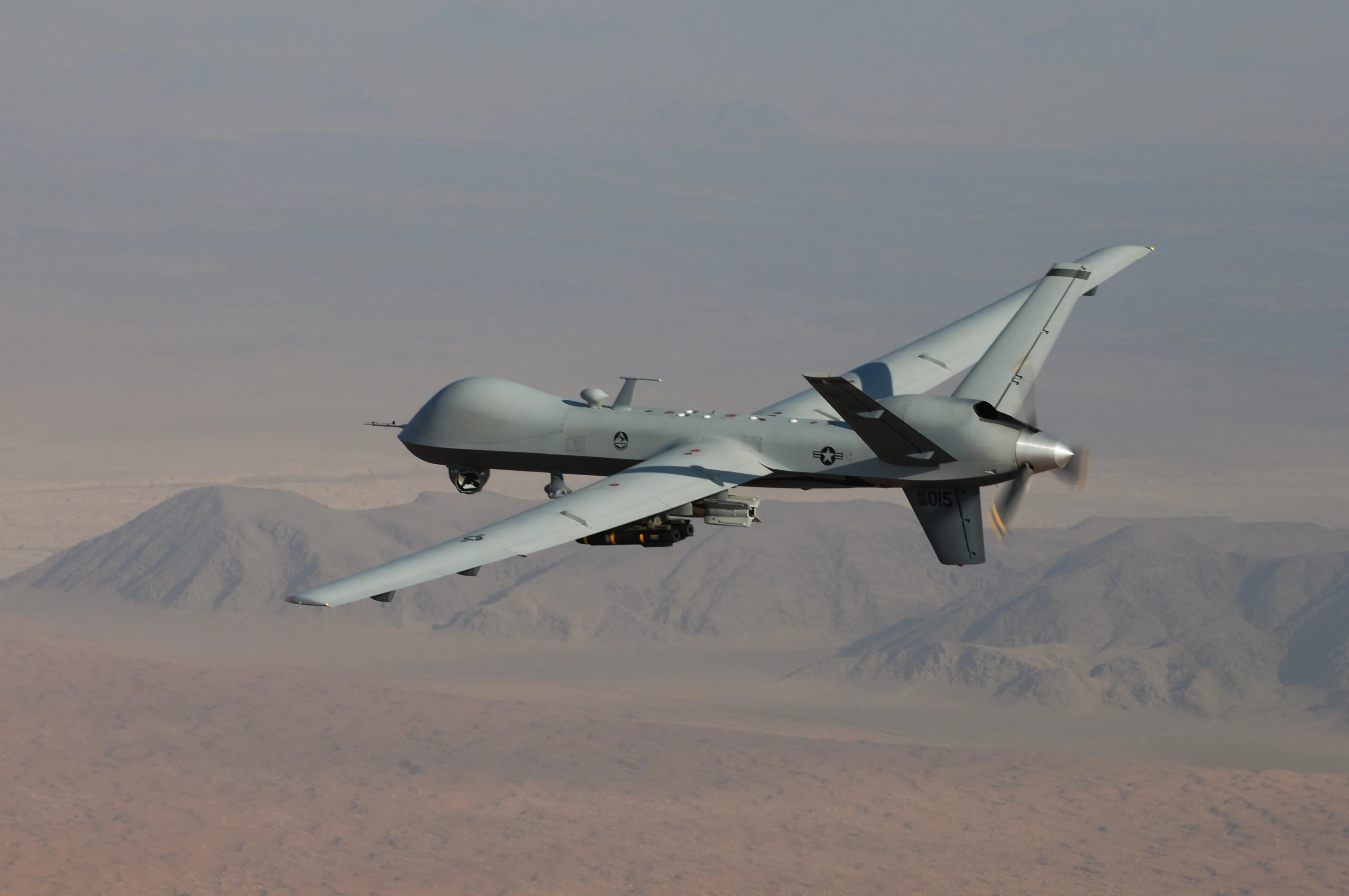
The U.S. Air Force is accelerating work on a lower-cost, more expendable unmanned aircraft intended to perform missions now handled by the MQ-9A Reaper, as combat losses and an aging fleet sharpen the need for a replacement and near-term backfill. The Massed Modular Aircraft, or MMA, effort seeks a drone able to carry substantial payloads over long distances while being affordable enough for the service to accept losses in combat.
Lt. Gen. Christopher Niemi, the Air Force’s chief modernization officer, said Sept. 3 that the service had been discussing a follow-on as the Reaper aged, but that its rate of consumption had become a concern. Defense Daily reported that Air Force Secretary Troy Meink directed an acceleration of the program, potentially moving its fiscal 2031 target for 20 mission-ready aircraft forward by roughly two years.
The pressure comes as the Air Force faces a diminished Reaper inventory and limited options for quickly rebuilding it. In May, Lt. Gen. David Tabor told the Senate Armed Services Subcommittee on Airland that the fleet had fallen to about 135 aircraft, approximately 54 below the service’s 189-aircraft floor. Niemi did not provide an updated inventory in September.
A Congressional Research Service Insight updated May 13 cited an April report that 24 Reapers had been lost since military operations against Iran began in February. The report said it was unclear whether the Pentagon had provided Congress with an accounting. The Washington Post later reported, citing three U.S. officials, that at least 45 aircraft had been lost—about one-quarter of the fleet.
A replacement built to absorb losses
The MMA competition opened through the Defense Innovation Unit on July 7, with the Air Force as a partner, and the solicitation closed July 23. Rather than pursue a more capable version of the Reaper, the program calls for a modular aircraft that can conduct Reaper-class strike, intelligence, surveillance and reconnaissance, electronic warfare, and communications-relay missions at a cost intended to support mass production and attrition.
The solicitation said the aircraft should carry at least 2,800 pounds of payload, have an unrefueled combat range of at least 2,300 nautical miles, and offer an 8,000-nautical-mile one-way transfer range. It also called for a minimum speed of 200 mph and operations from 6,000-foot runways or improvised airstrips. The design is expected to provide sufficient size, weight, power and cooling for varied internal or external payloads, including 25 kilowatts of power and 5 kilowatts of cooling, while supporting a level of autonomy that allows one operator to control several drones.
DIU’s rationale is rooted in the cost exchange between unmanned aircraft and air defenses. Its solicitation warned that the Joint Force’s reliance on low-density, high-value manned and unmanned aircraft is unsustainable against layered defenses supported by increasingly cheap anti-aircraft capabilities. The agency said a persistent airborne MMA presence for weapons employment, intelligence collection, electronic warfare or communications relay could force an adversary to expend air-defense missiles and resources faster than they can be replaced.
Niemi signed MMA requirements in May and has described the initial aircraft as relying on proven technology rather than new systems in order to meet its price objective. He characterized the concept as a long-aspect-wing turboprop in the “4,000 miles-type class”—farther-ranging and heavier than a Collaborative Combat Aircraft, or CCA, but slower. Officials did not explain how that description relates to the 8,000-nautical-mile ferry-range requirement in the July notice.
Cost and production remain central questions
The Air Force is measuring MMA’s expected air-vehicle cost against the CCA program. Niemi placed CCA air vehicles near $20 million and MMA at about half that amount, according to Defense Daily. An Air Force spokesperson told Breaking Defense that those figures apply only to the air vehicle, not to a fully missionized aircraft. Niemi told senators in May that a Reaper equipped with a full sensor package can cost as much as $50 million.
The service’s existing backfill choices are constrained. General Atomics ended MQ-9A production in 2025, and Tabor said the Air Force was pursuing a short-term fiscal 2026 buy of available MQ-9A airframes. Niemi also said budget limits make a large purchase of upgraded MQ-9B SkyGuardians unrealistic, arguing that it is mistaken to assume the Air Force could simply fund and receive 100 aircraft.
At the September briefing, Niemi said the Air Force would probably field at least 180 MMA drones. He argued that the Reaper’s value lies less in its airframe than in the mission systems it carries, describing its speed, altitude and range as decades-old technology. That assessment aligns with an MMA approach focused on combining mature aircraft technology with modular payload capacity and a lower unit cost.
Industry bids and the schedule
The initial solicitation called for full-scale prototype flight testing within 21 months of an award. Its original goal was an initial operating capability in fiscal 2031, defined as 20 mission-ready aircraft delivered to an operational unit and able to deploy. Col. Todd Dye, senior materiel leader in the Air Force’s medium-altitude ISR division, said awards for MMA concept refinement were expected in the first quarter of fiscal 2027, according to Breaking Defense. Officials did not announce a revised schedule at the Sept. 3 briefing.
General Atomics is among the companies pursuing the opportunity with a design it calls Wildfire, first reported by Aviation Week in August. Company spokesman C. Mark Brinkley told Air & Space Forces Magazine that the design meets the MMA requirements and exceeds most of them, but he did not provide capability or cost details. The company has not released images of the aircraft.
Brinkley told The War Zone that viewing MMA solely as a Reaper replacement misses the immediate backfill requirement. He said Wildfire does not depend on winning the competition and that General Atomics could deliver the aircraft years ahead of the current schedule. He described a 10,000-nautical-mile ferry range, carriage of four Long Range Anti-Ship Missiles and semi-autonomous control of 100 aircraft as design considerations rather than stated specifications.