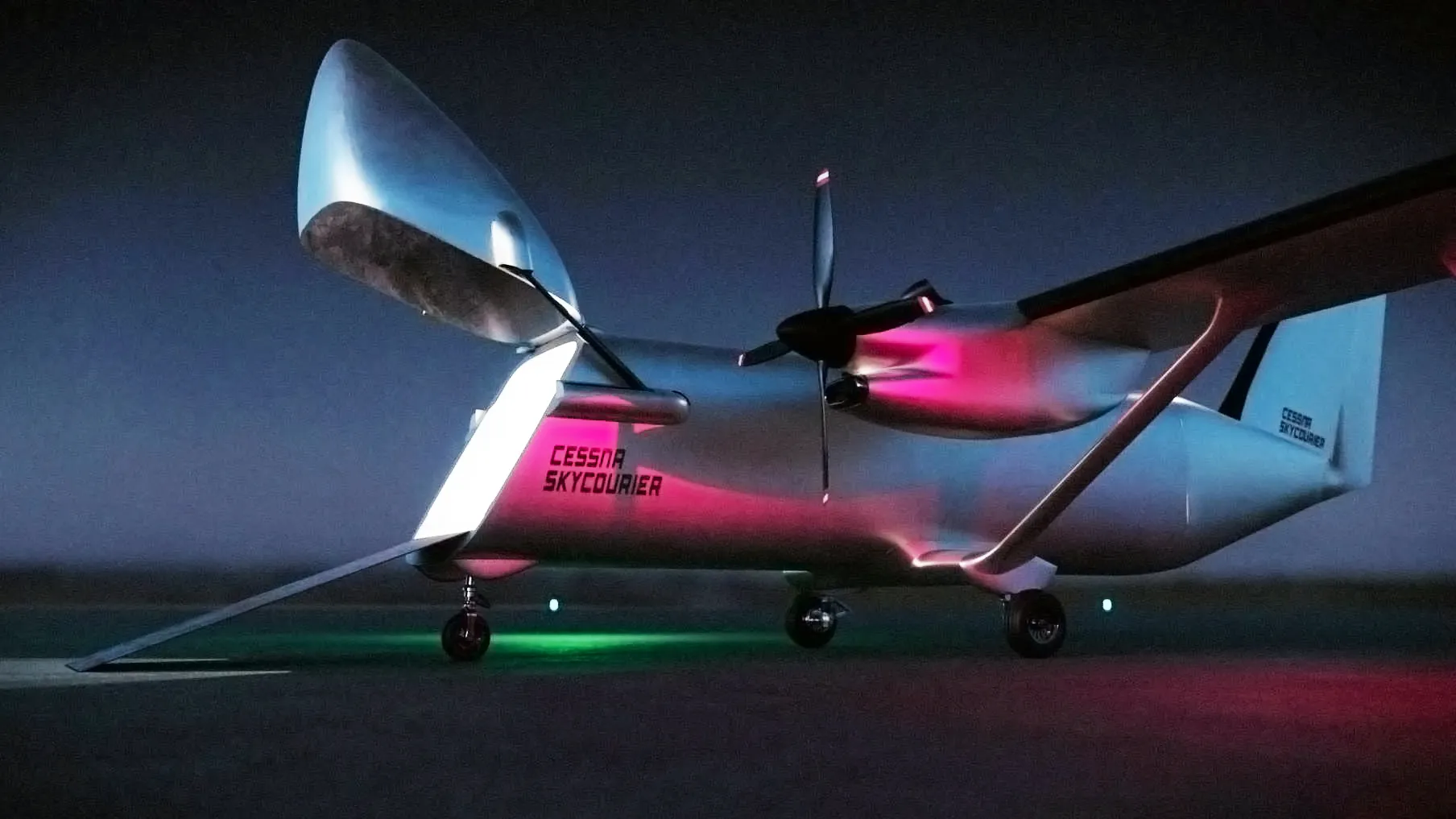
Textron and autonomy provider Merlin are proposing an uncrewed version of the Cessna 408 SkyCourier for military logistics, pitching an aircraft built around a current production airframe, standard cargo handling and operations from austere runways. The SkyCourier UX remains a concept: the companies have not built a prototype, and their next planned step is an optionally piloted version intended to help prospective users gain confidence in the platform.
A partial full-size model displayed at the Air & Space Forces Association’s Air, Space & Cyber Conference in Washington showed the central design change. In place of a cockpit, the aircraft would have a hydraulically opening nose leading directly into the cargo bay. Textron says that arrangement would make it easier to load outsized cargo without specialized equipment, though it would not increase payload.
Otherwise, the proposed aircraft retains the familiar SkyCourier configuration: twin turboprops, a high wing and an aluminum body. The underlying aircraft can carry about 6,000 pounds, or three standard containers. Its optimization for standard pallets is central to the companies’ military case, allowing cargo to move forward without necessarily being unloaded, broken apart and repackaged first.
A logistics case built around existing infrastructure
Textron and Merlin are presenting the SkyCourier UX as a way to move supplies among dispersed locations, including in contested environments. A company specification sheet puts its range at about 900 nautical miles, with takeoffs possible from runways as short as 3,300 feet and landings in 2,500 feet. The companies say those figures would support island-hopping operations in the Pacific, using refueling stops on austere runways.
That range would not enable a loaded aircraft to cover the nearly 2,000-mile distance between the first and second island chains. But Kyle Kremer, a retired Air Force major general and Merlin adviser, argued that the aircraft would not need to make that trip to be useful, instead linking logistics routes among locations including Palau, Tinian and Saipan.
With the range that it has, it has the ability to agilely move through there and connect logistics pipelines.
Kyle Kremer, Merlin adviser
The concept also rests on Textron’s ability to produce and support the crewed SkyCourier. Bob Gibbs, Textron’s vice president of special missions sales, said the conventional aircraft is fulfilling previously unannounced orders for modified aircraft for foreign medical evacuation, casualty evacuation and environmental-protection missions. He said SkyCouriers operate from the Arctic to the Amazon and that Textron supports its aircraft in 170 countries.
Merlin CEO Matt George emphasized production capacity as a differentiator from other uncrewed aircraft concepts. He said 14,000 people work on production lines in Wichita, Kansas, where crewed aircraft are being built, and argued that an available manufacturing base matters as much as the proposed capability itself.
Autonomy maturity and military demand
The proposed aircraft would use Merlin Pilot, an autonomy package that the company says has flown on four single- and multi-engine airframes. Merlin is working under a $105 million U.S. Special Operations Command contract to develop C-130J Super Hercules autonomy. The company says Merlin Pilot includes autonomous takeoff, landing and navigation; flight-envelope protection; GPS-denied navigation; route selection intended to avoid danger; and digital-copilot functions such as pilot health monitoring, gaze tracking, fatigue detection, contingency response and flight assistance.
Those capabilities do not mean the SkyCourier UX would be a fully defended logistics aircraft. The concept has no other built-in defenses, according to the source material, leaving open how much risk military services would accept for a platform with a relatively modest payload in contested logistics missions. The SkyCourier can cost up to $8.5 million depending on modifications.
Questions about autonomy maturity are also evident in the Air Force’s experience with larger aircraft. Merlin has teamed with the service on an AI copilot for KC-135 tankers, but Air Force Mobility Command commander Lt. Gen. Daniel Tulley said the service had not seen companies successfully test carry-on autonomy kits on old KC-135s and other aircraft. He said the technology is advancing rapidly, while cautioning that the service is not yet employing fully autonomous large aircraft at the ranges required for tanker operations.
Tulley nevertheless said there is a requirement for autonomous or other small light-lift capability to distribute supplies from major points of debarkation. Air Force Chief of Staff Gen. Ken Wilsbach likewise said the service is testing unmanned aerial logistics options and sees possible value in the Pacific, though he said there is no program of record yet. The Air Force last year awarded Reliable Robotics a $17.5 million contract to install an autonomy package on a Cessna 208B Caravan.
Kremer argued that a SkyCourier-sized uncrewed aircraft could relieve pressure on C-130 transports, described as the smallest currently available platform able to carry standard containers and already heavily tasked. In dispersed operations, he said, a needed spare part or component may be more consequential than its size suggests because supply stocks are not built up at every location.
You have to be able to get it where you need it, when you need it, and that’s what this provides.
Kyle Kremer, Merlin adviser
Textron and Merlin have not identified a single intended U.S. military customer for the SkyCourier UX. Gibbs said he hoped the Army and Air Force would “fight over it.” For now, the proposal joins a broader push toward uncrewed cargo aircraft, while its practical path depends on the planned optionally piloted development stage and whether a military customer chooses to pursue the concept beyond the show-floor model.