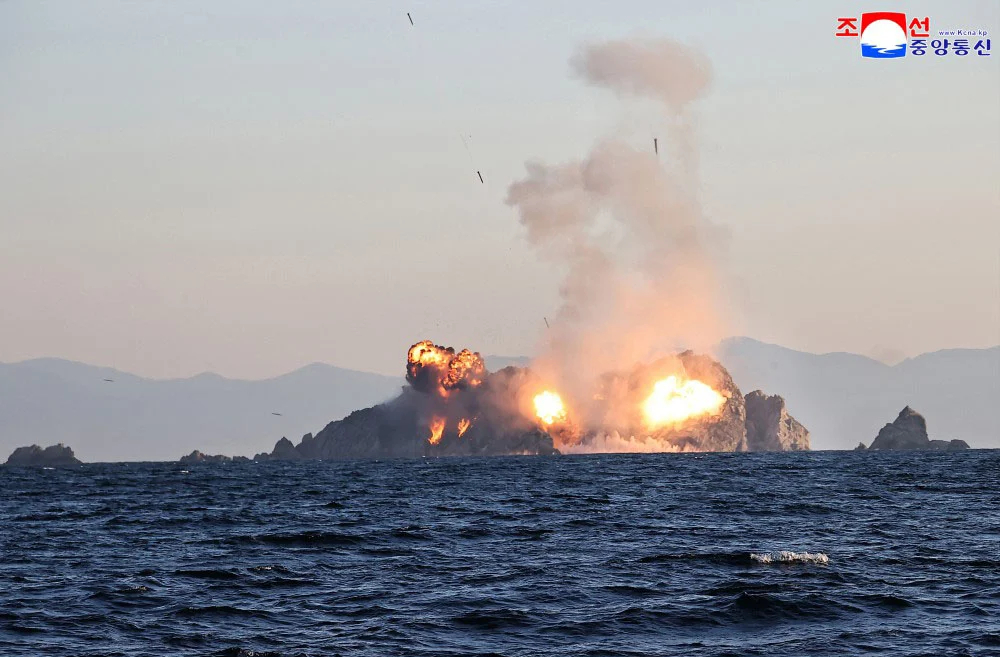
North Korea said it employed two types of one-way attack drones alongside short-range ballistic missiles, a tactical cruise missile and multiple rocket launchers during a Sept. 13 firepower exercise directed at an island in the Sea of Japan. Images released by state media showed the unmanned systems being launched as part of a broader strike drill involving five artillery and missile joint units.
The Korean Central News Agency described the event as a “firepower attack drill” and said participating units used several new combat systems, including attack drones of various kinds, a tactical cruise missile, a large-caliber thermal-pressure multiple rocket launcher and a tactical ballistic missile. KCNA did not identify the drill location or provide specifications for either drone type.
A KCNA collage released after the exercise depicted the range of systems involved. Separate photographs showed mobile ground launchers firing short-range ballistic missiles and rockets, as well as the two one-way attack drone types launching toward an island off North Korea’s coast. State media said every system struck its target with “100 percent accuracy in a single stroke,” a claim that could not be independently assessed from the released material.
Integrated-fire focus
According to KCNA, the exercise was intended to familiarize Korean People’s Army personnel with the Integrated Fire Command System. The agency said the drill also sought to improve proficiency in integrated automated fire command and increase the efficiency of target destruction through concentrated fire.
The combination of missile, rocket and unmanned strike systems shown in state imagery placed the drones within that concentrated-fire concept rather than presenting them as a standalone test. But the announcement left key details unresolved, including the drones’ range, payload, guidance method and whether they were launched from a common unit or alongside the missile forces pictured in the release.
Marshal Pak Jong-chon, vice chairman of the Central Military Commission of the Workers’ Party of Korea, and Maj. Gen. Yu Chang-son, director of the Artillery Bureau of the Korean People’s Army General Staff, guided the drills, KCNA said. Their attendance underscored the exercise’s focus on artillery and missile formations, while the state outlet characterized the attack drones as among the newer systems fielded in the event.
South Korea reports ballistic-missile launches
South Korea’s Joint Chiefs of Staff said on Sept. 13 that it detected short-range ballistic missiles launched from the vicinity of Wonsan toward the Sea of Japan beginning at about 5:20 a.m. The missiles flew about 250 kilometers, or 155 miles, the JCS said. South Korea and the United States were analyzing the launches.
Under a firm ROK-U.S. combined defense posture, our military is closely monitoring various North Korean movements and maintaining the capability and readiness to respond overwhelmingly to any provocation.
South Korea’s Joint Chiefs of Staff
U.S. Indo-Pacific Command said it was aware of the launches and was consulting with allies and partners. Based on its current assessment, the command said, the events did not pose an immediate threat to U.S. personnel or territory, or to U.S. allies in the region. The Sept. 13 firing was North Korea’s 13th ballistic-missile launch of the year, according to the source report.
Drill follows Freedom Edge 26
The North Korean exercise came one day after the United States, South Korea and Japan concluded Freedom Edge 26, a five-day multinational exercise that ran from Sept. 7 through Friday in international waters and airspace south and east of South Korea, as well as at installations and command posts in Japan.
Freedom Edge 26 brought together maritime, air, medical and cyber forces for training intended to improve coordination, interoperability and trilateral defensive readiness, according to an Indo-Pacific Command release. Participating personnel conducted maritime maneuvering and replenishment-at-sea events, multinational medical evacuation and search-and-rescue rehearsals, multinational air formations, command-and-control drills, air-defense communications and real-time data-sharing procedures. Cyber planners and command-post personnel also conducted coordination drills intended to connect information flows and support faster decision-making.
North Korean Minister of National Defense Kim Song Gi condemned the trilateral exercise in a Sept. 7 statement, calling it a provocative military activity conducted under the pretext of countering North Korean nuclear and missile threats. The state-reported firepower drill the following week paired that political message with imagery of North Korea’s missile, rocket and one-way attack drone systems operating in the same exercise.