Echodyne is investing $40 million in a new production facility intended to increase its radar-panel capacity tenfold, responding to what Chief Executive Eben Frankenberg describes as intense global demand for counter-drone systems. The facility, already online ahead of an official ribbon cutting planned for July, is designed to produce 30,000 radar panels a year at full rate, spanning the company’s smaller and larger models.
The Seattle-area company is shipping radars as quickly as it can manufacture them, Frankenberg said at the Eurosatory defense show near Paris. He said Echodyne pulled forward its entire planned 2027 expansion into this year as armies and other buyers seek ways to detect and engage increasingly numerous unmanned aircraft.
Counter-unmanned aerial systems were widely displayed at the 2026 Eurosatory show, reflecting the urgency surrounding drone threats. Echodyne’s team counted at least 29 stands featuring its radars integrated into counter-UAS offerings, according to Frankenberg. He linked the demand surge to the conflict in Ukraine and to the damage inflicted by drones in the Middle East.
“The Ukraine war made it obvious to everyone that drones had changed the face of warfare, but the Iran war made it obvious that everything’s at risk.”
Eben Frankenberg, Echodyne CEO
Short-range radar at scale
Echodyne’s business centers on compact solid-state radars that provide detection and fire-control support for counter-drone systems. The company uses proprietary metamaterials technology and densely packed antenna arrays to electronically steer radar beams, seeking to provide some of the performance associated with active electronically scanned array radars without the same complexity and cost, according to Frankenberg.
Frankenberg said the systems address a different requirement from the large, high-powered radars used in missile defense and traditional air-defense networks. Those systems remain important, he said, but widespread defense against low-cost drones will require many more relatively affordable, short-range sensors deployed across the battlefield or around protected sites.
“If you have a million cheap, lethal drones, you can’t have one battlefield-wide system at $5 million or $10 million. You have to have a ton of inexpensive, yet highly effective systems.”
Eben Frankenberg, Echodyne CEO
The company’s book-sized radar panels cost about $40,000, Frankenberg said, while its larger units, about the size of a small carry-on suitcase, are priced around $160,000. He expects the market for small radars to grow from tens of thousands of panels today to hundreds of thousands by 2030. Echodyne considers itself the current leader in that segment, he said, though he declined to give a precise market-share figure.
From collision avoidance to counter-UAS
Founded in 2014 as a spin-off from Intellectual Ventures, Echodyne initially pursued commercial drone collision avoidance with its first product, the EchoFlight. Frankenberg said that product drew attention but did not quickly find commercial momentum. The company’s first major break came in 2017, when Anduril adopted Echodyne’s EchoGuard radar for its Sentry autonomous surveillance tower, helping drive interest in radar for ground-to-air drone detection.
Echodyne subsequently developed the larger EchoShield for customers seeking greater detection range. The radar was introduced around the time Russia launched its full-scale invasion of Ukraine, when military demand for counter-drone systems accelerated. Defense now represents about 65% of Echodyne sales, Frankenberg said, reversing the company’s sales mix from before 2022.
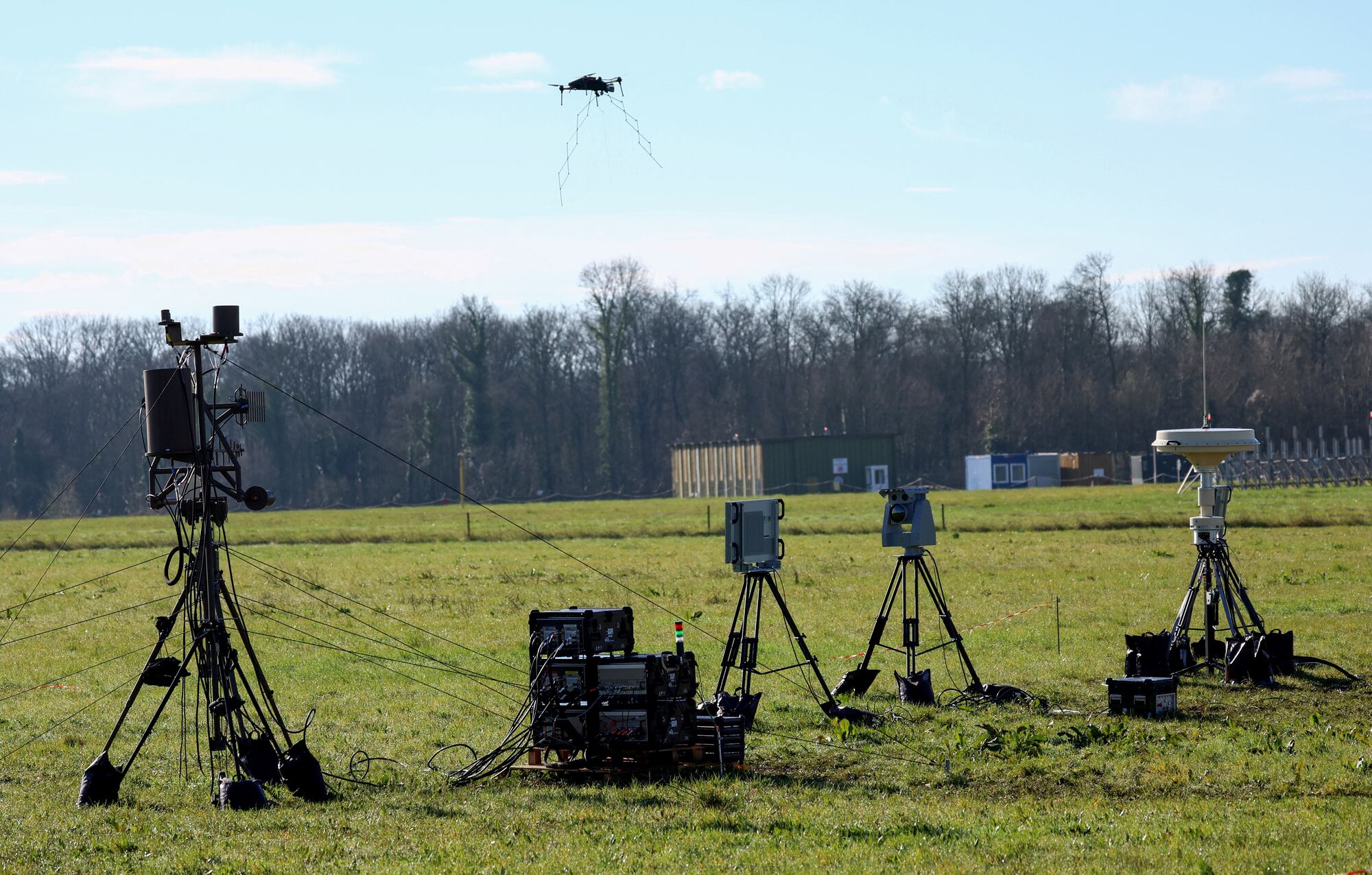
According to the company, EchoGuard can typically track a small quadcopter at 1 kilometer, or about 1,100 yards. EchoShield can track the same type of drone at 3 kilometers and track more than 1,000 objects at a time. The radars are generally incorporated into a broader sensor stack that includes optical sensors and, often, radio-frequency detection equipment.
Cueing guns, lasers and other defenses
Radar cueing is also central to Echodyne’s approach to adapting conventional weapons for counter-drone defense. Around 2020, the company worked with Northrop Grumman to integrate EchoGuard onto Bushmaster chain guns for counter-drone fire control. Frankenberg said radar addressed tracking problems that optical sensors alone had struggled to solve. Turret makers including Kongsberg and Rheinmetall have since adopted that approach, he said.
Frankenberg said a gun platform can be turned into an anti-drone system with radar, software algorithms and, depending on the platform, a computer upgrade. He expects substantial demand for such capabilities as maneuver units seek their own means of detecting and defending against nearby threats.
The company’s radars are also used in high-powered microwave counter-UAS systems from Epirus and ThinKom, laser-based systems from AeroVironment and Electro Optic Systems, European laser-weapon programs, and directed-energy projects involving larger defense contractors, Frankenberg said. Other configurations pair an Echodyne radar with pallets carrying interceptors.
Frankenberg does not expect one technology to dominate the counter-drone market. He said lasers and high-powered microwaves can be useful where operators have little tolerance for collateral damage, while rotary machine guns can be highly effective in circumstances where collateral effects are less of a concern. The expanding range of options may complicate procurement decisions, he said, but he expects room for multiple successful systems.
Echodyne became profitable last year and receives about 60% of its revenue from the United States and 40% from international markets, according to Frankenberg. He said the company is open to remaining private, pursuing an initial public offering or being acquired, while its immediate focus is meeting demand from what he called a “red hot” market.